
Just wish to share GK Beale’s thoughts about this difficult subject:
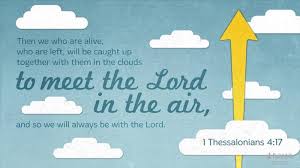
Paul is using the same imagery in 4: 15-17. What has been traditionally understood as the second coming of Christ is best conceived as a revelation of his formerly hidden, heavenly “presence. ” The old-world reality will be ripped away, and the dimension of the new, eternal reality will appear along with Christ’s “presence. ” The references to parousia in 2: 19, 3: 13 and 5: 23 also carry the same connotation. When Christ appears, he will not descend from the sky over Boston or London or New York City or Hong Kong or any other localized area. When he appears, the present dimension will be ripped away, and Christ will be manifest to all eyes throughout the earth (see Mt 24: 27). Just as one can lay flat a map of the whole world and see it all at one glance, so Christ will appear and be able to behold humanity at one glance and they him. How this is possible in literal geographical terms is certainly unclear, but the answer lies in recalling that a new dimension will break into the old physical dimension, and the possibilities of new kinds of perception and of existence beyond present understanding will then be realized. Interestingly, Revelation 21: 3, 22 say that directly following Christ’s final coming, God and the Lamb will form a “tabernacling” presence over all redeemed believers. Likewise, the resurrection of the dead (1 Thess 4: 16) should not be conceived as a physical rising upward from the grave but a transformation of an old-world body into a new creational body that can inhabit the dimension of the new world in Christ’s and God’s presence. Accordingly, also figurative is the portrayal of the saints who are still alive and are left and who will be caught up together with the resurrected dead in the clouds to meet the Lord in the air.
Again, the point is that their bodies will also be transformed into bodily new creations fit to inhabit the new creation (see further 1 Cor 15: 35-54). The old, fallen body is like a cocoon that will wither away, and God will cause a newly created body to emerge from it that is suited to live in a new dimension. The figurative nature of the language is also pointed to by reference to the trumpet call of God (1 Thess 4: 16), which is like the blowing of the trumpets in Revelation or like God’s throne in heaven or Christ as a heavenly lamb or like the book in his hand or like the various other objects mentioned in Revelation’s visions that are certainly figurative (on which see Beale 1999a: 311-69, 472-520). Indeed, the “sound of the trumpet” in Exodus 19: 19, which may be echoed in Paul’s reference to the trumpet, points further to a figurative understanding, since the trumpet sound at Sinai did not emanate from a literal trumpet.Beale, G. K.. 1-2 Thessalonians (The IVP New Testament Commentary Series) (pp. 138-140). Intervarsity Press – A. Kindle Edition.
 The Council