
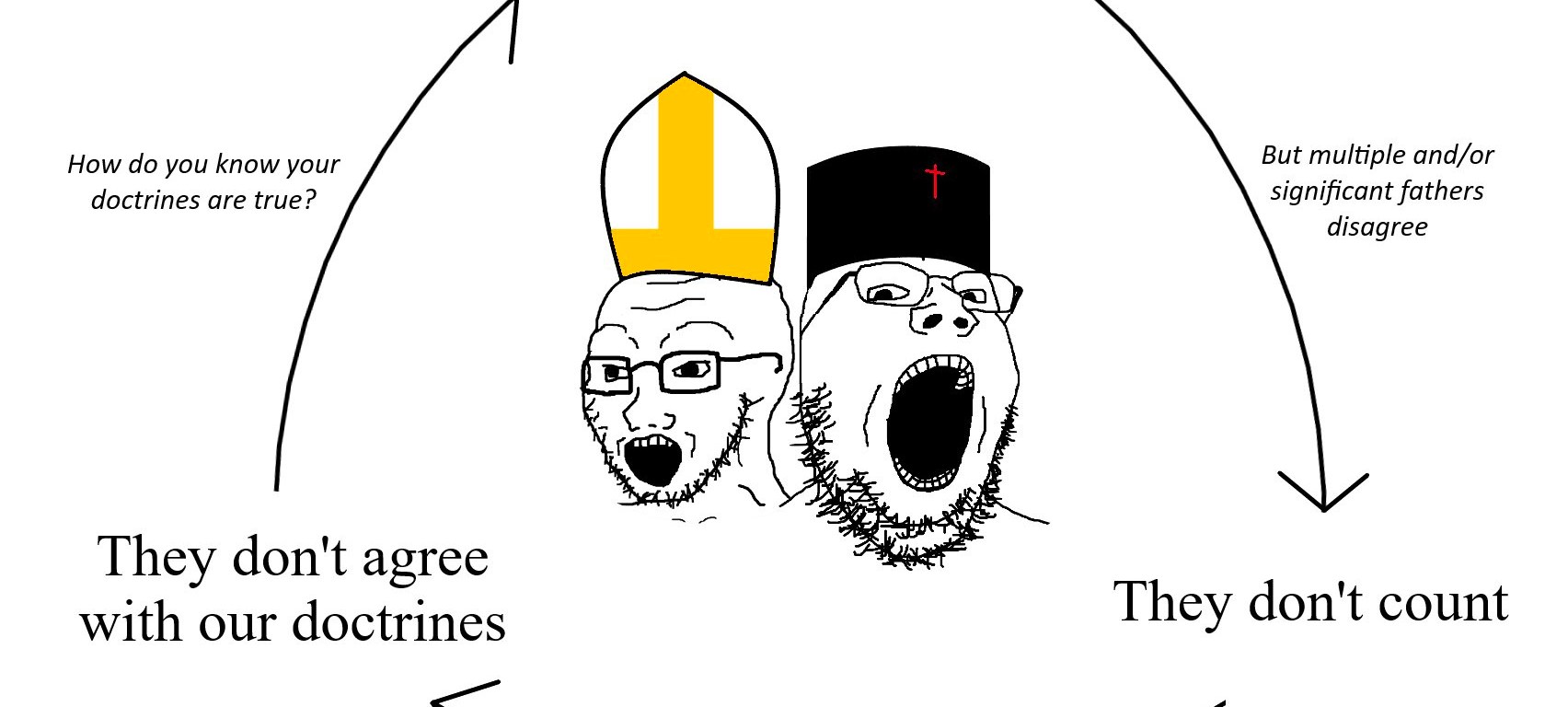
Here is a dialogue Jimmy had with an Eastern Orthodox:
Apologia:
our epistemic source is our faculties which are gifted to us by God. Even the bible talks about this in Romans 1 and how atheists are at fault because they did not see that God revealed Himself through the world. we can reasonably believe that our natural reasoning processes are truth-conducive because of this, or else it would be an unreasonable expectation. if we start with the rationale, then we can reason to God, and the Christian God through historical evidence, necessity of the trinity etc. this is noncircular because it’s not only coherent with the bible, but also externally verifiable. and descriptive processes show that we reason through Bayesian epistemology
so, no, not self-defeating and not inconsistent.
Jimmy Stephens:
There are numerous problems with this reasoning.
1.) It misdescribes Romans 1. Paul does not appeal to human faculties working unaided by Biblical revelation to construct philosophy that happens to include theism. Paul does not appeal to proofs or “historical evidence.” Paul appeals to God’s divine revelation.
2.) If knowledge of God did depend on sophisticated arguments and understanding of evidence, then Paul would be mistaken or lying to say all men know God. After all, not all men are even mentally capable of handling evidence.
Paul says all men – including unborn children, the mentally disabled, those in a coma, etc., who obviousy can’t argue, much less do it well. (edited)
3.) If you start with the rationale that the Christian God has endowed you with reliable faculties, then it is trivial to request “external verification.”
If you start by assuming your faculties are reliable, then you never get stronger verification than just assuming things conveniently.
So “if we start with this rationale” is trivial or obviously unworkable.
4.) It is logically circular. If all beliefs require “external verification,” then so does that belief, leading us to an infinite regress. It refutes itself.
Alternatively, it is not a logical circle to say God causes His audience to recognize His revelation and comprehend it. That is a one-directional arrow from God’s act to man’s understanding, not a circle.
5.) This position does not take seriously the Biblical teaching on sin. Sin afflicts our reasoning abilities. Without divine revelation, why should we expect our acts of reasoning to not be hopeless confused by sin? It would be titanic arrogance to neglect this issue.
6.) This position does not take seriously the finitude of man in contrast to God’s infinity. God is not an apple, a human, barometric pressure, a geometric equation, or some other random factoid in the universe readily available to man’s natural reasoning faculties. God is timeless, changeless, simple, and beyond all categories of thought.
So how could a person left to nothing but unaided faculties of reason ever know anything about God?
Apologia:
revelation through creation. in some ways, reason and common sense – a great example of how creation relates would be the teleological argument
Jimmy Stephens:
The teleological argument is an argument, not a divine revelation.
It’s also not found in Romans 1.
Paul doesn’t appeal to a teleological argument in Romans 1.
He appeals to God’s divine act.
Apologia:
i never said it did. many ‘philosophical’ arguments can be reduced down to inferences made from common sense (i.e. teleological, cosmological, divine conceptualism). but that doesn’t mean we cannot use sophisticated arguments to know Him as well
Jimmy Stephens:
Put another way, Paul doesn’t appeal to humans proving God exists with proofs. Paul appeals to God proving He exists without proofs.
Apologia:
i didn’t say the argument was revelation? i said it was related. let’s start with this: does paul say we know God through creation?
Jimmy Stephens:
Not when it comes to something like the teleological argument.
Sure, people often get an articulatable intuition that things are designed or made. That’s not an argument. It’s an intuition.
Apologia:
that’s why i didn’t start with the christian justification of reason. i was merely connecting it to the bible to prove its coherence.
“if we start with reason” is certainly not trivial. this will take a while to elaborate on so i will do this later
it’s not viciously circular, but saying the bible tells you the bible is infallible is
Jimmy Stephens:
I don’t know what “viciously” is doing here other than “logically.” But it is logically circular.
What is the non-reason-assuming reason for thinking reason is reliable?
Apologia:
certainly not! we can argue that man is a rational animal. our reason is from God, as the image of God we have been granted this truth conducive trait. however, we can argue that sin created serious blocks to reason which prevent us from exercising it correctly, or enacting praxis in line with reason due to temptation etc
Jimmy Stephens:
Such as when we do epistemology, or try to reason about theology. Exactly my point.
Apologia:
this is where the ad extra ad intra distinction is handy. do you know it?
Jimmy Stephens:
I take you it have in mind truths about God being indexed to His essence (ad intra) or to His relation to creation (ad extra)?
Apologia:
great. the teleological argument is a very natural leap for people to make when observing creation. how can it be so beautiful, so ordered? this leads to God. obviously oversimplified, but my point stands that we often think towards God in this manner
Jimmy Stephens:
That’s not Romans 1.
Paul nowhere says people make what they feel to be commonsensical leaps.
Furthermore, I think the best philosophical defenders of the teleological argument would find it to be an insult to the argument to equate it to the natural leap of the common man
Apologia:
it’s a form of the argument as i explained. when we reason dialectically, we are arguably propping up different hypotheses by thinking through arguments for and against, though they may be simplistic in some cases
Jimmy Stephens:
No, a belief formed instinctively without inference is not an argument.
The belief can variously be based on:
- “gut feeling” or emotional intelligence
habbit
cultural inheritance, peer pressure, milieu, etc - abductive convenience or heuristics
argument (a valid or validity-functional inference)
But the belief is not itself an argument.
And people assuming teleology is not an argument.
Apologia:
okay let’s define epistemic and logical circularity
maybe it’ll be clearer if we make syllogisms of our arguments
sola scriptura is logically circular as a consequence of its epistemic circularity
Jimmy Stephens:
Logical circularity is when you reason in a circle. The “logical” is the fact that we’re talking about a chain of inference, something that can be formalized into a syllogism. The “circularity” is the fact that the inference chain is redundant. It is an argument where one of the premises is repeated, implicitly or explicitly, in its conclusion.
This is also called petitio principii or question-begging.
This does sometimes, though rarely, happen where a Christan naively argues that because Scripture is the word of God, it is reliable, and because Scripture says it is the word of God, it is. Wherever you start in that argument, you end up where you started for the conclusion.
Epistemic circularity is when you have a belief source that underscores or sources the belief in its reliability. This can occur in two different intensities.
My eyes are a good example. I see that I’m typing on a computer. This evidences that my eyes are reliable. This is epistemically circular because the individual cases of sight only make my vision generally reliable if it is in fact reliable.
We might call this second-order justification. This kind of epistemic circularity is not self-sufficient. Each case of visual perception can grant a secondary justification for my belief that my eyes are reliable only on the basis of a more primal or first-order justification for that trust.
What makes God’s acts of revelation special is that they do not stem from a source that can fail. Eyesight is contingent on the right circumstances arranged in your environment so that you’re not subject to an optical illusion. Your eyes can also suffer disease, or the nerves involved, or the brain, et al. And then, even with these two parts working, there are other sources and psychological mediations going on in your gestalt that can still undermine visual perception
None of that applies to God. Here, I’m tempted to enlist a long description of God’s nature, His relation to the human mind, the psychology of God-imaging, and so forth, but I don’t have time and people who have not considered this enough have a naive tendency to think only one of God’s attributes has some magical power when abstracted from the rest.
Suffice it to say, where most epistemic circularity cases are not divine sources of knowledge, divine revelation is a case of epistemic circularity in which the source is divine. This makes all the difference.
Now, Roman Catholics are welcome to borrow this epistemological reasoning. Protestants (and arguably the Eastern Orthodox) will only be so happy for you guys to catch up. But in doing so, I anticipate a major problem in that, traditionally, Rome has rejected this sort of reasoning as basic to its doctrinal structure.
So there is an ironic self-refutation waiting in the corner – that of one needing to reject Rome’s system for adjudicating canon and doctrine in order to preserve Rome’s system from the perceived threat to epistemology the protestant’s revelational epistemology successfully counters.
That is why there’s the old hat assertion that protestants are begging the question or reasoning in a circle. Why? Because Rome presupposes the need for external/independent verification of God’s revelatory acts.
B. Philosophy:
Why think this.
You’re correct that all humans must act as if they have knowledge. But this does mean they must affirm they do have knowledge.
Preformative contradiction aren’t real contradictions and thus won’t be able to show that there’s something false about not affirming knowledge of any propositions
So how would you fufill the burden of proof for the propostion “I hve knowledge”
Jimmy Stephens:
1.) Because the Creator of all men says so:
The wrath of God is being revealed from heaven against all the godlessness and wickedness of men who suppress the truth by their wickedness. For what may be known about God is plain to them, because God has made it plain to them. For since the creation of the world God’s invisible qualities, His eternal power and divine nature, have been clearly seen, being understood from His workmanship, so that men are without excuse.
— Romans 1:18-20
The heavens declare the glory of God; the skies proclaim the work of His hands.
Day after day they pour forth speech; night after night they reveal knowledge.
Without speech or language, without a sound to be heard, their voice has gone out into all the earth, their words to the ends of the world.
— Psalm 19:1-4
The fear of the LORD is the beginning of knowledge, but fools despise wisdom and discipline.
— Proverbs 1:7
2.) Because judgments of any sort, whether a given action or a case of doubting, require knowledge to be motivated. A human being cannot successful act as if he possesses knowledge unless the action is motivated by knowledge what is necessary to act in that way, for example.
3.) Because skepticism itself is wishful thinking no different than blind faith without basis in knowledge.
4.) Historically, all skeptics (proper) have been hypocritical pagans. There lifestyle constitutes inductive support.
The act is not itself a proposition, and so in that trivial sense is not a contradiction. However, the act entails a belief in a proposition that contradicts other believed propositions. Therefore, while I can agree with you that there’s a difference between a performative error and two logically incompatible claims, the difference is not relevant.
Strictly speaking, I would not. Or it may be better to say I don’t have to. God is the one who has fulfilled that burden for all of us. He does this by revealing Himself, a notion that can be further clarified.
If you ask me how I save myself, it is important to point out the impropriety of the question. I don’t save myself; God saves me. Likewise, I do not establish the cognition of man. God does.
If you are asking instead, how do I argue that I have knowledge to barrel, that question presupposes that I know quite a lot:
- what inference is, broadly
- some knowledge of validity
- knowledge of the English language
- familiarity with discord
- philosophical familiarity with epistemology
- knowledge of Christianity
- knowledge of “presup”
I could keep going. Suffice it to say, a good argument is that your question entails you already know I know things, on pain of your question being moot.
Apologia:
this isn’t actually a challenge to hard skepticism, because i could be asking if you actually know things or if you’re acting as if you do, and for you to justify the decision
it leads to an infinite line of questions
the problem of hard skepticism is silly, but remains unsolved by your approach. that’s our entire point
if you believe the bible is revealed, and then say:
p1. if revelation is true, the bible is true
p2. revelation is true
c. the bible is true
then you see how this is redundant because you’re saying:
p1. if revelation is true, a revelation is true
p2. revelation is true
c. a revelation is true
now, you can’t actually support the fact that the bible is a revelation (the crux of this argument, because that’s what makes it obvious or self attesting as per the above) without saying that the bible just is revelation and you know that because revelation is true
that’s the essence of your argument. it is logically circular due to its epistemic circularity, and yes it is vicious (i’ll speak on this in a minute) because it literally doesn’t give any information to support the premise beyond the premise itself and the conclusion is the same as p2
lets make some assumptions for a moment:
if God (christian) exists, then we are made in the image of God
if we are made in the image of God, there must be something good or redeemable about us
if there is something about us that is good or redeemable, it must be present in every human since we are all made in the image of God
every person then must have the capacity to use what is good or redeemable, even if they will not
given these conditions, the only thing that people will agree to is using logic. so we can use this as a foundational premise, because every person is bound to using it. now that we have established logic, we can establish additionally that if the bible is true, there is some capability of humans to know creation through our senses. this is additionally something that we can use as foundational because every person uses a sense at some point. i could know this even by just asking.
based on these two very simple things, we can ascertain that logic and our senses are (to a degree) truth tracking and the more people that agree on a premise the less likely it is to be false on these two accounts. so therefore, we can establish history, science, and philosophical arguments from these.
the reason that this is not viciously circular is because it reasons from practical experience. it does not make any claim that any of the sources are infallible, but that this is the most likely case. and why does it make sense that we ought to believe the most likely case? because we majorly do believe the most likely case, and it serves us well 90% of the time.
these assumptions are far more conservative than the assumptions you make given the word ‘self attesting.’ you use it as a get out of jail free card, when this is the prime way to drive people away from Christ — something not affirmed as desirable by God in the bible. the problem of hard skepticism is best solved by practical experience. locke said something along the lines of: if you’re a skeptic, then you are uncertain your hand will burn when placed in a fire. you’re free to do so if you are genuinely skeptical, but i myself will stay far away.
a conservative assumption gives us less things to be likely to be wrong about. it’s the prime way to answer the problem of hard skepticism without taking advantage of it.
Jimmy Stephens:
You’re nullifying your own objection. If hard skepticism is silly, there is a reason why it is silly. You would have to show why revelational epistemology does not have access to that reason in order to say it fails to overcome hard skepticism.
And in general, if x is silly position, it’s not a good objection to anything.
As I pointed out to barrel, I don’t accept this distinction. I addressed that (see above)
If I had to diagnose your mistake from our conversation, my best guess is that you confuse argument and justification. You have been asking questions that request a justificiation, not an argument. When a justification is provided you, one which is not an argument, you then proceed to accuse the justification of invalidity, a property that can only apply to arguments.
You ask how we know the Bible is divine revelation or how it is reliable. Knowing that it is divine revelation is synonymous with knowing that it is reliable, once it is established what the nature of God is. That it is divine revelation causes any given reader to know that it is, so nothing more than reading the Bible is necessary in order to know that it is God’s word.
^ This is a justificatory account. It tells you how the belief in the protestant canon is justified. Now, it is not an argument; it does not proceed to demonstrate through a chain of premises some conclusion about the matter. So it would be quite beside the point to complain that this non-argument has a property of arguments that problematizes them.
You might then complain that this is a justification instead of an argument, but that would be silly. The only significance of (sound) arguments is that they are persuasive justifications. Unless you can show that the Bible is not in fact justification or that it is unpersuasive, we straightforwardly do not need arguments at all to know it is God’s word.
Even worse, you might complain that all justifications are (sound) arguments. Of course, that is very nearly the presupposition of Rome and yourself (wherefore I thought you were RC) when you demand external verification of the Bible’s divine nature/status. And it is a self-refuting one, since it puts us in an infinite regress of demands for arguments.
To illustrate this problem briefly, I’ll turn to the Münchhausen problem. We think knowledge involves justification. What is the nature and in particular, structure of those justifications? Do they tarry off in an infinite regress? Do they circle around into a self-appeal? Do they terminate or close on a special case?
If we agree that infinitism and coherentism do not work, then we are left with foundationalism or some tertium quid between foundationalism and failure.
If you take up foundationalism, you will have revoked making the kind of objection you mean to make to me, @b… @apologia. This is because you already take it as legitimate epistemology to start with some incorrigible, innate, or intrinsically justified belief. You cannot demand an argument for Christianity when that can just be treated as a basic belief on your own epistemological approach to justification.
In the mean time, my position rejects all three horns in the traditional trilemma. Contra infinitism, at least the most important cases of justification close. Contra coherentism, justification is not reducible to the structure of internal doxastic relations. Contra foundationalism, propositional isolates are not a special one-among-many acting analogous to an ultimate cause to proximate causes.
Divine revelation illuminates or infuses all justification whatsoever. As natural or general revelation, this is because it:
in part, creates the mind; esp. it “finishes” human consciousness, whether at conception or as a dispositional process brought about by natural telos
its content operates or plays the role of universal internal criterion for all human judgments; simply, it is the only universal means available to all men
it enables knowledge transactions because it is the teleological constitution of things experienced, similar to the way words are vehicles of linguistic intent
it presupposes as a limiting concept and implies special revelation
As special revelation because it:
in part, recreates the mind; it is the means and the only means in this age through which the Spirit renews the mind
its content operates or plays the role of universal internal criterion for all human judgments; general and natural correspond to each other in this way
it enables eschatological or ultimate judgments, without which all knowledge would be accidental and subject to final confusion; simply, general revelation requires interpretation and that cannot be done without special revelation
it enables self-conscious voluntary reasoning about experience, since the object of experience always includes God, directly or indirectly
it presupposes as limiting concept and implies special revelation
On this account of justification, knowledge of God is prompted by any and all experiences whatsoever, is implicit in any and all beliefs whatsoever, and is even more fundamental than propositional beliefs. Justification for it is found in every component, structure, transaction – whatever – of the human mind, whatsoever.
On that view, it is equally- in fact more ridiculous to demand external verification because there is nothing external to the created situation just laid out. To ask for something external to or independent of that would just be to ask for something outside the topic of knowledge altogether.
Sorry to be so longwinded, but one last comment. I think this issue manifests obviously when we consider other religions. It’s self-oblivious to ask a Muslim for external verification of the Qu’ran. That is both inconsistent with our own Scripture’s teaching about its believability as well as a consistent Muslim’s portrayal of the Qu’ran.
If I want to critique the Qu’ran, the Book of Mormon, the Granth, the testimony of some purple man, I simply let him tell his story. It is hard – inconceivably hard to come up with even a coherent story, much less a cogent one.
Same thing with the claims to the deuterocanon. That’s easy to critique. We simply read the text and see what it claims about itself, and look at the history of its epistemological vindication. We’ll find in both incredible inconsistencies with the claim that, say, the Book of Maccabees is divine
 The Council
Were all those last dozen or so paragraphs from ‘Apologia’ or did you forget to list who was speaking? Also, in what category (if any) do you think Van Til would fit into relating to the Munchhausen Trilemma?
LikeLiked by 1 person