
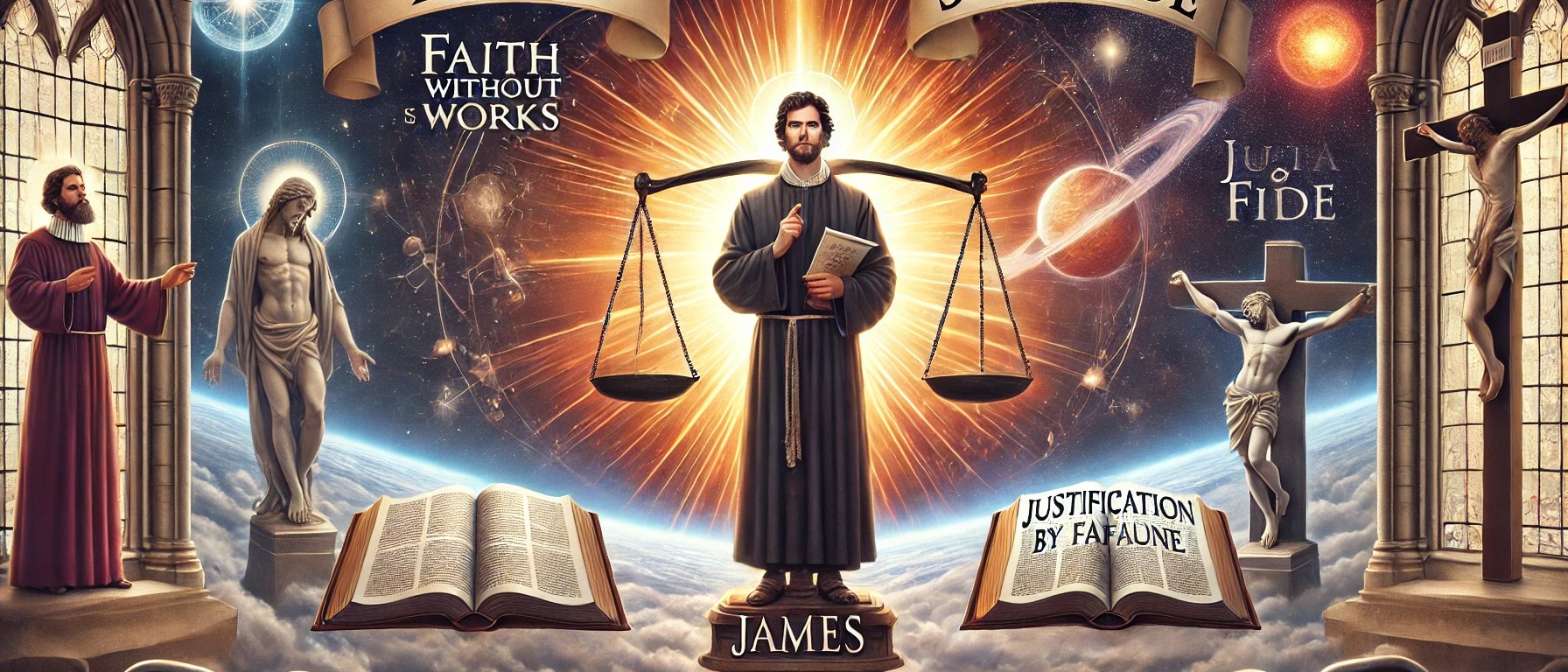
In the prior chapters of James, the author sets the stage for his argument in chapter 2 about faith and works. James begins by emphasizing the importance of enduring trials and developing steadfastness (James 1:2-4). This perseverance in the Christian life is seen as evidence of genuine faith. He then discusses wisdom, urging believers to ask God for it with unwavering faith (James 1:5-8), followed by a warning against being double-minded.
In James 1:19-27, James urges Christians to be “doers of the word,” not just hearers, calling for actions that reflect their faith. He criticizes mere verbal professions of faith without accompanying works of obedience. This introduces the central theme of the epistle: genuine faith manifests in action. The contrast between hearing and doing serves as a precursor to James 2:14-26, where James delves deeper into the relationship between faith and works.
The Issues Addressed in Chapter 2
At the start of James 2, the author rebukes partiality in the Christian community, particularly favoring the rich over the poor (James 2:1-7). This partiality conflicts with the royal law of love, which calls for treating others as we wish to be treated (James 2:8). James asserts that showing favoritism violates God’s law, stressing that breaking any part of the law makes one guilty of breaking the whole law (James 2:9-11). This demonstrates that selective obedience is not true obedience, reinforcing that a genuine faith leads to consistent works of love and justice.
Thus, the discussion in 2:14-26 follows naturally from these concerns. James insists that faith without works is dead because it fails to show the tangible evidence of a transformed life. The passage is aimed at addressing those who profess faith but fail to live in accordance with its demands, such as showing favoritism or ignoring the needs of others. For James, works are not a separate add-on to faith but the necessary expression of genuine trust in God.
Addressing the Nature of Faith
James 2:14 poses the critical question: “What good is it, my brothers, if someone says he has faith but does not have works? Can that faith save him?” The rest of the passage examines whether faith, when devoid of action, can truly be considered salvific. By bringing up practical examples, such as providing for the poor (James 2:15-16), James illustrates that real faith must result in compassionate actions. This builds on earlier points about showing love and avoiding partiality.
Faith and Works: Complementary, Not Contradictory
James’ argument is often misunderstood as opposing Paul’s teaching of justification by faith alone. However, as scholars like Thomas Schreiner note, both apostles are dealing with different issues. Paul addresses legalism—the belief that one could earn salvation through adherence to the law—while James critiques antinomianism, the idea that faith can exist without transforming one’s life.
James’ call for works does not deny faith’s role in justification; instead, it reinforces that genuine faith will naturally produce works. Faith and works are complementary, as Paul himself acknowledges in Ephesians 2:8-10 and Galatians 5:6, where he affirms that faith works through love. James’ discussion complements Paul’s by focusing on the evidentiary nature of works—how they demonstrate the authenticity of faith.
Leading up to James 2:14-26, James addresses practical concerns within the Christian community: trials, wisdom, favoritism, and partial obedience. By the time he discusses faith and works, he’s addressing a faith that is not merely intellectual but transformational. Works are not the basis of justification but the necessary fruit of it. Therefore, James and Paul, while using different terminology, share a consistent theology where genuine faith necessarily results in good works. This forms the heart of James’ argument and correction to his audience.
James 2:14 – The Central Question: Can Faith Without Works Save?
James 2:14 – The Central Question: Can Faith Without Works Save?
Verse: “What good is it, my brothers and sisters, if someone claims to have faith but has no deeds? Can such faith save them?” (NIV)
There are important distinctions between how different authors treat this concept. Hays explains this well:
1. Intellectual Complexity: Hays notes that Paul’s discussion of justification is more complex than James’. However, this doesn’t make one right and the other wrong. Both are inspired, and their differing approaches reflect their unique aptitudes and backgrounds, selected by God.
2. Relationship Between James and Paul: Hays suggests three possible views on how James and Paul are interrelated:
(i) They wrote independently;
(ii) Paul opposes James;
(iii) James opposes Paul.
Hays supports the first option, arguing that both address different issues.
3. The Meaning of ‘Justify’: In James 2:19, the key verb “justify” can mean “acquit,” “vindicate,” or “demonstrate righteousness.” Even if James uses it to mean “shown to be righteous,” the question remains—what does James mean by “righteous”? Rahab, used as an example, shows that righteousness for James means living out faith in action. True faith, according to James, is obedient and demonstrated through sacrifice and deeds.
4. Words vs. Concepts: Hays makes an important distinction between the meaning of words and the concepts behind them. For instance, knowing the definition of “cancer” doesn’t explain its full reality. Similarly, Paul and James use the same terms—justification and righteousness—but refer to different categories. James sees faith and works as complementary, while Paul views them as antithetical due to their respective theological contexts.
5. Paul’s Doctrine of Justification: Paul’s view on justification by faith is rooted in vicarious atonement and penal substitution, where Christ’s work justifies the sinner. For Paul, faith is a negation of works—trusting in Christ alone for justification. Works cannot contribute to this because justification is based on what Christ did, not on what we do.
6. Justification as Ascribed, Not Achieved: Paul sees justification as an ascribed status, given by Christ’s work, not an achieved status through our own. Hays provides an analogy: if a king adopts a peasant, the peasant instantly gains the status of a prince. For Paul, this ascribed status, or justification, is once-for-all and not a process.
Living vs. Dead Faith: James introduces two rhetorical questions to prompt reflection on genuine faith. The second question, “Can such faith save them?” implies that mere intellectual assent cannot save. As Hays notes, James emphasizes the difference between living faith—active and producing good works—and dead faith, which is passive and without deeds.
Paul vs. James: The apparent contradiction between James and Paul is resolved when understanding their contexts. Paul emphasizes that we are justified by faith alone before God. James, on the other hand, argues that true faith manifests in works, demonstrating that it is genuine. They address different aspects of the same truth.
Theological and Practical Concerns: James’s audience might have misunderstood Paul’s teaching, thinking works were unnecessary. James counters this by explaining that faith without works is incomplete and cannot save. Riddlebarger clarifies that claiming faith without demonstrating it through works shows a misunderstanding of what real faith entails.
Understanding the Term ‘Justify’: As noted by Robert Cara, Christians have long wrestled with the use of the term “to justify” (dikaioō) in James and Paul. Cara points out that the Reformed tradition, reacting against the Roman Catholic Church’s view from the Council of Trent, insists that Paul uses “justify” in a technical sense. For Paul, it means that God declares a sinner righteous based solely on the merit of Christ, not their own works. In this view, faith alone is the instrument through which justification is received (Romans 3:28).
However, when James uses the same term, it must be understood in a more general sense, as “demonstrate” or “show” that one is righteous. This definition fits the context of James 2:24, where he argues that works are the evidence of genuine faith. Using biblical examples like Abraham and Rahab, James illustrates that a true and living faith is always accompanied by works that demonstrate righteousness.
Three Senses of ‘Justify’: Cara suggests that “to justify” operates in three ascending meanings:
- General Sense (James 2:24): This refers to declaring or demonstrating that someone’s actions align with their faith, proving that faith is real. As Cara explains, just as “the Yankees’ actions justified Bob’s prediction,” works justify the truth of one’s claim to faith. James uses this meaning to argue that Abraham’s and Rahab’s faith was shown to be genuine by their deeds.
- Forensic Sense (Meaning 2): This sense aligns with a judge declaring someone legally righteous based on their conformity to the law (e.g., Deuteronomy 25:1). Here, actions are evaluated based on their legal standing in relation to a set standard.
- Pauline Technical Sense (Meaning 3): Paul’s use of “to justify” includes the imputation of Christ’s righteousness to believers. Here, God declares a sinner righteous not because of their actions but because Christ’s righteousness is credited to their account. This justification happens at the moment of faith, and it is based entirely on Christ’s work, not the believer’s deeds.
Paul vs. James: The perceived tension between James and Paul, as Schreiner, Moo, and Cara note, is resolved by understanding that they are addressing different questions. Paul focuses on the grounds of justification—how one is declared righteous before God. He insists that faith alone justifies without works because of Christ’s imputed righteousness. On the other hand, James emphasizes the evidence of justification—how true faith manifests itself in works. As Cara explains, James argues that works “justify” in the sense that they demonstrate the presence of genuine faith.
To further clarify James 2:14, it’s important to recognize that James is addressing a kind of faith that merely consists of intellectual assent without any corresponding action. The phrase “can faith save him?” can be better understood as “Such a faith (without works) can’t possibly save a person, could it?” This highlights that faith without works is ineffective and cannot lead to salvation. James is not dismissing faith but emphasizing that genuine, saving faith must manifest itself in works.
This distinction between genuine faith and intellectual assent aligns with the broader biblical teaching on justification and sanctification. While justification is by faith alone, works are the evidence of a living faith. Paul himself supports this in his writings, where he speaks against antinomianism while affirming that true faith naturally leads to good works. Thus, there is no contradiction between Paul and James, as both affirm that salvation by faith results in a transformed life marked by obedience and righteousness.
To further understand James’ message in this passage, it’s important to note that he addresses his audience as “brothers,” implying that they are already part of the faith community. James’ concern is not about initial justification, but rather the evidence of a living faith through works. He draws a direct connection between faith and action, underscoring that faith without compassionate deeds is dead. As seen in Jesus’ teaching (Matthew 25:42-43), genuine faith expresses itself by caring for others, reflecting Christ’s love and active obedience.
A key insight to strengthen the argument is the distinction between James’ use of “works” and Paul’s. While Paul often contrasts erga (works) with faith to reject works-based righteousness (e.g., works of the law), James uses the term in a different context, emphasizing deeds as the natural outworking of genuine faith. This clarifies that James is not challenging sola fide but rather showing that true, living faith inevitably produces good deeds as evidence of inner transformation, aligning with Paul’s own teaching that we are saved unto good works (Eph. 2:10).
James 2:15-17 – The Illustration of Words Without Action
Verses: “15 Suppose a brother or a sister is without clothes and daily food.
16 If one of you says to them, ‘Go in peace; keep warm and well fed,’ but does nothing about their physical needs, what good is it?
17 In the same way, faith by itself, if it is not accompanied by action, is dead.”
In these verses, James presents a concrete example of how faith is empty if not coupled with action. The image of a fellow believer in desperate need, lacking even basic necessities like food and clothing, is designed to expose the failure of a superficial faith. The well-wishing words of “Go in peace; keep warm and well fed” are entirely devoid of value without practical assistance. This situation perfectly illustrates the deficiency of faith that expresses itself merely in words or intentions but not in deeds. In the same way, James concludes, faith without corresponding actions is dead, lifeless, and of no use.
This example underscores the relational nature of true faith, which inevitably leads to love for others. Genuine faith expresses itself through acts of service, care, and charity, particularly toward those in need. The use of hyperbolic language, as in “poorly clothed” (translated as “naked” in some versions), indicates that James is describing a dire situation, one that calls for a tangible and compassionate response. Words without action, like faith without works, are useless.
As Douglas Moo explains, James’ example resonates with key biblical themes, such as Isaiah’s call to clothe the naked and feed the hungry (Isaiah 58:7) and Jesus’ teaching in Matthew 25:31-46, where the kingdom is promised to those who care for “the least of these.” Moo points out that mere words, like sermons and prayers, are essential to the Christian faith, but they only carry real meaning when they are accompanied by actions that reflect those words.
Moo also draws attention to the repetition of “what good is that?” in both verse 14 and 16. This rhetorical question emphasizes the futility of words that are disconnected from actions, as well as the corresponding futility of a faith that does not manifest itself in good works. James’ comparison of faith to a body without a spirit (later in 2:26) captures the essence of a “dead” faith: one that is inactive, unproductive, and spiritually barren.
The word “gymnoi” (poorly clothed) is translated as “naked” in the KJV, which captures the intensity of the scenario James depicts. This heightens the urgency of action. The phrase “go in peace” is a familiar Jewish expression for dismissal, yet here it is used ironically to underscore the inadequacy of such a response without any real help. By pointing out that the needy person’s situation remains unchanged despite the well-meaning words, James reveals how empty and powerless words alone are.
Conclusion
Faith, by its very nature, must manifest itself in deeds. James shows us that faith is not a mere intellectual or verbal exercise; it must have practical implications. If we profess faith, it should lead to a life of love and charity, serving others, especially those in need. Without such actions, our faith is nothing more than hollow words, devoid of substance and life. Thus, James powerfully reinforces the inseparability of faith and works, not for justification, but as the evidence that faith is real and alive.
James 2:18 – The Challenge to Demonstrate Faith
Verse 18: “But someone will say, ‘You have faith, and I have works.’ Show me your faith apart from your works, and I will show you my faith by my works.” (ESV)
In this verse, James introduces an imagined objection to his argument, likely from someone claiming that faith and works are independent aspects of the Christian life. This person might suggest that one can possess faith without works, or vice versa. However, James responds with a clear challenge: faith cannot be demonstrated apart from works because it is an internal belief, invisible without outward evidence.
The key word “show” emphasizes the observable nature of genuine faith. Faith that is truly alive will naturally manifest itself in good works, making it something visible and verifiable to others. James argues that faith, if it is real, must have tangible outworkings. In contrast to the hypothetical objector who claims faith without works, James insists that faith is proven by actions: “I will show you my faith by my works.” This parallels the analogy of offering words of well-wishing without meeting physical needs (as in verses 15-17), underscoring that faith without deeds is as useless as empty words without action.
This challenge highlights the inseparability of faith and works. James’s argument aligns with the broader biblical theme that faith cannot be a mere intellectual assent or internal belief but must produce external fruit—good works that serve as evidence of its authenticity.
Interpretations of “Someone”:
There are three main possibilities regarding who this “someone” is:
- An ally of James who agrees with his argument, illustrating that faith without works cannot be demonstrated.
- An objector who doubts the necessity of works alongside faith.
- A hypothetical figure representing a general view that faith and works are separate.
Most scholars, including Burdick and Moo, lean toward understanding this “someone” as an objector. This individual argues that faith and works can exist independently. However, James’s counter-argument is that faith without deeds is dead, as works are the natural outworking and evidence of genuine faith.
Conclusion:
In this turning point of his argument, James is not separating faith and works but showing how they are intertwined. Faith, if it is genuine, must result in actions that reflect a transformed life. The works themselves are not the basis of salvation, but they are the necessary evidence of true saving faith. James continues to stress that a “faith” devoid of works is lifeless and cannot save. True faith must be dynamic, lived out, and evidenced by works that glorify God.
James 2:19 – The Example of Demonic Faith
Verse: “You believe that God is one; you do well. Even the demons believe—and shudder!” (ESV)
James continues his argument by addressing a common belief in monotheism, which was central to the Jewish faith. He commends his audience for their belief in the oneness of God, yet he immediately counters by pointing out that even demons hold this belief. While acknowledging God’s existence is necessary, it is not sufficient for salvation. This mere intellectual assent is not accompanied by obedience or love for God, which differentiates saving faith from demonic belief.
James’s reference to demons provides a stark example. Demons have correct theological knowledge—they recognize God’s oneness and power—but this understanding only leads them to fear. They tremble because, although they know the truth about God, they remain in rebellion and separated from Him. Their “belief” does not lead to transformation or submission but rather to terror because they fully grasp God’s judgment and sovereignty without aligning their will with His.
This comparison serves to expose the inadequacy of a faith that is limited to intellectual acknowledgment without the corresponding works of obedience and devotion. James is arguing that intellectual belief alone, even when it is theologically sound, is insufficient to bring about true salvation. True saving faith requires more than doctrinal correctness; it must produce a life of action, obedience, and love for God and others.
Expanded Insights:
As Moo notes, this passage provides a severe critique of “faith” that is nothing more than intellectual acknowledgment of theological facts. Demons, who believe and shudder, show that faith without works is incomplete and ineffective. Schreiner explains that true faith is not just knowledge of God’s existence but involves trust, obedience, and relationship with God, leading to transformative action.
Reymond highlights that this verse is pivotal in James’s argument, marking the difference between merely knowing about God and truly trusting Him. Hays adds that James illustrates the contrast between demons who know of God and believers whose faith must manifest in love and obedience to God’s will. This makes it clear that mere knowledge of God does not equate to saving faith.
By using the example of demons, James forces his readers to confront the reality that orthodoxy in belief, without the evidence of a transformed life, is useless. Even the most accurate doctrinal beliefs are futile without a corresponding life of faithful obedience. This example underscores that true faith must always be accompanied by works that reflect the nature of God’s transformative grace. Intellectual belief is important, but it is only the foundation—without works, faith remains as incomplete and ineffective as the belief of demons.
In this way, James builds upon his broader theme that faith, to be alive and genuine, must result in good works. Belief alone, no matter how correct, is not enough for salvation if it is not paired with a life lived in obedience to God.
James 2:20-22 – Abraham’s Faith Demonstrated Through Works
Verse 20: “Do you want to be shown, you foolish person, that faith apart from works is useless?”
James confronts his audience with a rhetorical challenge, addressing them as “foolish” (kene), meaning “empty” or “devoid of understanding.” The word suggests both intellectual and moral emptiness. James implies that the person lacks true spiritual insight, despite perhaps knowing theological truths. His use of “foolish” not only refers to ignorance but also implies a stubborn, willful refusal to accept that faith without works is unproductive. In addressing this “foolish person,” James demands to show proof (ginōskō), asking, “Do you want evidence that faith without works is useless?” He is rhetorically calling attention to their misunderstanding by introducing Scriptural proof.
The Greek word argos for “useless” (also translated as “idle” or “ineffective”) is significant. It creates a wordplay with erga (works), suggesting that a faith without works is not merely inactive but spiritually dead, barren, and unable to save. This builds on the earlier argument in verse 17, where James asserts that “faith by itself, if it does not have works, is dead.” Faith, devoid of action, is incapable of accomplishing anything meaningful. It does not “work” in the sense of being unfruitful. James uses this introduction to lay the groundwork for his Scriptural defense, particularly through the example of Abraham.
Verse 21: “Was not Abraham our father justified by works when he offered up his son Isaac on the altar?”
Here, James appeals to the figure of Abraham, “our father,” which emphasizes the shared Jewish heritage and respect for Abraham among his audience. Referring to him as “our father” brings to the forefront Abraham’s exemplary faith in God. James references the incident in Genesis 22, where Abraham was asked by God to sacrifice his son Isaac, his heir and the fulfillment of God’s promise. This episode is one of the most critical demonstrations of faith in the Old Testament. By highlighting this event, James underscores the relationship between faith and works. Abraham’s willingness to sacrifice Isaac was a tangible demonstration of his faith.
The phrase “justified by works” might appear at odds with Paul’s teaching in Romans 3:28, where Paul says that a person is justified by faith alone, apart from works of the law. However, James is not contradicting Paul but using “justified” in a different sense. Paul speaks of justification as the initial declaration of righteousness before God, based solely on faith. James, however, refers to justification as the vindication or demonstration of faith before men, showing that true faith is evidenced by works. Abraham’s “justification by works” refers to his faith being validated, demonstrated, and brought to its full expression through the act of obedience.
For James, Abraham’s willingness to offer Isaac was the moment where his faith was made evident to the world. His faith in God was not mere intellectual assent but was so strong that he was willing to sacrifice the son he had waited years for, trusting that God’s promise would still be fulfilled. Thus, his faith was not passive; it was active, dynamic, and validated by works.
Verse 22: “You see that faith was active along with his works, and faith was completed by his works.”
James explains the relationship between faith and works using the example of Abraham. He emphasizes that “faith was active along with his works,” using the Greek word synergei, from which we derive the word “synergy.” This word emphasizes the cooperation or partnership between faith and works. Abraham’s faith and works were not separate entities functioning independently of one another but were working together in perfect harmony. This cooperative relationship shows that faith was not dormant but active and alive, stimulating Abraham’s actions.
The phrase “faith was completed by his works” uses the Greek word teleioō, meaning “to bring to maturity” or “to bring to completion.” James is not implying that Abraham’s faith was insufficient before he acted, but that his works brought his faith to its full maturity or intended goal. Works are not seen as something separate from faith but as the natural outworking and fulfillment of true faith. Just as fruit is the natural product of a healthy tree, good works are the natural outcome of living faith. Without works, faith remains incomplete and unable to fulfill its purpose.
This concept of teleioō is essential for understanding James’ argument. Faith, in its mature form, naturally produces good works. The works don’t add to faith; they are the necessary fruit of faith. Abraham’s faith was “perfected” or “completed” through his obedience, as his willingness to act demonstrated the depth and genuineness of his trust in God.
Theological Implications:
James’ teaching on the relationship between faith and works complements, rather than contradicts, Paul’s doctrine of justification by faith. Paul emphasizes that faith alone justifies a person before God, referring to the initial act of justification, where a sinner is declared righteous through faith in Christ (Romans 4:5). James, on the other hand, addresses the evidential nature of faith, focusing on how that faith is demonstrated and validated in the life of a believer. While Paul is concerned with how one enters a relationship with God, James is concerned with what that relationship looks like once it is established.
Thus, the two perspectives are not contradictory but complementary. For Paul, faith is the root of justification; for James, works are the fruit. Works are the necessary evidence that faith is alive and real. If faith does not produce works, it is dead and ineffective, as James insists throughout this passage. Faith without works, for James, is not faith at all.
By using Abraham as an example, James provides a model of faith that is not static or theoretical but active and demonstrated through obedience. Abraham’s willingness to offer Isaac as a sacrifice was a profound act of faith that showed his total trust in God’s promises. This is the type of faith James advocates—a faith that is completed, fulfilled, and made perfect through action.
Conclusion:
James 2:20-22 underscores the inseparable relationship between faith and works. Through the example of Abraham, James shows that true faith is not passive or merely intellectual but is living, active, and completed by works. Faith without works is dead and cannot justify. In contrast, works are the natural outgrowth of genuine faith, validating and demonstrating that faith to the world. The cooperative relationship between faith and works is essential for a complete and mature Christian life. James challenges his readers to ensure that their faith is alive, dynamic, and demonstrated through their actions. Works do not replace faith but complete it, bringing faith to its intended goal. In this way, faith and works are not in opposition but in harmony, working together to produce a vibrant, living faith that justifies and glorifies God.
James 2:23 – Fulfillment of Scripture
Verse: “And the Scripture was fulfilled that says, ‘Abraham believed God, and it was counted to him as righteousness’—and he was called a friend of God.” (James 2:23, ESV)
1. Scripture Was Fulfilled
The phrase “the Scripture was fulfilled” (Greek: ἐπληρώθη ἡ γραφή — eplērōthē hē graphē) points to how the narrative of Abraham’s life came to its full expression through his works. The verb πληρόω (plēroō) means “to fulfill” or “to bring to completion.” This word does not necessarily imply a prophecy being realized but signifies the “completion” or “full expression” of something. In this case, Abraham’s faith, initially credited as righteousness in Genesis 15:6, reached its full significance through his obedient action in Genesis 22 when he offered up Isaac.
James uses this term to argue that faith and works operate together in harmony. Abraham’s faith wasn’t a one-time event but was fulfilled, or made complete, through his active obedience. The πίστις (pistis)—faith—credited to him in Genesis was real, but it was fulfilled through his deeds.
2. Counted to Him as Righteousness
The phrase “counted to him as righteousness” (Greek: ἐλογίσθη αὐτῷ εἰς δικαιοσύνην — elogisthē autō eis dikaiosynēn) is taken directly from Genesis 15:6 (LXX). The verb λογίζομαι (logizomai) means “to reckon,” “to credit,” or “to account.” This term indicates that God imputed, or credited, righteousness to Abraham because of his faith. Importantly, this righteousness was not something Abraham earned through his works but was granted as a result of his belief in God’s promises.
In Paul’s writings, particularly Romans 4:3, λογίζομαι emphasizes forensic justification—the legal declaration by God that the sinner is righteous based on faith alone. However, James applies this in a more comprehensive sense, showing that this credited righteousness is proven and completed by works. The δικαιοσύνη (dikaiosynē), or righteousness, credited to Abraham in Genesis was fully manifested through his obedience when he offered Isaac.
3. Abraham’s Faith and Works
James emphasizes that faith (πίστις) and works (ἔργα — erga) must cooperate, as he previously stated in verse 22: “Faith was active along with his works, and faith was completed by his works” (Greek: ἡ πίστις συνήργει τοῖς ἔργοις αὐτοῦ — hē pistis synērgei tois ergois autou). The verb συνέργει (synērgei) illustrates that faith and works were working together synergistically. This highlights the interdependence between believing in God and demonstrating that belief through action. James asserts that without ἔργα, faith remains incomplete or dead.
The fulfillment of Genesis 15:6 through Abraham’s obedience in Genesis 22 supports James’ argument that real faith, the kind of faith that saves, must be demonstrated through action. It’s not that works justify a person in the same way that faith does, but rather that works confirm and give full expression to the faith that already justifies.
4. Friend of God
James introduces the title “friend of God” (Greek: φίλος Θεοῦ — philos Theou) to describe the intimate relationship Abraham had with God. This term is not found explicitly in Genesis but is derived from other parts of Scripture and Jewish tradition, such as Isaiah 41:8 and 2 Chronicles 20:7, where Abraham is called God’s beloved or friend. The Greek word φίλος (philos) connotes more than just casual acquaintance—it implies a deep, loyal relationship based on trust, love, and obedience.
By calling Abraham a “friend of God,” James emphasizes that genuine faith produces not only justification but also an ongoing, intimate relationship with God. This relational closeness with God was not merely the result of Abraham’s belief but also his faithful actions in obedience to God’s commands. Thus, πίστις (pistis) and ἔργα (erga) are interwoven in such a way that they both establish righteousness and a profound friendship with God.
5. Comparing Paul and James
In this verse, James’ use of λογίζομαι (logizomai, counted) and δικαιοσύνη (dikaiosynē, righteousness) echoes Paul’s teaching on justification by faith (e.g., Romans 4). However, the two apostles emphasize different aspects of the same truth. Paul focuses on how righteousness is credited to believers through faith alone, apart from works. James, on the other hand, argues that this credited righteousness is fulfilled and demonstrated by works.
Paul and James are not in conflict; rather, they approach the doctrine of justification from different angles. Paul is concerned with how a person becomes justified before God (forensic justification), while James focuses on how that justification is proven genuine (evidential justification). James’ teaching complements Paul’s by explaining that the faith which justifies is never without works—it is always accompanied by visible fruit.
6. Theological Implications
James’ reference to πληρόω (plēroō, fulfilled) and φίλος Θεοῦ (philos Theou, friend of God) highlights the relational and evidential dimensions of faith. True faith is never static or abstract; it is relationally oriented toward God and dynamically expressed through obedience. This passage challenges the notion that faith can be an isolated, intellectual belief. Instead, it must lead to tangible expressions of trust in God’s will.
Moreover, by calling Abraham a φίλος Θεοῦ, James reminds his audience that faith leads to a privileged relationship with God—one based on both trust and obedience. Abraham’s friendship with God was a result of his willingness to act on his faith, demonstrating that true friendship with God is marked by both belief and faithfulness.
Conclusion
In James 2:23, the apostle provides a powerful synthesis of faith and works through the example of Abraham. By quoting Genesis 15:6, James emphasizes that faith is the foundation of righteousness but asserts that such faith must be fulfilled through action. Abraham’s obedience in Genesis 22 completed and demonstrated the faith that was credited to him as righteousness. Moreover, this obedience resulted in Abraham being called a φίλος Θεοῦ, a friend of God. Thus, James teaches that faith, in its fullness, necessarily involves works that confirm and perfect that faith, leading to an intimate relationship with God.
In this way, James’ teaching complements Paul’s doctrine of justification by faith, showing that true faith must always result in obedient action, which in turn demonstrates and perfects the righteousness credited to believers. Faith and works, rather than being in conflict, work together to produce a living, active, and saving relationship with God.
In Romans 4:9-12, Paul explicitly states that Abraham was justified by faith before he was circumcised, using this argument to highlight that justification is not tied to any ritual or work. Paul writes, “He received the sign of circumcision as a seal of the righteousness that he had by faith while he was still uncircumcised” (Romans 4:11). This is critical for Paul’s point that justification is based on faith alone and not on external actions or obedience to the law.
If the Catholic interpretation is correct, and Abraham was justified later by his works when he offered Isaac in Genesis 22, this would directly conflict with Paul’s timeline. Paul asserts that Abraham’s justification had already occurred in Genesis 15, long before circumcision (Genesis 17) or the offering of Isaac (Genesis 22). According to Paul, the justification happened at the moment of faith, which he describes as being “credited as righteousness” before any works or even circumcision. This sequence is central to Paul’s argument against the Judaizers, who insisted on circumcision for salvation.
Thus, if Catholics argue that Abraham was “justified” again or in some fuller sense when he offered Isaac, it would create a theological inconsistency with Romans 4. It would imply that Abraham wasn’t fully justified by faith in Genesis 15, contradicting Paul’s teaching that justification is by faith alone and that Abraham’s righteousness was credited before any physical act or obedience to a command.
In essence, the Catholic interpretation reintroduces the very idea Paul sought to refute: that works, like circumcision or obedience, play a role in justification. However, Paul’s argument is clear that Abraham’s righteousness, and by extension, the believer’s, is credited solely through faith, apart from any subsequent works or rituals. Therefore, placing Abraham’s justification in Genesis 22 after circumcision, as Catholic theology might suggest, fundamentally undermines the entire structure of Paul’s argument in Romans 4. It shifts the focus from justification by faith alone to a mixture of faith and works, which is contrary to Paul’s consistent message.
As C.E.B. Cranfield notes, the differing aims of Paul and James do not imply a fundamental contradiction. Paul addresses the erroneous belief that humans can obligate God through works, while James opposes the notion of a barren faith devoid of obedience. Cranfield further highlights that James combats the idea that faith can exist without producing works, labeling this “dead faith.” Meanwhile, Paul affirms that faith naturally produces obedience but stresses that justification occurs prior to and independent of any works. By conflating these distinct perspectives, the Catholic interpretation risks misrepresenting both the nature of faith and the process of justification as outlined in the New Testament.
In conclusion, Romans 4 asserts a timeline that places Abraham’s justification by faith before his circumcision and later acts of obedience, such as offering Isaac. Therefore, any view that suggests Abraham was later justified by works contradicts the order and nature of justification as taught by Paul. James, rather than challenging this, complements Paul’s teaching by addressing the demonstration of faith through works, not the basis of justification itself.
As C.E.B. Cranfield notes, the differing aims of Paul and James do not imply a fundamental contradiction. Paul addresses the erroneous belief that humans can obligate God through works, while James opposes the notion of a barren faith devoid of obedience. Cranfield further highlights that James combats the idea that faith can exist without producing works, labeling this “dead faith.” Meanwhile, Paul affirms that faith naturally produces obedience but stresses that justification occurs prior to and independent of any works. By conflating these distinct perspectives, the Catholic interpretation risks misrepresenting both the nature of faith and the process of justification as outlined in the New Testament.
In conclusion, Romans 4 asserts a timeline that places Abraham’s justification by faith before his circumcision and later acts of obedience, such as offering Isaac. Therefore, any view that suggests Abraham was later justified by works contradicts the order and nature of justification as taught by Paul. James, rather than challenging this, complements Paul’s teaching by addressing the demonstration of faith through works, not the basis of justification itself.
The observation from C.E.B. Cranfield reinforces that Paul and James are addressing distinct issues. Paul opposes the idea that one can merit salvation through works, while James refutes the notion of a dead, workless faith. Their terminologies differ in how they treat “faith” and “works,” but their underlying theology aligns. True faith, according to both Paul and James, is not a mere intellectual exercise but a transformative reality that necessarily produces works. Cranfield’s insight affirms the complementary nature of their teachings rather than presenting them as contradictory.
4o
James 2:24 – Justified by Works and Not by Faith Alone
James 2:24, “You see that a person is justified by works and not by faith alone,” serves as the climax of James’s argument that genuine faith must manifest in works. The term “justified” (Greek: δικαιοῦται, dikaioitai) here refers to the visible demonstration or vindication of one’s faith, not the initial act of justification before God, which Paul emphasizes in Romans 3 and 4.
The Distinction Between James and Paul:
Paul’s focus is on the means by which someone enters a right relationship with God—faith alone, apart from works. He addresses how sinners are justified before God through faith in Jesus Christ’s atoning work, not by any human effort. His teaching aims to counter legalism, the idea that one can earn salvation through observance of the Mosaic law (Romans 3:28; Galatians 2:16).
James, on the other hand, is dealing with a different issue: the nature of genuine faith. He is combatting an antinomian view—faith without works is lifeless. For James, faith that does not produce works is dead, and his argument aims to show that true faith must inevitably lead to good deeds. Thus, in James’s use of “justified,” he is referring to the public demonstration of a person’s faith through works, showing that their faith is alive and authentic (James 2:26).
This explains the seeming tension between their messages. They are addressing different problems, not contradicting each other. As C.E.B. Cranfield observes, “The false views which Paul and James are opposing, in Rom. 4 and here respectively, are different. Paul is combating the idea that men can put God under an obligation to themselves, while James is opposing the idea that a real faith can exist without producing works of obedience.” Cranfield highlights how James is concerned with proving the reality of faith through obedience, whereas Paul focuses on grace and faith as the means of justification before God.
Works as Evidence of Faith:
The works James emphasizes (Greek: ἔργα, erga) are not the “works of the law” (Greek: ἔργων νόμου, ergon nomou) that Paul discusses in Romans. Rather, they are the acts of love, mercy, and obedience that naturally flow from genuine faith in Christ. For James, these works do not merit salvation but instead demonstrate that one’s faith is living and effective. A person who has been justified by faith will produce good works as the fruit of that faith.
This distinction is vital in understanding the complementary nature of Paul and James’s teachings. While Paul addresses justification before God, James addresses the vindication of faith before men. For James, works are the outworking and proof of genuine faith, not the basis for justification itself.
Theological Insight:
By claiming that a person is “justified by works and not by faith alone,” James asserts that faith without works is barren, empty, and dead (James 2:17, 26). This aligns with Paul’s view in Galatians 5:6 that “faith working through love” is what counts. James’s emphasis is on the evidence of faith, while Paul focuses on how one becomes justified.
The use of Abraham in both Romans 4 and James 2 illustrates this point. Paul highlights Abraham’s justification by faith before he did any works, particularly before his circumcision (Romans 4:9-12). Abraham was declared righteous by God based solely on his faith in God’s promises (Genesis 15:6). However, James emphasizes how Abraham’s faith was later vindicated and fulfilled by his willingness to obey God in offering Isaac (Genesis 22:9-12), demonstrating that his faith was genuine and alive (James 2:21-22).
Rahab as a Counterintuitive Example:
James also includes Rahab the prostitute (James 2:25) as another example of justification by works. Steve Hays points out that Rahab is a counterintuitive choice for a model of faith, given her background as a Gentile and a prostitute. Yet, this inclusion is deliberate, as it underscores the point that faith is not about heritage or social standing but about trust in God that manifests in obedience. Rahab’s protection of the Israelite spies (Joshua 2) demonstrated her faith, proving that even those with seemingly disreputable pasts can exhibit true, living faith through their actions.
Catholic Interpretation and Romans 4:
The Catholic interpretation of James 2:24, which asserts that justification involves both faith and works as co-contributors, undermines Paul’s teaching in Romans 4. Paul strictly states that Abraham was justified by faith before he was circumcised (Romans 4:9-11), and any claim that Abraham was justified by works after his circumcision would contradict Paul’s clear timeline. For Paul, justification is a forensic act, where God declares a sinner righteous solely through faith, not based on any works. James complements Paul’s teaching by focusing on how faith is later vindicated through works, not on how one initially becomes right with God.
C.E.B. Cranfield’s observation reinforces this distinction. Paul and James are addressing different errors and using the same terms in different ways. Where Paul opposes legalism and the idea of earning salvation, James opposes a lifeless faith devoid of action. Both, however, share a fundamental agreement that true faith is transformative and that works are the natural fruit of justifying faith. As Cranfield notes, “Paul contends that we are justified apart from the help of works, so James does not allow those who lack good works to be reckoned righteous.”
Conclusion:
In summary, James 2:24 highlights the evidentiary role of works in the Christian life. Far from contradicting Paul, James complements his teaching by insisting that genuine faith will always manifest in works. While Paul focuses on how a sinner is justified before God—by faith alone—James focuses on how that faith is demonstrated as genuine through a life of obedience. Together, Paul and James present a holistic view of faith and works: we are justified by faith alone, but the faith that justifies is never alone. It is always accompanied by works, the visible fruit of a living and active faith.
Conclusion:
James and Paul are not in conflict. While Paul emphasizes that we are justified by faith alone, apart from works (Romans 3:28), James teaches that true, saving faith is always accompanied by works. The issue in James 2 is not the necessity of works for justification, but the fact that genuine faith always produces observable, external actions. Faith, if it is real, will show itself through deeds. Thus, James highlights that faith without works is dead, while living faith, demonstrated by deeds, is what saves.
This passage underscores the important distinction between a faith that is mere profession and faith that works through love and obedience. True faith, according to James, must be shown by works, just as Abraham’s faith was demonstrated by his obedience, and the demons’ belief is insufficient without action.
Verse 25: “And in the same way was not also Rahab the prostitute justified by works when she received the messengers and sent them out by another way?” (ESV)
In James 2:25, James introduces Rahab as a further example of being justified by works. This is a stark contrast to Abraham, a revered patriarch, as Rahab was a Gentile prostitute. Yet, her inclusion in this passage emphasizes the point that genuine faith, regardless of a person’s background, must manifest in actions. Rahab’s faith was demonstrated when she risked her life to hide the Israelite spies in Jericho and send them to safety (Joshua 2:1-21). James’s point here is that Rahab’s faith was proven real by her actions, showing that faith and works are inseparable for both the highest and lowest in society.
The example of Rahab is counterintuitive, as noted by Steve Hays, because she was not only a Gentile but a prostitute, making her seem like an unlikely candidate for demonstrating faith. However, James uses her to show that God’s standards are not based on social status but on obedient trust. Rahab’s faith, like Abraham’s, was proven through her courageous and faith-filled actions.
Verse 26: “For as the body apart from the spirit is dead, so also faith apart from works is dead.” (ESV)
James concludes this section with a powerful analogy: just as a body without the spirit is lifeless, so faith without works is dead. The comparison emphasizes that works are to faith what the spirit is to the body: the animating force that gives it life. Without works, faith is like a corpse—something that may have the appearance of faith but lacks any real vitality or efficacy. This underscores James’s overall argument that faith, if it does not result in good works, is not true, saving faith.
This analogy connects back to James’s earlier assertion that faith without works is dead (James 2:17) and reinforces the inseparability of the two. A living, active faith will necessarily produce good works, and just as a body without breath cannot live, faith without works cannot save.
Theological Significance:
James’s use of Rahab as a counterexample alongside Abraham underscores the universality of his message. It doesn’t matter whether someone is a patriarch or a prostitute; true faith is evidenced by action. The point James drives home in verse 26 is that genuine faith will always produce corresponding works, just as a living body is animated by its spirit. Faith without works is like a lifeless body, a stark warning to those who claim to have faith but do not live it out.
In bringing both Abraham and Rahab into the discussion, James shows that both the revered patriarch and the marginalized Gentile were justified not only by their faith but by the works that accompanied it. This reinforces the core message that faith, when genuine, is transformative and visible through works.
This explanation incorporates the key insights, focusing on the difference between living and dead faith, the role of works as evidence of true faith, and the continuity between James and Paul’s teaching.
Bibliography
- C.E.B. Cranfield, The Message of James, Scottish Journal of Theology, 18 (1965): 341-348.
- Thomas Schreiner, Faith Alone: The Doctrine of Justification, Zondervan, 2015.
- Richard B. Gaffin, By Faith, Not by Sight: Paul and the Order of Salvation, P&R Publishing, 2013.
- Douglas J. Moo, The Letter of James, 2nd ed., Pillar New Testament Commentary, Eerdmans, 2021.
- Douglas J. Moo, The Letter of James: An Introduction and Commentary, Tyndale New Testament Commentaries, InterVarsity Press, 1985.
- Robert L. Reymond, Paul: Missionary Theologian, Christian Focus Publications, 2000.
- William D. Mounce, Why I Trust the Bible: Answers to Real Questions and Doubts People Have About the Bible, Zondervan, 2021.
- Steve Hays, “The Perils of Pauline,” Triablogue, 2008. Link
- Steve Hays, “Robert Stein on Faith & Works,” Triablogue, 2006. Link
- Mormon Research Ministry, “James 2,” MRM.org. Link
- Kim Riddlebarger, “Faith Apart from Works Is Dead (Part One),” The Riddleblog, 2017. Link
- Tabletalk Magazine, “Justification: Paul vs. James,” Tabletalk Magazine, 2019. Link
- P.J. Cockrell, “Do Paul and James Disagree on Justification by Faith Alone?” PJ Cockrell Blog, 2017. Link
- Sam Storms, “Justification: By Faith or by Works?” Enjoying God Blog, 2017. Link
- R. Scott Clark, “A Timely Reminder: James 2:24 Does Not Teach Justification Before God by Works,” Heidelblog, 2022. Link
- Kim Riddlebarger, “Faith Apart from Works Is Dead (Part Two),” The Riddleblog. Link
- The Gospel Coalition, “James Commentary,” The Gospel Coalition. Link
- Steve Hays, “Faith & Works,” Triablogue, 2013. Link
- Steve Hays, “The Nature of Saving Faith (James 2:14ff),” Triablogue, 2006. Link
- Steve Hays, “Paul and James on Justification,” Triablogue, 2017. Link
 The Council