
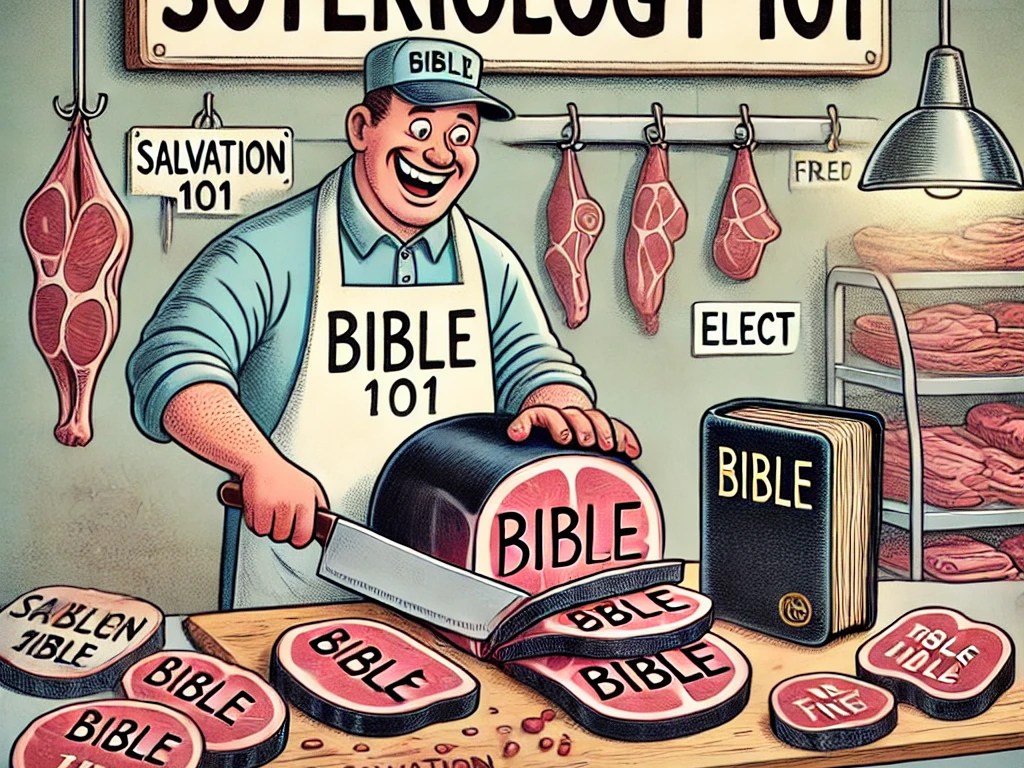
Leighton Flowers has raised several analogies to challenge Calvinist compatibilism and the moral framework it entails.
https://watchmencouncil.com/2024/10/30/how-to-flunk-soteriology101/
First, he uses a “love potion” analogy to argue that Calvinist determinism entails a form of artificial manipulation incompatible with true love. Then, he presents a second analogy to argue that Calvinist determinism unfairly exempts God from moral standards that would apply to humans.
The Love Potion Analogy: Misrepresenting Compatibilist Freedom
Flowers initially objects to Calvinist compatibilism by using the example of a love potion. In this analogy, he suggests that if a man gives a woman a potion to make her love him, her love is manipulated rather than genuine. He then suggests that under Calvinist determinism, this “potion-induced love” would be considered true love because it aligns with her greatest inclination, despite being caused by an external agent. He implies that such love would be considered real, even though it’s clearly forced.
This analogy misses the mark in several ways. First, it assumes that Calvinists are strictly committed to classical compatibilism, which is not always the case, as some Calvinists adhere to semi-compatibilism, distinguishing between acting freely and acting responsibly. In Calvinist thought, moral culpability is not solely about acting freely but about acting in accordance with one’s God-given desires and character. Furthermore, libertarian Calvinists exist, holding that human freedom involves genuine choices that are not determined by prior causes, though they affirm God’s sovereignty in a way that differs from compatibilists. However, from my compatibilist perspective, this approach offers a more consistent framework for understanding the interplay between divine sovereignty and human responsibility. In fairness to Flowers, I’ll address this issue from the compatibilist viewpoint.
By equating God’s causation with a love potion, Flowers incorrectly portrays divine influence as external manipulation rather than internal transformation. In Calvinism, God’s causation works from within, drawing out genuine desires and inclinations that reflect a person’s God-given character. The woman’s response in the love potion analogy is not analogous to Calvinist determinism because her affections are artificially overridden. Calvinists, on the other hand, understand God’s role as Creator to involve a transformation that respects human freedom while aligning the heart with divine purposes.
As Calvinist philosopher Guillaume Bignon explains, actions are morally accountable when they flow from a person’s genuine desires and character, not when they’re externally imposed:
“For a choice to be free such that its maker is morally responsible, it need not be undetermined, but it does need to be determined (assuming determinism is true) by the agent’s own desires, which flow from the agent’s God-given character and inclinations.”
– Guillaume Bignon, Excusing Sinners and Blaming God
The “Bill” Analogy: Misunderstanding Divine Goodness vs. Created Goodness
After the love potion analogy, Flowers raises a second analogy to argue that Calvinist determinism unfairly exempts God from moral standards. He presents the following scenario:
“If Bill claimed, ‘Torturing babies for enjoyment is wrong,’ and Bob replied by saying, ‘Yes, for everyone except for the creator of babies.’ And Bob asks, ‘Why?’ And Bill answers by saying ‘Because he is the creator of the baby.’ Is that a sufficient answer? Of course it’s not because we all intuitively and biblically know it’s evil to torture babies for your own enjoyment.”
This analogy implies that if human beings are morally bound not to commit certain acts, then God should also be bound by these same standards. Flowers seems to argue that exempting God from human moral restrictions amounts to “special pleading.” But this analogy misrepresents the nature of divine goodness and overlooks the crucial distinction between divine and created goodness.
In Christian theology, God is the very source of moral law and goodness. This means that His actions aren’t bound by human-specific standards; rather, moral standards derive from His nature. What is good for creatures reflects God’s nature but doesn’t limit Him in the way it limits us. Divine goodness is therefore original and foundational, while human goodness is derivative—rooted in God’s design for creation.
Flowers’ analogy assumes a univocal approach to moral standards, treating divine actions as if they must adhere to the same creaturely moral limits as human actions. But this approach fails to honor the Creator-creature distinction, which recognizes that God’s actions reflect His own nature rather than imposed, external standards. This understanding allows for analogical predication: when we say God is “good” or “loving,” we mean that He is the source of goodness, not bound to human definitions of it.
Flowers’ analogy, which assumes that God is bound by the same moral limitations as human beings, overlooks crucial distinctions in Christian theology regarding divine goodness. By conflating divine and created moral standards, this analogy misinterprets the fundamental nature of God and the Creator-creature distinction. To address this, we can categorize goodness into three levels, each illustrating a unique relationship to moral law.
1. God’s Original Goodness (Ex Lex)
This is God’s eternal Goodness, which:
- Reflects the Triune love and life within God Himself.
- Exists independently of any creation or covenant.
- Is uncreated and is exclusively divine, transcending all created moral law (ex lex).
- Serves as the very source of all other forms of goodness.
At this level, God’s Goodness isn’t bound by moral law; rather, moral law flows from His Goodness. God is Goodness itself, not simply in possession of goodness, which eliminates the idea that He is “exempt” from standards.
2. God’s Covenantal Goodness (Ex Lege)
This level, specific to God’s covenantal role, denotes:
- God’s engagement with creation and His covenantal faithfulness.
- Mediated goodness (ex lege), reflecting God’s unique responsibilities as the sovereign Covenant Maker.
- The moral law’s design, specifically crafted for His covenant with humanity.
In this sense, God’s actions are faithful within a covenantal framework. This covenant-based relationship allows God to act in ways (like the Flood) that would be inappropriate for human agents, not due to a lack of moral alignment but because of the distinct covenantal responsibilities.
3. Created Moral Goodness
Finally, human moral goodness:
- Derives from God’s original Goodness but is constrained by covenantal terms designed for human beings.
- Reflects divine goodness analogically—humans are called to live in a manner that mirrors, yet is subordinate to, God’s Goodness.
- Functions within human nature and creaturely limitations.
This created moral goodness is bound by the moral law established in the covenant, forming a pattern but not an absolute measure for God’s own actions.
Why Flowers’ Analogy Fails
With these distinctions in mind, Flowers’ analogy falters for several reasons:
- Category Error: Misunderstanding God’s Original Goodness
Flowers’ analogy conflates God’s transcendent, original Goodness (ex lex) with the moral obligations imposed on humans through covenant. In Reformed thought, God’s goodness is the source of moral law and exists independently of any covenant with creation. By projecting creaturely moral limits onto God, Flowers ignores that moral law flows from God’s nature rather than binding or constraining it. This misstep leads to a critical category error where Flowers treats divine Goodness as if it operates under creaturely obligations, blurring the Creator-creature distinction foundational to understanding divine moral freedom. - False Equivalence: Distinct Roles in Covenantal Relationships
Flowers assumes moral obligations are uniform across covenant participants, equating God’s role with that of humans. However, within covenantal relationships, each participant’s responsibilities align with their unique nature and role. For instance, God, as Creator, sustains and guides creation toward His ultimate purposes. Human beings, however, are bound to specific moral laws fitting their nature as creatures. This distinction means that divine allowances and actions serve a redemptive purpose beyond finite comprehension, rendering Flowers’ comparison insufficient to capture the Creator’s unique role in the covenant. - Overlooked Distinctions: Ignoring Ex Lex and Ex Lege
Flowers’ analogy fails by not distinguishing between God’s transcendence over moral law (ex lex) and His covenantal participation within moral frameworks (ex lege). In Christian theology, ex lex reflects God’s sovereign, unbounded Goodness, while ex lege speaks to His self-imposed faithfulness within a covenantal context. Flowers’ oversight here leads him to theological blunders, as he presumes that God’s actions are bound by the same moral constraints as those of His creatures. By disregarding these distinctions, Flowers’ arguments overlook the profound theological framework that accommodates both God’s sovereignty and His covenantal faithfulness.
Leighton appears to interpret this distinction as a form of voluntarism, assuming that God can arbitrarily decree anything as “good.” However, this mischaracterization fails to capture the nuances in Reformed theology, where God’s Goodness is neither arbitrary nor subject to external standards.
Flowers’ analogy falls short in one of two ways: either by failing to distinguish God’s transcendence over moral law—where His Goodness exists independently of any law He created—or by overlooking God’s unique status within the law, where He operates as the sovereign Author of moral obligations yet remains inherently good in His nature. Neither position implies that God’s relationship to moral law reduces to voluntarism.
If we consider God’s Goodness as ex lex—transcendent and self-sufficient—then divine Goodness is not determined by arbitrary decrees but by the very nature of God’s being, which is Goodness itself. Alternatively, if we view God’s covenantal role as ex lege—acting within the framework He established—then His actions reflect His faithful character rather than mere voluntaristic command.
Instead of asking whether moral rules for humanity are binding for God, we should understand that:
- God’s original Goodness transcends created moral law.
- God’s covenantal goodness operates according to His unique divine status.
- Human moral obligations reflect divine Goodness but are shaped by our created nature.
Flowers’ approach introduces further theological problems by treating divine and human goodness as univocal, effectively undermining divine aseity—God’s self-existence and independence. By assuming that God’s actions must align with human moral standards, Flowers implies that God’s Goodness relies on an external moral order. This dependence contradicts God’s self-existent nature, suggesting that His Goodness is contingent upon a created standard rather than arising from His own uncaused being. If divine Goodness depended on an external moral standard, it would place God under a standard outside Himself, effectively subordinating Him to created norms.
Furthermore, Flowers’ univocal approach introduces a reformulated dilemma: does God possess virtues because they are inherently good, or are they good simply because God possesses them? This dilemma echoes the classical Euthyphro problem, making divine Goodness seem arbitrary. If virtues are good independently of God, then a standard of goodness exists outside God to which even He must conform, undermining divine aseity. Conversely, if virtues are good solely because God possesses them, it risks making moral goodness arbitrary, as it would depend entirely on God’s possession rather than on an intrinsic nature of Goodness itself.
This dilemma, however, does not arise within my position. By distinguishing between divine and human goodness, I hold that goodness is neither imposed upon God nor arbitrarily defined by His possession of it. Instead, divine Goodness originates from God’s self-existent nature and is not contingent upon external standards or comparisons. Thus, God’s virtues are good not because they conform to an external moral framework or because they are arbitrarily deemed so, but because they flow from His uncaused, self-sufficient being. This understanding preserves divine aseity and avoids reducing moral goodness to an arbitrary standard while maintaining God as the ultimate source and standard of all goodness.
Additionally, treating God’s moral properties as identical to human moral properties presents further issues. These properties must be either created or uncreated. If created, God would be dependent on His own creation to be who He is, undermining His aseity and self-sufficiency. If uncreated, this would imply that human beings possess divine properties, blurring the distinction between Creator and creature. Either way, this framework detracts from God’s transcendent nature and the Creator-creature distinction fundamental to Christian theology, reducing divine Goodness to mere conformity with creaturely ethics rather than the source from which all ethical standards ultimately flow.
Parody Argument: Exposing the Limits of Flowers’ Approach
To illustrate the limitations of Flowers’ analogy, consider the following parody argument:
Imagine Bill claimed, “Watching the torture of babies without intervening is wrong,” and Bob replied, “Yes, for everyone except the Creator who allows free agency.” Bill then asks, “Why?” and Bob answers, “Because He is the Creator of the baby, and He has permitted freedom for a greater purpose.”
In this reframed analogy, we recognize that God’s permissive will is not morally identical to passive human allowance of suffering. Humans often have the immediate power to stop suffering without bearing unbearable or negative consequences, as they are not responsible for overseeing all creation or bound by infinite knowledge and redemptive purposes. God, however, allows certain events for reasons beyond immediate human understanding, fully considering the ultimate good His allowance will bring.
This parody exposes the flaw in applying human moral judgments to God’s actions. Such analogies overlook the Creator-creature distinction, presuming that God’s actions should be morally evaluated in the same way as human actions, thereby ignoring the infinite gap between Creator and creation. When Flowers equates divine causation with human manipulation or moral irresponsibility, he fails to account for the fundamental difference in God’s role as sovereign, wise, and good beyond human categories.
Flowers’ critique also contains inconsistencies that become clear in his selective application of human moral standards to God. He does not fault God for creating individuals with unchosen attributes like gender or ethnicity, yet he objects to divine causation when it involves directing human will. Similarly, Flowers does not criticize God for sustaining sinful humanity but finds fault in the notion that God could guide human actions for redemptive purposes. This selectivity suggests that Flowers assumes a univocal relationship between human and divine action, disregarding the Creator-creature distinction.
Moreover, Flowers’ “Bill analogy” assumes that God’s moral obligations and human moral obligations are identical. His analogy equates divine “allowance” with passive human permissiveness, missing the fact that God’s relationship to creation operates at an entirely different level. Humans do not sustain existence, possess perfect knowledge, or act from an eternal perspective. Divine actions, therefore, serve ultimate purposes beyond immediate human comprehension and are not subject to human ethical constraints.
In sum, Flowers’ analogies fail to address the theological understanding of moral responsibility, divine causation, and the Creator-creature distinction in Calvinism. Recognizing that God’s causation is analogical, not univocal, we see why divine determinism escapes Flowers’ objections, grounding Calvinist compatibilism as a coherent and robust view within Christian theology.
Divine Mysteries and the Limits of Human Analogies
Leighton Flowers’ approach to divine causation relies on a fundamental but overlooked assumption: he treats God’s actions and causality as if they are identical to human actions and causality. In doing so, Flowers sidesteps the profound mystery of God’s nature, a mystery Christian theology holds as foundational. Within Calvinism, divine causality is not simply “bigger” or “more powerful” than human causality—it is categorically different, sui generis and holy, embodying a unique sovereignty that transcends creaturely categories. This assumption causes Flowers to beg the question against Calvinism by assuming that God’s causality operates on the same terms as ours, a view Calvinism fundamentally denies.
Flowers’ approach overlooks that, although God’s actions are knowable, they do not follow the same rules, entailments, or properties as creaturely powers and causes. The Creator-creature distinction is central to Calvinist theology, affirming that God’s causality surpasses any analogy we can draw from created things.
Flowers’ approach reflects a rationalist tendency to confine God’s actions to human comprehension. Here, rationalism assumes that anything beyond human understanding is invalid or impossible, forcing divine action into creaturely categories. This tendency mirrors rationalistic objections to doctrines like creatio ex nihilo (creation from nothing) and the Trinity. Rationalists argue that these doctrines violate familiar frameworks of identity and experience, claiming that creation requires pre-existing material or that personhood operates only within human categories.
Analogies to Creatio Ex Nihilo and the Trinity
Rationalist objections often reduce God to human terms, as seen in critiques of creatio ex nihilo and the Trinity.
Identity Objections
Some rationalists argue that creation from nothing violates the law of identity, reasoning that since “nothing” has no identity, it cannot produce “something.” This thinking misses the distinctiveness of God’s causative power, which does not require pre-existing materials. Similarly, rationalists claim the Trinity violates non-contradiction by proposing a triune God. This objection fails to account for the fact that God’s identity is not limited to created categories and frameworks.
Suppose we confine the concept of origins to our experience as humans: creating a book requires an author and materials, creating a child requires biological elements, and building a structure requires resources and tools. In this limited framework, creation ex nihilo becomes “impossible” because, for humans, creation demands pre-existing resources. From this perspective, rationalists assume God would need materials to create, just as humans require tools and resources.
Similarly, consider limiting personhood and identity to our creaturely understanding of human individuals. If this framework is all that exists, then God’s personhood must resemble human personhood, erasing the possibility of a Trinity. Under such rationalistic constraints, the notion of a three-in-one God is not merely challenging but appears logically untenable.
In particular, the rationalist perspective relies on common notions of numerical identity and assumes transitivity: if A is identical to B, and B is identical to C, then A must be identical to C. Applied rigidly, this framework makes the Trinity appear contradictory, suggesting that each divine person (Father, Son, and Holy Spirit) would be numerically identical, yet distinct. The Trinity collapses under this imposed transitivity. But Christian theology understands divine identity analogically, transcending these creaturely constraints. The Trinity requires a framework that respects divine mystery—an identity beyond numerical constraints and rooted in God’s uniqueness.
Experience Objections
Other rationalists reject creatio ex nihilo on the grounds that human experience offers no analogy for “something coming from nothing.” Again, this perspective misses the Christian worldview, which affirms a Creator unrestricted by creation’s limitations. Flowers’ rationalism, by this reasoning, would limit divine causation to human causation alone.
Just as rationalism restricts God’s capacity to create, it imposes on God a causative force indistinguishable from human causation. Flowers assumes that if human causation can be coercive, divine causation must also be coercive—a presumption that fundamentally misunderstands Calvinist compatibilism.
Reformed Distinctions in Divine Causation and Regeneration
Reformed theology asserts that divine causation and human agency harmonize within the Creator-creature distinction. Divine causation does not negate human agency; rather, it functions uniquely as a restorative force, illustrated by analogies such as healing blindness or bringing life from death. These examples reveal a causative influence that respects human nature while redeeming it. Reformed theology frames regeneration as God aligning the human heart with the good, preserving agency rather than overriding it coercively.
When Flowers likens divine influence to “love potions” or manipulation, he assumes that God’s causative influence resembles human interference. Calvinism, however, understands God’s influence as uniquely restorative, consistent with His sovereignty and with a causative agency that transcends human limitations.
If divine causation can coexist with human agency broadly, it follows that this coexistence holds in specific contexts, such as regeneration. Calvinism affirms that God’s sovereignty operates without compromising human agency, embracing this as a divine mystery rather than a contradiction.
From a Calvinist perspective, we do not claim to fully understand how God can cause agents to possess genuine agency while also being divinely directed. Rather, we affirm that He does so, rooted in the belief that God’s sovereignty transcends human comprehension.
In regeneration, we do not presume to know exactly how God instills new desires without compromising agency. What we do know is that God’s work results in genuine transformation, aligning a person’s actions with their God-given nature. While the mechanics may elude us, the outcome demonstrates that God’s causative influence respects and preserves human agency rather than diminishing it.
This is why Reformed thinkers often use restorative analogies to describe regeneration, illustrating how God’s work differs fundamentally from manipulative coercion. Analogies like restoring sight to the blind or healing a broken will convey that regeneration restores individuals to their intended nature, rather than imposing a foreign influence. By contrast, analogies involving “love potions” or manipulation presuppose, without justification, that divine causation must resemble coercive interference, missing the uniquely restorative quality of divine regeneration.
If one grants that God can cause genuine agency while influencing intentions broadly, then He certainly possesses this ability in the specific context of regeneration. Criticizing divine action in this broader sense only reinforces this point: if harmony between divine causation and agency is possible in general, it is certainly plausible in the specific case of regeneration. Any analogy that reduces this to mere “manipulation” ultimately begs the question, assuming without justification that divine causation must resemble human coercion rather than uniquely divine restoration.
Positive Mysterianism: Embracing Divine Mystery
Dr. James Anderson articulates positive mysterianism as the view that theological doctrines may appear paradoxical but are rationally acceptable. This stance acknowledges our limitations in understanding divine mysteries, recognizing that contradictions may reflect our finite perspective rather than actual inconsistencies.
“Certain theological doctrines, while appearing paradoxical or even contradictory, can still be rationally affirmed by believers. This stance acknowledges the limitations of human understanding when grappling with divine mysteries, suggesting that apparent contradictions may arise from our finite perspective rather than indicating actual inconsistencies in the doctrines themselves.” — Dr. James Anderson
Rejecting divine mysteries as “special pleading” implies that Christians must discard doctrines like the Trinity or creatio ex nihilo simply for lack of exhaustive explanations. Yet Christian theology acknowledges that God’s ways transcend human understanding. The Creator-creature distinction allows for analogical rather than univocal descriptions of God’s actions, reflecting a mystery that finite reason alone cannot grasp.
Leighton’s approach to analogy—insisting that divine actions must resemble human actions to be understood as just—fosters the same reasoning found in objections to doctrines like creatio ex nihilo and the Trinity. By applying creaturely limitations to divine actions, his view implicitly denies the uniqueness of God’s causative power and transcendent nature, which undergird these central doctrines. If Leighton were consistent in applying this logic, he would find himself unable to affirm essential Christian teachings, as they inherently transcend human categories of experience and identity. For instance, creation from nothing and the triune nature of God both defy ordinary human concepts of identity and causation, yet are foundational to Christian belief. Rejecting doctrines based on their lack of human analogy would lead not only to a dismissal of divine determinism but also to a rejection of these cornerstone doctrines. Thus, if Leighton’s view of analogy were applied consistently, it would undermine not only his objection to Calvinist determinism but key doctrines of the faith as well.
 The Council