
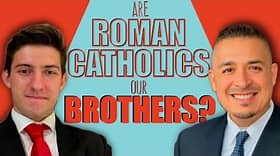
The recent discussion between Redeemed Zoomer and Ramos offered an insightful look into the ongoing Protestant–Catholic dialogue. Both came in with conviction and clarity on their respective positions. While Redeemed Zoomer clearly came out ahead in terms of argumentation—especially when Ramos leaned on anecdotal impressions and sidestepped deeper theological sources like the Council of Trent—Zoomer’s own arguments, though forceful, carried several internal tensions that deserve a closer look.
1. Zoomer Makes a Strong Case on the Canon
Redeemed Zoomer’s handling of the canon debate was arguably his strongest moment. Ramos had suggested that because Scripture is necessary for salvation, the canon must have always been known with certainty. Zoomer responded with a solid historical point: Christians throughout church history had slightly different canons, and yet the gospel still reached them. This shows that exhaustive knowledge of the canon’s boundaries is not itself a precondition for saving faith.
Ramos tried to recover by appealing to a sort of “collected canon” model—arguing that there was still a general consensus in the church—but this didn’t really address the underlying issue. The fact remains that Christians with different canonical lists still shared in the same core truths of the gospel. Zoomer’s point here rightly challenges any ecclesiology that demands infallible certainty on the canon as a prerequisite for gospel knowledge.
2. Zoomer’s Oversight on Doctrinal Essentials
That said, Zoomer stumbled a bit when he tried to rank doctrines based on how often they were discussed in church history. He argued that because the early church spent more time on the Trinity and the Incarnation than on justification, these must be more central. But this doesn’t necessarily follow. The intensity of historical debate doesn’t determine salvific importance. Justification might require less technical language, but the error Paul confronts in Galatians shows that it can be just as salvifically central.
Zoomer also seemed to suggest that only those Trinitarian models affirmed by the early church fall within the bounds of orthodoxy. That raises some questions. For instance, I reject eternal generation but affirm eternal sonship. Should that be considered heretical? Surely not. Yet this kind of hard boundary-setting begins to resemble the same problems Protestants often critique in Roman Catholic dogmatic development. The concern isn’t that Zoomer is “too precise” but that he might be importing a kind of ecclesiastical absolutism inconsistent with the Reformational spirit.
Zoomer further claimed that Trinitarian doctrine requires more precision than justification. That may be true in terms of theological development, but so what? The issue isn’t how many nuances exist, but whether Rome’s doctrine of justification constitutes a fatal gospel error. The early church faced plenty of heresies on justification. In fact, the Judaizing heresy condemned by Paul in Galatians—addressed in Acts 15—is one of the earliest and most devastating. Yet Zoomer only highlights Pelagianism as the major historical threat, strangely omitting Galatians entirely—at least until Ramos brings it up.
3. Ramos’s Missteps on Essentials and Precision
To his credit, Ramos eventually brought up the Galatian heresy, but he didn’t fully press the point. Earlier, he had seemed to conflate doctrinal essentiality with the level of detail or precision required to articulate a doctrine. But these are two different things. Some doctrines may require more theological precision, but that doesn’t make them more essential. Precision and salvific weight aren’t always proportionate.
This confusion left Ramos unable to press a key point: that justification, though conceptually simpler than Trinitarian theology, can be just as essential—perhaps more so—because it deals directly with the question of how one is made right with God.
4. Misreading the Galatian Heresy
When Ramos finally brought up the Judaizing heresy in Galatians, Zoomer offered a unique but problematic interpretation. He argued that the issue in Galatia was ethnic superiority. While social dynamics certainly played a role, the root concern was theological: requiring circumcision and law-keeping as necessary for salvation. This wasn’t merely ethnic pride—it was a distortion of the gospel itself.
Moreover, Jewish identity in the biblical context wasn’t strictly ethnic. Converts from other nations became Jews through religious adherence, not birthright alone (cf. Esther 8:17; Acts 2). So to interpret the controversy primarily through an ethnic lens undercuts the seriousness of the doctrinal error Paul was condemning.
5. Zoomer’s Unclear Use of Beliefs and Entailments
Zoomer also tried to navigate the issue of lay Catholic belief by appealing to a distinction between explicit belief and theological entailment. He noted that most Catholics he knows don’t think of their good works as obligating God to save them. That’s an important pastoral observation. Many sincere believers may hold to systems that entail problematic doctrines without personally embracing those conclusions.
However, this also creates a tension in Zoomer’s argument. He rightly condemns Pelagianism as a fatal error, even if a self-identified Pelagian doesn’t explicitly say they believe they can earn salvation. So the question becomes: when do entailments cross the line into heresy, and when can they be treated as mere inconsistencies?
We should grant that theological entailments don’t always mean someone is unsaved. The Reformers themselves recognized that many within the Roman Church were true believers in spite of the system, not because of it. But Zoomer seems unclear on when a person’s system makes them culpable and when their ignorance or inconsistency offers room for grace. If entailments are never heretical unless explicitly affirmed, then hardly anyone could be held accountable. But if entailments always condemn, then we risk excluding those whose hearts are aligned with gospel truth even if their theology is confused.
 The Council