
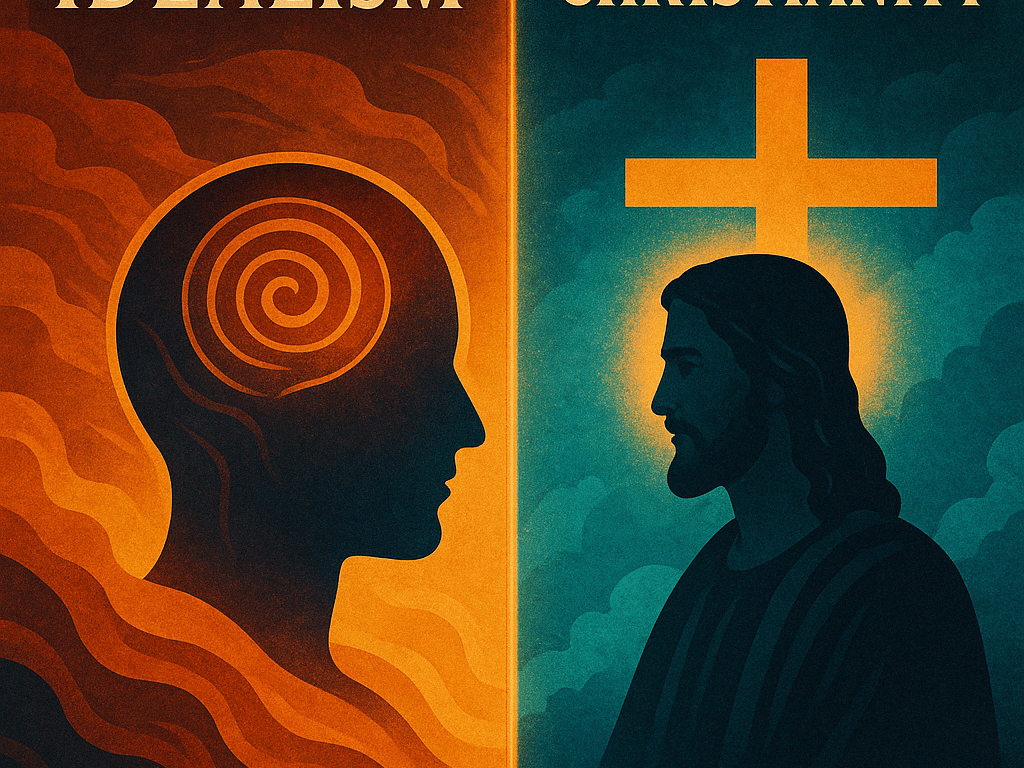
The problem of the one and the many—the tension between unity and diversity—has haunted philosophy from its inception. How can diversity exist without fragmenting into chaos? How can unity exist without collapsing into abstraction? Most systems answer this by privileging one pole over the other. Idealism, while posturing as a defense of unity and coherence, ultimately fails to provide a sufficient ontological grounding for either unity or diversity. By contrast, Christian theism begins not with an abstract principle, but with the ontological Trinity: one God in three persons.
As Van Til argued, only the Triune God accounts for both unity and diversity without reducing one to the other. God is the original One and Many. All creaturely reality is an ectypal reflection of this archetypal harmony.
1. Idealism’s Dilemma: A Mind Among Minds or a Mental Absolute?
Idealism affirms that reality is fundamentally mental, but this poses a devastating dilemma: either God is a mind among minds (thus subordinated to a universal principle of mentality), or mentality itself is the Absolute (rendering God impersonal). In either case:
- Option A: God as a mind among minds violates aseity. He is no longer ipse esse subsistens but an instance of a broader genus, “mind.” This introduces a metaphysical abstraction above God, flattening the Creator-creature distinction.
- Option B: Mentality as impersonal absolute dissolves divine personality into abstraction. This is the move of Hegelian or Spinozist idealism, in which God becomes synonymous with rational process or cosmic consciousness.
Implications:
- There can be no ultimate personal absolute. Either God is demoted to a finite agent, or “God” becomes a mere process without self-awareness.
- Worship becomes incoherent. If God is not the self-existent person, there is no true Thou to worship, only a cosmic mechanism or projection.
- Revelation collapses. If God is a fellow participant in a larger metaphysical framework, His Word cannot be ultimate. We end up in an impersonal monism or fragmented pluralism.
These entailments apply across the spectrum of idealist evasions, all of which attempt to anchor reality in “the mental,” yet fail to preserve personhood or the Creator-creature distinction:
- Neoplatonism: The mental is understood as an impersonal principle (the One) beyond being. The One is pure unity, and all multiplicity is a degradation through emanation. This eliminates relationality at the source, making personhood a derivative illusion. Worship becomes mystical absorption into the impersonal, not communion with a personal God.
- Pantheism: The mental is equated with the totality of being—”all is divine” because all is one substance. Yet if everything is God, nothing is God distinctively. There can be no transcendent Lord, no covenantal grace, no moral standards independent of the flux of nature. The result is either determinism without meaning or relativism without judgment.
- Panpsychism: Mental properties are distributed across all entities, rendering all things conscious or proto-conscious. But this devolves into explanatory incoherence: how do fragments of awareness yield personal agency? It cannot ground moral responsibility or rational discourse. The multiplicity of minds lacks a coherent unity unless subordinated to a higher mind—yet this higher unity is absent or impersonal.
- Platonism: The realm of Forms is treated as ultimate. These are impersonal, timeless mental archetypes. But they do not know, love, or communicate. If God participates in these Forms, He is not their source. Thus, Platonism reverses the ontological order: personality is built on abstraction, not the other way around.
Each model represents one of three moves:
- Mental as abstract law (Platonism): dissolves personality into necessity; rationality is de-personalized.
- Mental as God (pantheism): absorbs God into the world; unity without transcendence.
- Mental as participation or identity (panpsychism, Neoplatonism): merges creature and Creator in a shared continuum; distinction is lost in gradation.
Core Critique: Idealism in all its forms privileges the mental while failing to define it as inherently personal. When “mind” is not tethered to divine personhood, it becomes a fluid metaphor: sometimes a system, sometimes a principle, sometimes a substance. This ambiguity permits projection but prevents worship. The abstract mental may structure reality, but it cannot love, reveal, or redeem.
By denying or diluting God’s self-existence, these systems collapse into forms of metaphysical monism or dualism. Monism obliterates all real distinctions—between God and creation, good and evil, person and process—resulting in a universe that is undifferentiated and unknowable in any meaningful sense. Dualism, on the other hand, preserves distinctions arbitrarily: it posits multiple eternal realities (e.g., mind and matter, unity and multiplicity) without a coherent source to unite them. In both cases, unity and diversity are either abstractly juxtaposed (resulting in incoherence) or hierarchically subordinated (resulting in impersonalism or polytheism). The result is a metaphysical framework that cannot support intelligibility, communion, or moral order. Without a personal absolute who is both one and many, all attempts to resolve the tension disintegrate into abstraction or contradiction.
2. The Trinity: The Personal Resolution to the One and the Many
Christian theism, uniquely among worldviews, affirms that both unity and plurality are original and ultimate—because God is Triune:
- Unity of essence: One simple, eternal, necessary being.
- Diversity of persons: Father, Son, and Spirit—coequal, coeternal, and coessential.
As Van Til emphasized and Bosserman developed, this is not an abstract solution but a personalist ontology. The Trinity is not a conceptual tool imposed on God to solve metaphysical puzzles; He is the solution in Himself. God does not participate in being—He is Being itself (Exod. 3:14; John 1:1–3).
Implications:
- Unity and diversity are equally ultimate: This provides the only coherent foundation for explaining why creation exhibits both regularity and variety.
- Knowledge and ethics are relational: As Oliphint argues, epistemology and moral obligations are covenantal, because God is a personal, relational being.
- Human society and reasoning mirror Trinitarian structure: Bosserman notes that rational coherence, communication, and personhood all derive from God’s triunity. Without this, man is left either to fragment into relativism or absorb into pantheism.
3. Van Til and Bosserman on Idealism’s Collapse
As Van Til argued repeatedly, idealism uses theological vocabulary, but it reinterprets it through foreign philosophical grids. It collapses into one of three fatal directions:
- Pantheism (God = world): Especially in Hegelian idealism, God becomes identical with the unfolding of history—a cosmic monologue with no personal other.
- Impersonal Logic (God = rational structure): God becomes “rational coherence” or “logical necessity,” not a person to be known or worshipped.
- Temporal Creature (God = highest mind): Theistic personalism redefines God as a superior mind subject to time, change, and learning. This is not classical theism but philosophical anthropomorphism.
Implications:
- Epistemological instability: If God is learning or evolving, then truth itself changes. Certainty becomes impossible.
- Moral relativism: A God whose will evolves cannot ground eternal moral norms. Ethics becomes contextual and ultimately arbitrary.
- Collapse into self-worship: As Van Til showed, idealism in its many forms inevitably leads to man being the measure of all things, since no fixed personal absolute stands above creation.
Only the Trinity provides the ontological foundation for true unity-in-diversity. Bosserman emphasizes that Trinitarian theology is not a compromise between extremes, but a sui generis resolution that explains why we expect the world to be rational, relational, and morally meaningful.
4. The Creator-Creature Distinction and Participatory Error
Idealism cannot sustain the absolute ontological divide between Creator and creature. In every form, it leads to some notion of shared participation in a higher universal (e.g., “mind”). But Christian theism affirms:
- God is a se; we are ab alio.
- God does not participate in being—He is being. We do not share in His being but exist by His decree.
Implications:
- No metaphysical neutrality: As Van Til and Oliphint argue, there is no “common ground” on which man and God meet as equals. All reasoning is either covenantally faithful or rebellious.
- No independent rationality or morality: Human knowledge and ethics are analogical, not univocal. This guards against both rationalism and irrationalism.
- Condescension is covenantal, not necessary: God relates to creation not out of metaphysical compulsion but voluntary grace. As Oliphint stresses, divine condescension upholds the Creator-creature distinction while making true knowledge and fellowship possible.
This means that Christian theism not only avoids the errors of idealism, but exposes them as counterfeit attempts to resolve metaphysical tension apart from the living God. The ontological Trinity is not one more system among many—it is the foundation for all intelligibility, identity, and worship.
5. Idealism Destroys Redemptive History
If physical reality is nothing more than a mental appearance within the divine mind, then the defining events of the gospel—the Incarnation, Crucifixion, and Resurrection—are reduced to symbolic phenomena. They become internal features of divine consciousness rather than real, historical, embodied acts.
But biblical Christianity insists on redemptive actuality:
- Romans 5 requires a historical Adam to ground federal representation.
- Hebrews 9 demands a real, once-for-all atonement—executed in time and space, not merely conceived in thought.
- 1 Corinthians 15 declares that if Christ was not bodily raised, our faith is futile.
Idealism spiritualizes the gospel into myth. It severs the covenantal link between history and redemption. As Van Til warned, idealism collapses the distinction between Creator and creature, between God and world—erasing the very premise upon which redemptive history rests.
Worse still, by reclassifying redemptive events as internal phenomena of God’s mind, idealism renders them no more real than a dream. But mental states—thoughts, intentions, perceptions—are categorically distinct from embodied historical realities. The Incarnation is not God dreaming of flesh, nor is the Resurrection a metaphorical “waking” within the divine psyche. These are public, bodily, space-time acts. To reduce them to symbols within consciousness is to treat them like dreams: vivid, perhaps meaningful, but ultimately lacking concrete objectivity. It’s like waking from a dream and pretending you never left it.
Scripture gives us no such option. The gospel is not dream-theater—it is God in the flesh, crucified under Pontius Pilate, risen in a garden, witnessed by many, and ascended into heaven. Idealism cannot account for this because it cannot preserve the reality of the world in which these acts occurred. And so, it collapses the gospel itself.
6. Idealism Undermines Human Freedom
Idealism entails that all creaturely actions are eternally embedded in the divine mind—forever fixed and necessary. This metaphysical determinism masquerades as transcendence, but it effectively eliminates human freedom:
- Libertarian freedom vanishes: No agent could have done otherwise; all alternatives are already eternally resolved within God’s mental schema.
- Contingency disappears: Events do not “happen”—they merely appear within the stream of divine consciousness.
- Causal agency collapses: Creatures are not true agents but characters in God’s mental play—there is no room for creaturely initiative, only divine ideation.
This results in a form of simulation determinism, where human experience becomes akin to a character inside a novel. The character may speak, feel, and act, but only as pre-determined by the author’s thoughts. This differs radically from the biblical view of persons made in God’s image—true agents, morally accountable, responsive to divine commands and covenant blessings or curses.
In Reasons for Faith, K. Scott Oliphint explains why this matters not only for moral responsibility, but also for theological coherence. He distinguishes between:
- Absolute necessity—what is necessary because of God’s nature (e.g., God must be just),
- and Hypothetical necessity—what becomes necessary once God freely decrees it (e.g., “Christ must suffer,” not because suffering is metaphysically necessary, but because God has willed it so).
“While an extrinsic necessity of coaction is incompatible with liberty, hypothetical necessity, arising either from a decree of God or from the existence of the thing, conspires with it… Something that did not have to be, but that, once decided, necessarily was.”
—Reasons for Faith
This distinction preserves freedom without denying sovereignty. God remains the first cause of all things, but His decree brings about contingency—events that are truly possible in their own right, not illusions of freedom. By contrast, idealism allows no space for a free decree, because all that exists is a necessary extension of the divine mind. There is no divine decision—only divine consciousness.
As Oliphint further notes, this makes even libertarian free will impossible, and not just on Calvinist terms. Idealism collapses all real options into the single stream of divine imagination. It’s not that God governs a free world—it’s that the world is God’s thought, and nothing more.
If idealism is true, there are no genuine “possible worlds”—only a fixed metaphysical unity masquerading as diversity. In this framework:
- You did not choose to believe; you simply appeared to.
- You did not respond to grace; you were dreamed responding.
- There is no “otherwise,” no true moral trial, no contingency.
As a result, idealism nullifies human responsibility while also undermining divine justice. It gives the illusion of moral agency but removes the ontological grounding necessary for guilt, repentance, or reward. It is not the sovereignty of Scripture, but a metaphysical fatalism masquerading as providence.
7. Idealism vs. Scientific Realism
In an effort to rehabilitate idealism in the modern age, many proponents appeal to quantum mechanics. The claim is that phenomena such as the observer effect or wavefunction collapse prove that reality is dependent on observation—that is, mind. But this move fundamentally misunderstands the relationship between scientific theory and metaphysical ontology.
Quantum theory is epistemically underdetermined. That is, the data of quantum experiments can be interpreted in multiple ways, many of which are realist, not idealist. These include:
- Bohmian mechanics (a deterministic, hidden-variable model),
- GRW collapse theories (which posit objective collapses in the wavefunction),
- Many-worlds interpretations (where decoherence yields branching realities),
- and even pilot-wave theories that preserve realism without collapse.
The “observer effect” does not imply that the mind creates reality—it merely describes that measurement limits our knowledge of certain properties. It is an epistemic constraint, not a metaphysical conclusion.
Scientific realism assumes several non-negotiables:
- A mind-independent world exists whether we observe it or not.
- Causal regularities persist across time and space.
- Objects and events continue in their properties even when unobserved.
Idealism undermines all three. It suggests that the world exists because God is thinking it. But this means:
- The regularity of nature is not grounded in objective law, but in divine mental habit.
- Objects do not continue when unperceived—they are sustained only by active thought.
- Scientific discovery becomes a process not of uncovering the world, but of reading God’s dream-book.
This makes the scientific enterprise parasitic. You can act as though the world is stable and independent, but only by borrowing the assumptions of realism while affirming a system that denies them.
In effect, idealism does not support science—it simulates it. Like a video game world, it has internal consistency but lacks external reality. The player may believe he is exploring a vast universe, but he is only navigating a programmed system.
If science is built on realism, then idealism destroys science at the root. It makes scientific laws merely mental projections, not discoveries of real order. In doing so, it collapses explanation into divine subjectivity. Idealism replaces law with dream, and exploration with introspection.
8. Hermeneutics and Revelation: Scripture Resists Idealism
At its heart, idealism is a hermeneutical strategy—it imposes a grid on all experience, including Scripture. But that grid distorts the Bible’s most basic affirmations. If all that exists is mental, then revelation itself becomes symbolic. The words of Scripture are not records of divine acts in time, but pointers to archetypal truths within the divine mind.
This undermines biblical revelation in four devastating ways:
- God’s speech is collapsed into consciousness: Revelation is no longer a communicative act from a personal God to real creatures, but an internal self-reflection of God expressed in literary form.
- History becomes metaphor: The Exodus becomes a symbol of liberation, not an act of deliverance. The Cross becomes a moral image, not a bloody atonement.
- Covenant is reduced to projection: God’s relational promises are not real engagements with a people in time, but eternal ideas expressing divine order.
- Propositional revelation is denied: Scripture ceases to be God’s Word to man, and becomes man’s symbolic participation in divine ideas.
Van Til was adamant: you must receive revelation on its own terms. If the Bible says God spoke to Moses from a bush, then God spoke to Moses from a bush. That is not a metaphor for divine inward illumination—it is historical event. If Jesus rose from the grave, He walked out of a tomb. He was seen, touched, and eaten with. That is not symbolic—it is public, empirical, physical truth.
As Oliphint underscores in God With Us, the doctrine of divine condescension guards us from idealism’s error. God truly relates to creation without ceasing to be God. He enters time, speaks human language, binds Himself by covenant—all without becoming subject to creation. But He does so really, not phenomenally. Idealism, by contrast, obliterates this distinction. It turns condescension into illusion.
In idealism, God does not accommodate Himself to us—He imagines us imagining Him. Revelation becomes recursive, symbolic, and self-referential. It ceases to be the Word of the living God, and becomes a dreamtext for mystical exegesis.
To adopt idealism is not to elevate Scripture—it is to reinterpret it beyond recognition. It is to make Moses a mystic, Jesus a myth, and Paul a philosopher of cosmic consciousness.
But the God of the Bible is not dreaming. He is speaking.
Further Suggestions:
 The Council
One thought on “Against Idealism”