
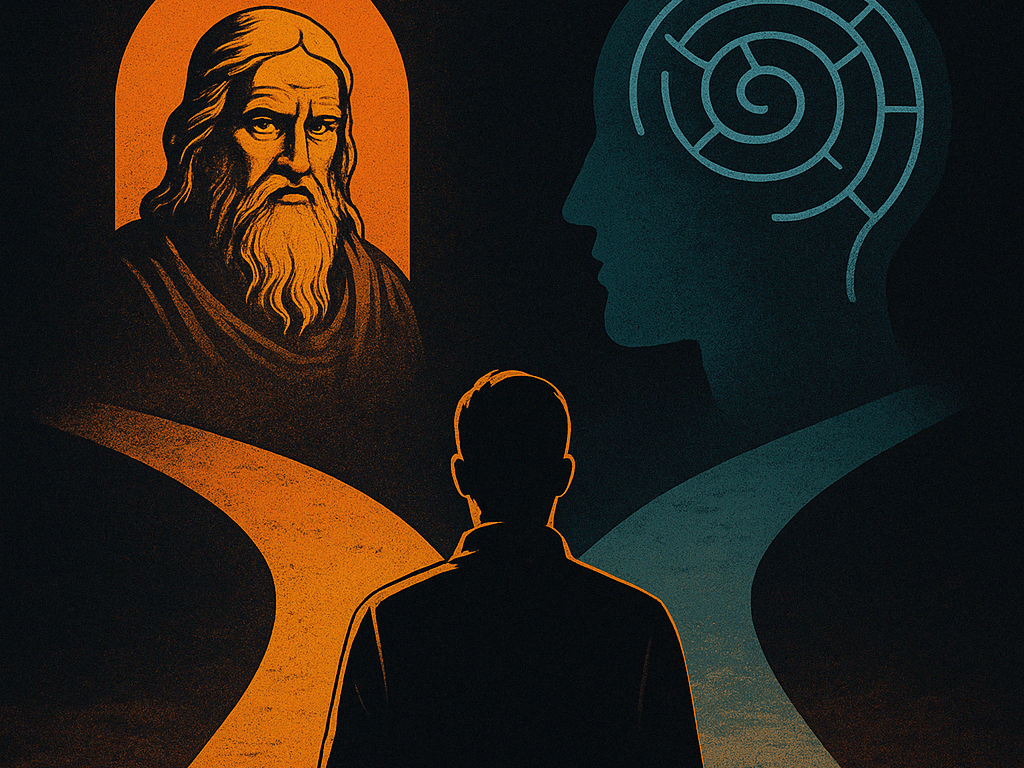
Atheists have often presented to me what they call “the problem of starting points.” They argue that we must begin either with ourselves or with logic—because, they say, to start anywhere else is to descend into incoherence. If you begin with God, they claim, you can’t even know Christianity is your starting point, since you’d have to know you exist and that logic is valid before you could know anything at all.
But this objection stems from a deep confusion about what it means to “start with” something.
Critics assume that “starting with God” means we temporally begin with the belief that God exists and then proceed to build the rest of our knowledge on that. But this is a misunderstanding. When Christians say they start with God, they are referring to a logical or ultimate starting point, not a chronological one. In other words, belief in God holds preeminence over other beliefs. It is the necessary precondition for knowledge, not simply the first idea to cross the mind.
This challenge can be turned around. What does the objector start with? Himself? Logic?
If he says he starts with himself, we must ask: with what tools does he analyze “himself”? Logic? Reason? Sensory input? But then he’s not starting with himself—he’s starting with abstract principles he hasn’t justified.
If he claims to start with logic, he’s treating logic as an autonomous metaphysical reality without accounting for its origin, necessity, or grounding. He’s making the same mistake—treating the phrase “start with” as if it only refers to a temporal order, rather than a system-wide foundation.
Some objectors also say that TAG (the Transcendental Argument for God) fails because it presupposes the very things it tries to account for—like intelligibility or logic. They argue that we don’t need to justify these preconditions because we must already assume them in any conversation. They might even add, “You need your senses to read the Bible, and logic to understand it.”
But this response is just a sophisticated form of fideism. It claims we must assume intelligibility, reason, and sensory reliability without offering any basis for why they exist or function as they do. The skeptic ends up having faith in his own faculties—while mocking the Christian for doing the same, but with justification rooted in divine revelation.
It’s not illegitimate to ask someone to show how their worldview justifies metaphysics, epistemology, and ethics—especially if they’re claiming that their worldview is rational. Yet most secular worldviews simply assume these preconditions without explanation. This is not only question-begging, it confuses two distinct things:
- The preconditions for making a claim (like logic and language)
- The preconditions for the truth of the claim’s content
In short, just because someone uses logic doesn’t mean they’ve accounted for its existence. To use intelligibility is not the same thing as to explain what makes intelligibility possible. The Christian argument is about what must be the case in order for our use of logic and reason to be valid in the first place.
Furthermore, “starting with God” doesn’t mean we’re starting with epistemology alone—we are starting with a whole metaphysical system. To “start with God” means to affirm the entire Christian worldview, including a God who creates rational minds, upholds logical laws, and communicates truth. Epistemology cannot stand alone; it requires a metaphysical foundation. For something to be known, there must be a knower and an object of knowledge—both of which are grounded in the reality of God.
Van Til scholar Robin Ingles-Barrett provides clarity here by borrowing Van Til’s distinction between ultimate and proximate starting points:
“The hangup you have here is a common one as well. Your use of the word ‘first’ is ambiguous. It can mean first in order or first in importance. While we may first presuppose that presupposing is rational temporally, that does not mean that the first presupposition is of first importance. Calvin avoids this mistake in the first chapter of the Institutes by showing that man’s knowledge of himself and his knowledge of God are inextricably related by virtue of man knowing himself as a creature and knowing God as Creator.”
Van Til puts it like this:
“As a help to clarification of the subject we may perhaps suggest a distinction between an immediate and an ultimate starting point. By an immediate starting point is meant the place where knowledge of facts must begin. It is of course quite consistent with a theistic position to say that we must start with the ‘facts’ as that term is understood ordinarily. Neither Augustine nor Calvin would have objected to saying that knowledge of self was their immediate and temporary starting point. But when the question of an ultimate starting point is raised the matter is different. In that case Augustine and Calvin would both have to say that their ultimate starting point is God. That is, they could intelligently think of their own non-existence but were unable to think intelligently of God’s non-existence.”
— Cornelius Van Til, A Survey of Christian Epistemology
A helpful analogy is that of a book. In a story, you don’t begin with the theme—you begin with characters and events. But a good story has a unifying thesis that governs the whole narrative, even if the reader doesn’t encounter it explicitly on the first page. Likewise, the Book of Judges illustrates its theme not at the beginning, but by implication through its many narratives—culminating in the final line:
“In those days there was no king in Israel; everyone did what was right in his own eyes.” (Judges 21:25)
The point is that a worldview’s foundation governs everything, even if it doesn’t appear first in order. To “start with God” is to say: without Him, nothing else—logic, morality, knowledge, selfhood—makes sense.
Further Reading
 The Council