
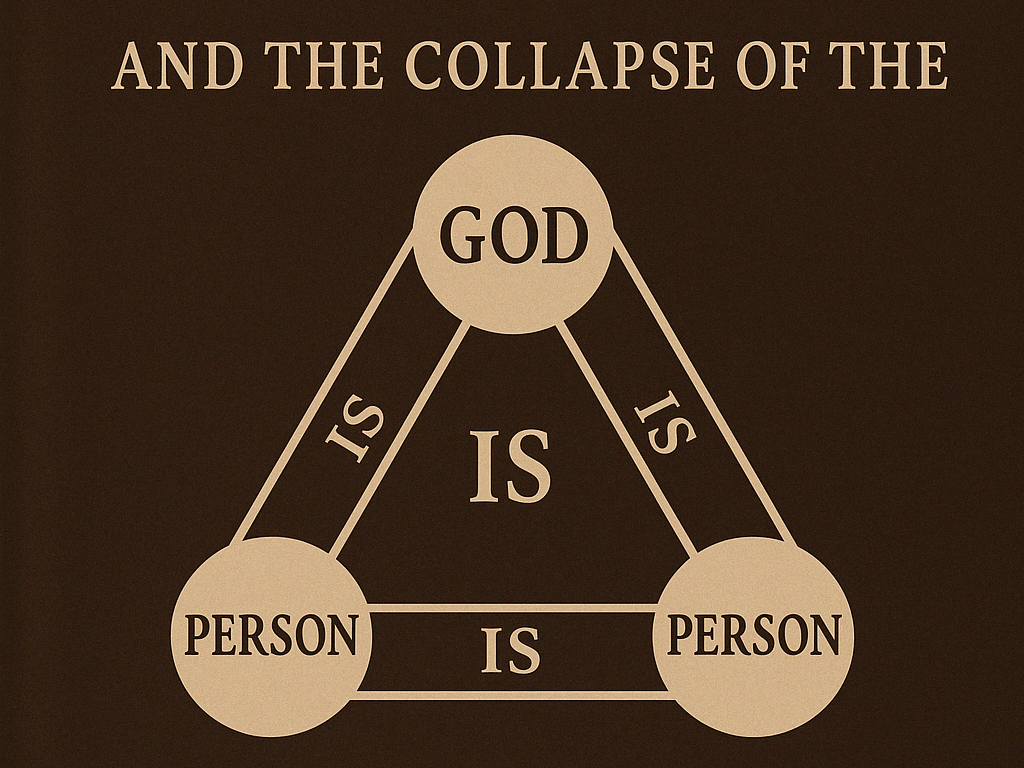
The doctrine of the Trinity is often regarded as complex and has long been the subject of serious theological and philosophical debate. One recurring issue concerns the law of identity and how it relates to the persons and essence of God. A recent conversation among friends put the challenge in the form of a simple argument:
1. If Trinitarianism is true, then either the hypostases are identical to the ousia, or they instantiate the ousia.
2. But the hypostases are neither identical to the ousia nor instantiate the ousia.
3. Therefore, Trinitarianism is false.
In response, Jimmy Stephens offered the following:
Premise 1:
A) Refutes itself. Suppose we apply this principle to the whole of reality, whatever we take that to be. Surely we think it is identical with itself, but that identity neither comports to a singular ousia nor an instantiation. If reality’s self-identity is a case of instantiation, that just mean everything that exists is an instantiation of raw “reality.” That is monism of the emptiest sort. If reality’s self-identity is cashed out in terms of a singular ousia, then you have one being enveloping all reality, similar to pantheism. Such monism does not comport with the dichotomies and opposites found in the world. Either way, this dichotomy falls short.B) Cannot be justified. Ask Christ: the best he has is question-begging appeals to intuition. On Trinitarianism, Scriptural testimony to the Trinity trumps an unbeliever’s appeals to intuition. So much for that.
It’s monism because it’s the idea of reality (as more than a concept) being a mirror of the concept of itself.
What does that even mean?
What distinguishes the two?
If nothing, then it’s not an instantiation at all.
If something, then how is one not something else entirely?
When we usually talk about instantiation, we’re talking about a principle, universal, concept, law, or some such abstracta having a concrete application or representative or something like that. An instantiation of pie is a cherry pie.
But that presupposes a duality. You have the abstracta and the concreta.
You have the transcendent, unchanging thing, and you have its time-and-space representative.
But reality here is just a placeholder for our entire picture of the cosmos.
By definition, there’s nothing beyond it, nothing that transcends it, nothing that isn’t part of it.
(For a Christian, that means God and creation. There is no “third man” to that duo.)
Now, presumably, he wants to say reality is identical to itself.
If he cashes out that identity in terms of instantiation, he needs a “reality” transcending reality to be instantiated.
That makes no sense.
 The Council