
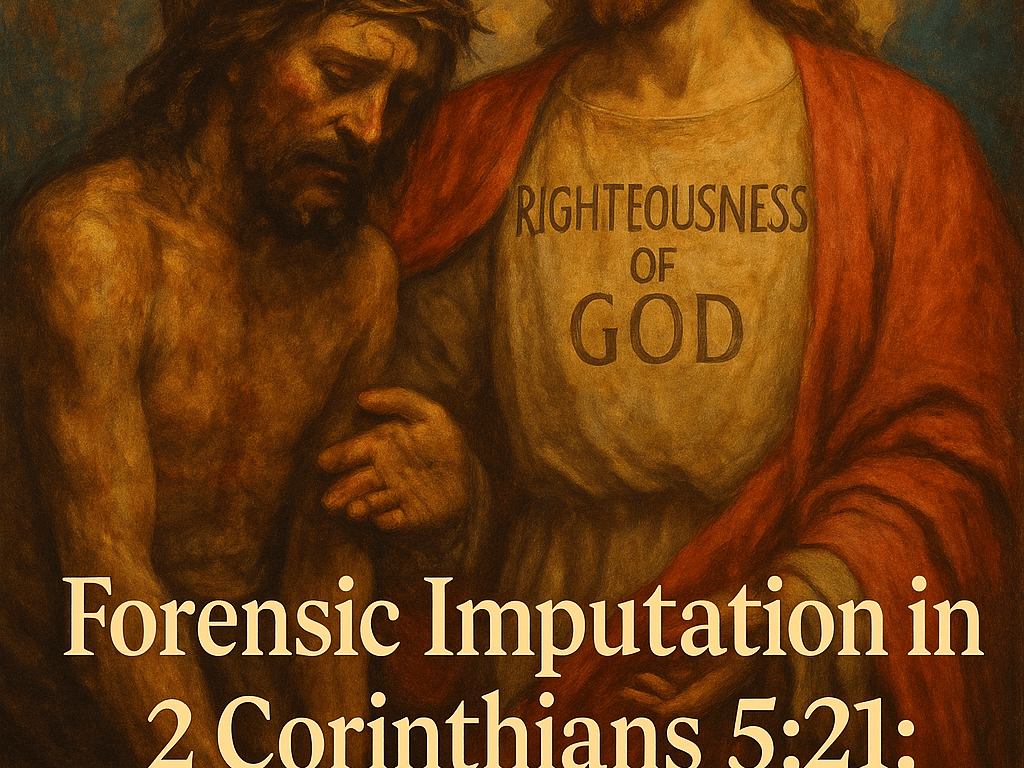
In his exegesis of 2 Corinthians 5:21, Erick Ybarra argues against the traditional Protestant understanding of forensic imputation, proposing instead that Paul teaches ontological transformation through union with Christ. According to Ybarra, Christ was “made sin” by assuming the Adamic condition of mortality, while believers “become the righteousness of God” through actual ontological renewal rather than imputed righteousness. While Ybarra’s emphasis on union with Christ contains valuable insights, his interpretation ultimately fails to account for Paul’s consistent forensic framework and the text’s substitutionary logic.
I. The Forensic Foundation: Reconciliation as Non-Imputation (vv. 18-19)
Paul frames the entire discussion of 2 Corinthians 5:18-21 within the concept of reconciliation, which he explicitly defines as God “not counting [μὴ λογιζόμενος] their trespasses against them” (v. 19). This foundational statement establishes the forensic nature of the argument that follows.
The verb λογίζομαι carries unmistakable forensic connotations throughout Paul’s writings. As Charles Lee Irons demonstrates in The Righteousness of God: A Lexical Examination of the Covenant-Faithfulness Interpretation, this term consistently denotes judicial reckoning rather than ontological transformation:
“In Pauline usage, λογίζομαι when used in the passive or divine passive voice, especially in soteriological contexts (e.g., Rom 4:3, 4:5–8, 2 Cor 5:19), invariably refers to a forensic reckoning of status before God’s tribunal, not to an ontological transformation or moral renovation within the believer.” (Irons, 252)
This forensic framework finds its closest parallel in Romans 4:6-8, where Paul quotes David’s declaration that the blessed person is one “to whom the Lord will not impute sin” (ᾧ οὐ μὴ λογίσηται κύριος ἁμαρτίαν). The conceptual link between these passages suggests that Paul’s theology of reconciliation operates consistently within judicial categories. Reconciliation is not primarily about ontological renewal but about the removal of legal barriers between God and humanity.
II. “Made Sin”: Judicial Substitution, Not Ontological Transformation
Ybarra’s interpretation of Christ being “made sin” (ἁμαρτίαν ἐποίησεν) as an assumption of Adamic mortality represents a creative but ultimately unsustainable reading. Paul’s careful qualification that Christ “knew no sin” (ὁ μὴ γνόντα ἁμαρτίαν) excludes any notion of moral contamination or guilt. However, the solution is not to retreat into ontological categories but to recognize the judicial nature of Christ’s sin-bearing.
Murray J. Harris provides crucial insight into the sacrificial background of Paul’s language:
“The expression ‘made sin’ finds its most natural explanation against the backdrop of the Levitical sacrificial system, where ἁμαρτία frequently denotes a ‘sin offering’ in the LXX (e.g., Lev 4:24; 5:12; 6:25). Yet Paul’s usage transcends mere ritual symbolism to embrace the reality of penal substitution—Christ bore not only sin’s ceremonial representation but its actual judicial penalty.” (Harris, 451)
Mark Seifrid clarifies the judicial mechanics of this transaction:
“Christ did not become a sinner ontologically, but was constituted sin forensically—that is, he was judicially appointed to bear sin’s condemnation. This implies not moral contamination but legal substitution in which the innocent bears the penalty due the guilty.” (Seifrid, 263)
C.K. Barrett’s commentary reinforces this forensic reading:
“Christ came to occupy that position before God which is normally the consequence of sin—separated from divine favor and subject to divine judgment. He was made sin in the sense that he endured the judicial consequences that sin deserves, becoming the object of God’s wrath against human rebellion.” (Barrett, 180)
The phrase “made sin” therefore describes Christ’s judicial appointment as sin-bearer rather than any ontological transformation into fallen humanity. God treated Christ as if he were sin itself, subjecting him to the full weight of divine judgment that human rebellion deserves.
III. “Becoming the Righteousness of God”: Imputed Status, Not Infused Quality
Ybarra’s interpretation of believers “becoming the righteousness of God” (γενώμεθα δικαιοσύνη θεοῦ) as ontological renewal faces significant exegetical obstacles. The phrase δικαιοσύνη θεοῦ carries consistent forensic connotations throughout Paul’s corpus, referring to a status declared by God rather than a quality infused by God.
Irons provides extensive lexical analysis demonstrating the forensic nature of this phrase:
“In the construction δικαιοσύνη θεοῦ, the genitive θεοῦ functions as a genitive of source or authorship, indicating righteousness that originates from God’s judicial declaration. This represents a status of acquittal pronounced by the divine judge, not an internal transformation effected by divine power.” (Irons, 276)
The theological consistency of Paul’s argument requires reading 2 Corinthians 5:21 in light of his fuller exposition in Romans 1:17 and 3:21-26, where “the righteousness of God” is revealed in the gospel and received through faith apart from works of law. This righteousness is fundamentally a gift of divine favor, not a quality of human character.
Colin Kruse confirms this forensic interpretation:
“To become the righteousness of God signifies being placed in right relationship with God through divine adjudication rather than through moral transformation. This righteousness is not inherent to the believer but declared by God on the basis of union with Christ.” (Kruse, 174)
Seifrid emphasizes that the language of “becoming” denotes a change in status rather than essence:
“Paul employs the verb γίνομαι not to describe ontological transformation but to indicate a change in judicial standing. The believer ‘becomes’ righteous in the same sense that Christ ‘became’ sin—through divine declaration rather than essential change.” (Seifrid, 266)
IV. The Architecture of Exchange: Chiastic Structure and Double Imputation
The literary structure of 2 Corinthians 5:21 reveals Paul’s theological logic through a carefully constructed chiasm:
A: Christ—knew no sin
B: Made sin
B’: We—become righteousness
A’: In Him
This chiastic arrangement emphasizes the complete exchange between Christ and believers: Christ receives our sin judicially, while we receive his righteousness judicially. The parallelism is not ontological but forensic, involving the transfer of legal liability and merit rather than moral qualities.
Barrett, Irons, and Seifrid all recognize this structure as expressing the doctrine of double imputation:
“Paul presents in verse 21 the clearest articulation of double imputation found anywhere in his writings: Christ receives the judicial burden of our sin while we receive the judicial benefit of his righteousness. Both transactions are forensic in nature, involving God’s declaration rather than moral transformation.” (Irons, 301)
The absence of the explicit term λογίζομαι in verse 21 does not negate the forensic nature of the exchange. The forensic framework established in verse 19 continues to govern Paul’s argument. As Irons explains:
“The forensic logic flows uninterrupted from verse 19 to verse 21. Verse 21 provides the theological explanation for how God can refrain from imputing sin to believers (v. 19): their sins were imputed to Christ, who bore them as their substitute.” (Irons, 284)
V. New Creation as Consequence, Not Cause (vv. 16-17)
Ybarra attempts to synthesize the “new creation” language of verse 17 with the “righteousness” language of verse 21, arguing that both refer to ontological transformation. However, careful attention to Paul’s theological sequence reveals that new creation results from reconciliation rather than constituting it.
Seifrid clarifies the causal relationship:
“The new creation described in verse 17 and the righteousness received in verse 21 are not synonymous but sequential. Forensic justification provides the foundation upon which moral renewal is built. The new relationship with God established through imputed righteousness enables the new life of sanctification.” (Seifrid, 255)
Barrett concurs with this understanding:
“Just as believers no longer evaluate Christ according to fleshly categories, they now assess all reality in light of the cross. The judicial verdict of justification, grounded in Christ’s substitutionary death, transforms the believer’s entire worldview and moral orientation.” (Barrett, 181)
The “new creation” therefore represents the fruit of forensic justification rather than its essence. Ontological transformation flows from forensic declaration, not vice versa.
VI. Union with Christ as the Context of Imputation
A crucial element often overlooked in discussions of imputation is Paul’s emphasis that believers become righteous “in him” (ἐν αὐτῷ). This phrase indicates that forensic imputation occurs within the relational context of union with Christ rather than as an abstract legal transaction.
Irons provides important clarification on this point:
“The believer does not become righteous through direct infusion of divine essence or through autonomous moral achievement. Rather, the believer becomes righteous by being united to the one who is inherently righteous. Union with Christ provides the relational framework within which forensic imputation operates.” (Irons, 310)
This understanding resolves the false dichotomy between forensic and relational categories. Imputation is not a cold legal fiction but occurs within the warm reality of spiritual union. Christ’s righteousness becomes ours not through ontological fusion but through covenantal solidarity.
Conclusion: The Gospel of Substitutionary Grace
Ybarra’s attempt to reinterpret 2 Corinthians 5:21 through ontological categories, while motivated by legitimate concerns about maintaining the reality of union with Christ, ultimately obscures Paul’s clear teaching on substitutionary atonement and forensic justification. The lexical evidence, syntactical structure, and theological logic of the passage consistently point toward a forensic exchange in which Christ bears the judicial consequences of sin while believers receive the judicial benefits of righteousness.
The righteousness that believers “become” is not infused into their being as an ontological quality but declared over them as a forensic status. This righteousness remains located “in Christ” rather than inherent within the believer. As Irons concludes:
“Paul’s gospel is not the theology of Trent, with its emphasis on infused righteousness and gradual sanctification. It is the theology of substitutionary grace, in which God’s justice is satisfied through Christ’s sacrifice and God’s mercy is extended through imputed righteousness.” (Irons, 315)
This forensic understanding preserves both the objectivity of salvation (grounded in Christ’s finished work) and the subjectivity of salvation (experienced through union with Christ). The gospel is neither merely legal nor merely relational but both simultaneously—a judicial declaration that creates a new relationship and a new relationship that rests upon a judicial foundation.
Paul’s logic in 2 Corinthians 5:21 remains elegantly simple: Christ was treated as sin in a judicial sense so that believers might be treated as righteous in a judicial sense. This is the heart of the gospel—not the gradual transformation of sinners into saints, but the instantaneous declaration of rebels as righteous through the substitutionary work of Christ. It is this gospel that reconciles the world to God and makes all things new.
 The Council