
By Jimmy Stephens
1) Partialism, Composition, and the Real Hinge-Point
I think the partialism thing hinges on whether and why you believe composition is a metaphysical contingency-maker or whatever.
I think God’s non-composite because I think composition entails dependence, contradicts aseity, is incompatible with immutability, etc.
But if someone doesn’t believe that, like the Trinitarian parialists don’t, then I think you have two ways forward:
you can critique the theology on other key doctrines,
Or
you can investigate their divine mereology,
For unitarians, in most cases, I probably wouldn’t bother with the latter. The topic is too abstract. Unless I’m talking with someone who affirms Tawhid or something like it (spelling?), I would always defer to the former strategy for the sake of persuasiveness.
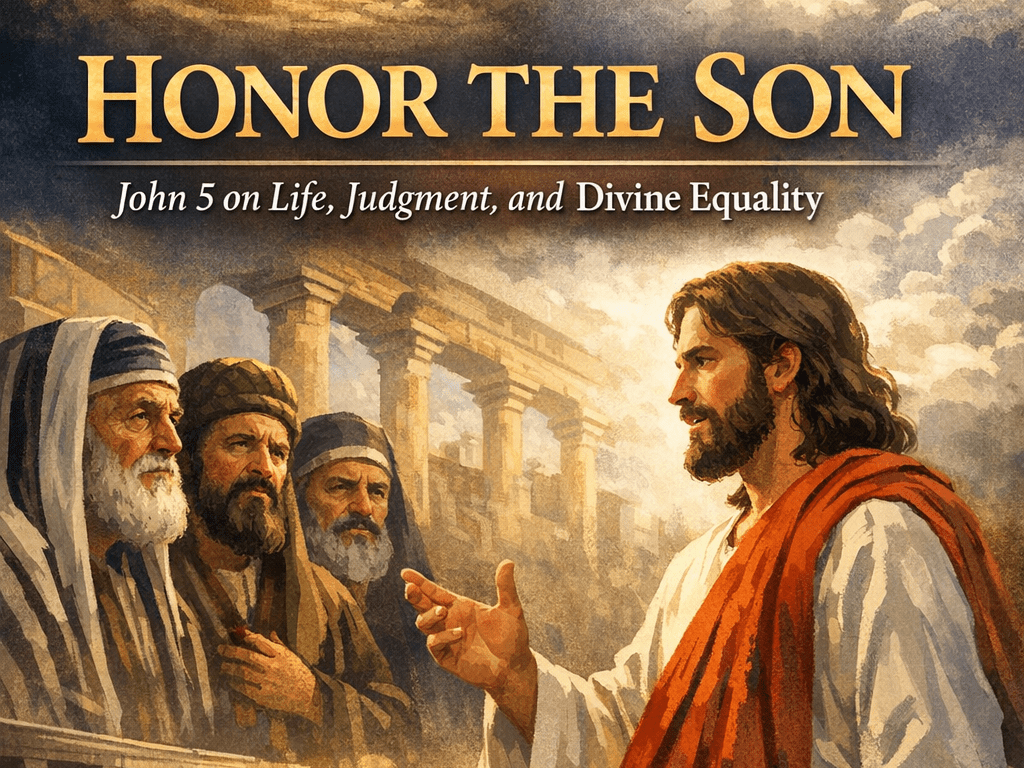
2) John 5’s Setup: The Pool Miracle, the Sabbath, and “Equal with God”
John 5:16
Now because Jesus was doing these things on the Sabbath, the Jewish leaders began persecuting him.
5:16
What had Jesus just done? He healed the lame man at the pools.
John 5:17–18
So he told them, “My Father is working until now, and I too am working.” For this reason the Jewish leaders were trying even harder to kill him, because not only was he breaking the Sabbath, but he was also calling God his own Father, thus making himself equal with God.
What precedes the upcoming text at 26-27 is Christ’s messianic proof of deity. Jesus establishes who he is at the beginning of this chapter by doing divine works and establishing equal authority with God.
John elucidates:
John 5:19–20
[T]he Son can do nothing on his own initiative, but only what he sees the Father doing. For whatever the Father does, the Son does likewise. For the Father loves the Son and shows him everything he does, and will show him greater deeds than these, so that you will be amazed.
What is Jesus speaking about here? His previous miracle especially, but divine miracles like that in general. He’s talking about the messianic works he accomplishes that establish His Deity.
Now
Here are the two really big concepts being introduced that EG proponents completely ignore.
John 5:21–23
For just as the Father raises the dead and gives them life, so also the Son gives life to whomever he wishes. Furthermore, the Father does not judge anyone, but has assigned all judgment to the Son, so that all people will honor the Son just as they honor the Father.
John 5:21-22
The two concepts here are life-giving and judgment.
3) Life-Giving and Judgment: The “EG Quote Mine” in Context
Just as the Father creates and recreates life, so does the Son, imaging His Father. Just as the Father judges souls on Judgment Day, so will the Son, imaging His Father. These are two instances sandwhiched in a paragraph that elucidates: “he was also calling God his own Father, thus making himself equal with God.”
What only God has the right and power to do, Jesus does.
Jesus proves this by carrying out these works that only God has the right and power to do as an imaging of God the Father.
The implication in the background is brought to the fore with the next sentence:
John 5:23 (end)
The one who does not honor the Son does not honor the Father who sent him.
This gives bite to the earlier statement that Jesus was making himself equal to God. How was he making himself equal to God? In such a way that, to criticize Christ was to criticize God Himself.
However, the important part that EG proponents fumble over is that, this is an argument Jesus is making (a) to interpret the immediately prior miracle, and (b) to put forward two outstanding instances of his Father-imaging:
life power (creation of it, recreation of it),
role of the Judge,
Now, was there life created or recreated prior to creation? Was there a Judgment Day needing a judgment by a judge prior to creation? Are those essential attributes of God? Come now.
Having introduced life-giving and judgment, Christ connects those to his messiaship. He connects them to his salvific accomplishment.
John 5:24–25
I tell you the solemn truth, the one who hears my message and believes the one who sent me has eternal life and will not be condemned, but has crossed over from death to life. I tell you the solemn truth, a time is coming – and is now here – when the dead will hear the voice of the Son of God, and those who hear will live.
What is the life here? The recreation of fallen sinners. Jesus is characterizing the Gospel in terms of his life-granting power enacted through the hearing (believing) of his voice. Those who believe the Gospel receive new life and are saved from eternal death.
Christ also interlocks life-giving and judgment. Notice how receiving everlasting life comes with “and will not be condemned!” In other words, for Christ to give you new life is also for him to practice his divine power of judgment, to make you righteous before God. You do not stand condemned, but justified.
That is the context when we get to the EG quote mine verses:
John 5:26–27
For just as the Father has life in himself, thus he has granted the Son to have life in himself, and he has granted the Son authority to execute judgment, because he is the Son of Man.
This is synonymous with saying:
Just like the Father has power to grant life because He’s God, so the Son also has power to grant life, and just the same, the Son is the Judge because He is Daniel’s Son of Man.
Life here is not existence.
Life here is not a mere animation principle.
Remember, Jesus is talking about life-giving and judgment. He’s talking about the Father having life in Himself in the sense that He has life to give in no limited amount or derivative quality. Just as the Father can give you life because He has that power in and of Himself, so too can the Son.
This is interlocked with judgment. Just as the Father has the right to judge you in and of Himself, because He’s God, so too the Son. Jesus is Immanuel, the cloud rider, God-come-to-His-own, the Mediator.
The very next sentences vindicate this reading further:
John 5:28–29
Do not be amazed at this, because a time is coming when all who are in the tombs will hear his voice and will come out – the ones who have done what is good to the resurrection resulting in life, and the ones who have done what is evil to the resurrection resulting in condemnation.
This is not talking about aseity or trinitarian theology itself.
Certainly, it is implicitly Trinitarian, necessarily Trinitarian, but it is Trinitarian by implication and not by subject matter.
Jesus isn’t doing systematic theology on the difference between the Son and Father.
Jesus is defending his miracle at the pools by interpreting his miracle as a Messianic work of the Son who images the Father, specifically as one who inherits the Father’s life-giving and judging role, and so who must be the Son of the Father, the Second Person of God.
John 5:30
I can do nothing on my own initiative. Just as I hear, I judge, and my judgment is just, because I do not seek my own will, but the will of the one who sent me.
Remember: life-giving and judgment come hand-in-hand. What applies to the one applies to the other. Just as Jesus does not judge except on the basis of the Father’s plan who sent him, so also, he does not give everlasting life except on the basis of the Father’s power, who gives it to him through the Spirit.
Watch Jesus a few verses later sum-up this issue as a Gospel issue hinging on their rejection of his Messiaship, which is why they condemned his miracle at the pools.
John 5:36
For the deeds that the Father has assigned me to complete – the deeds I am now doing – testify about me that the Father has sent me.
What deeds?
His miracles that he performed in human flesh.
This is talking about his Incarnate Messiaship, not His eternal deity.
Does it entail His Sonship, Deity, and other things about them? Absolutely! Is it the topic matter? No.
Christ cannot be the Messiah unless He is God. But saying Christ is the Messiah is not identical to saying He’s God.
He declares His Sonship in light of his Incarnate messianic miracles, not by citing something about receiving the essence or being generated in eternity or talking about how aseity works, etc.
Futher Suggestion:
- The “Is Eternal Generation Biblical?” article presses (1) a critique of making Nicene reception function like an extra canon, and (2) an exegetical critique of reading “only-begotten” language as literal “derivation,” including discussion of monogenēs as “unique” rather than “begotten.” The Council
- It also directly targets John 5:26 as a common EG prooftext, arguing that “life” in-context is the same life the Son gives (i.e., eschatological/salvific life), and that the thrust is the Son’s equality in the prerogative of giving life and executing judgment. The Council
- The “Proverbs 8, Aseity, and Generation” piece engages Proverbs 8:22–26 by (a) foregrounding the “Lady Wisdom” frame, (b) challenging a straight line from Proverbs 8 to John 1, and (c) discussing the interpretive options for qānānî (possess/create/beget) and how metaphorical “begetting” functions in wisdom literature. The Council
- It also expands the John 5:26 point with a caution against over-reading “in himself” as if it can’t be said (in a derivative, gospel sense) of believers (e.g., the John 6:53 parallel), drawing on commentary material to reinforce the “present possession of eternal life” reading. The Council
 The Council