

——Against the Claim That Personhood Begins at First Breath
I recently engaged in a dialogue with someone over when a human being becomes a person. He holds that the Bible teaches a person comes into existence at first breath, and he raised several objections to more traditional pro-life arguments.
The passage Luke 1 states:
Luke 1:15 ““For he will be great in the sight of the Lord; and he will drink no wine or liquor, and he will be filled with the Holy Spirit while yet in his mother’s womb.”
My interlocutor states this:
“The baby in Elizabeth’s womb didn’t have the Holy Spirit. If you think this is what the passage says, you’re misinterpreting it.
Luke 1:15 says that he “WILL BE great in the sight of the Lord, and he WILL drink no wine or liquor, and he WILL BE filled with the Holy Spirit, while yet (in the future) separated from (ek koilias) his mother’s womb.”
These words are translated into the English as “will be” because they are in the future tense in the Greek. Proper interpretation of Scripture comes only after understanding what is being said in the original language as written by the human author.”
Even pro-abortion scholars recognize that this is saying that John the Baptist will have the Spirit while he is in his mother’s womb. This is from Dr. Daniel McClellan work arguing something similar:
The interpretive problems here are even clearer. To begin, this is another example of a rhetorical exception to the rule, and it is also not generalizable to all humans. The author makes this pretty explicit in verse 15 by explaining that John would be filled with the holy spirit even within the womb. The author isn’t saying this because it’s normal, but precisely because it’s not. The author wants to emphasize that John is a shocking exception to the norm. The fetal leap is described as a unique, supernaturally orchestrated event, and it is Elizabeth who interprets it as a leap “for joy.” But fetuses do not experience emotions like joy. Those only begin to develop after birth. A fetus also can’t identify a woman they’ve never met by her voice alone, much less know the identity and mission of the fetus she herself is carrying based only on hearing her voice.
Notice the trained and highly motivated scholar desperate to argue the Bible teaches abortion is fine is forced to admit that verse 15 is damning and just an exception. I won’t respond to Dan just yet as a longer response is in the works. But he just states this doesn’t prove any exception except these especially divine births. So what greek terms are my opponent appealing to to get around this?
15 ἔσται γὰρ μέγας ἐνώπιον τοῦ κυρίου,
for he will be great before the Lord,
καὶ οἶνον καὶ σίκερα οὐ μὴ πίῃ,
and wine and strong drink he shall certainly not drink,
καὶ πνεύματος ἁγίου πλησθήσεται
and he will be filled with the Holy Spirit
ἔτι ἐκ κοιλίας μητρὸς αὐτοῦ,
even/still from his mother’s womb.
the phrase ἔτι ἐκ κοιλίας μητρὸς αὐτοῦ is the one in contention. But there seems to be no justification for taking the phrase to mean anything than what we expect it to mean.
Positively, John was to be filled with the Spirit. The activity of the Spirit is stressed in the birth narrative (1:35, 41, 67; 2:25, 26, 27) and throughout the Gospel (3:16, 22; 4:1, 14, 18; 10:21; 11:13; 12:10, 12) and Acts (H. von Baer, Der Heilige Geist in den Lukasschriften, Stuttgart, 1926; E. Schweizer, TDNT VI, 404–415). In the birth narrative the emphasis is on prophetic inspiration heralding the arrival of the new era. πίμπλημι is almost exclusively Lucan; it is used of filling, especially with the Spirit (1:41, 67; Acts 2:4; 4:8, 31; 9:17; 13:9), but also with fear, anger, et al. (4:28; 5:7, 26; 6:11); it can mean ‘to fulfil’ (1:23, 57; 2:6, 21, 22; 21:22); cf. πληρής, 4:1; 5:12; πληρόω, 1:20; et al.; G. Delling, TDNT VI, 128–131. In John’s case the gift of God was present with him from his mother’s womb. κοιλία is the ‘belly’ or internal organs, especially the ‘stomach’ (15:16); following LXX usage it is often used for the ‘womb’ (1:41, 42, 44; 2:21; 11:27; 23:29; J. Behm, TDNT III, 786–789). For the phraseology here cf. Jdg. 13:5, 7; 16:17; Pss. 22:9f.; (21:10f.);; 71:6 (70:6); Is. 49:1, 5; Je. 1:5; Sir. 49:7; 1QH 9:29–31; Mt. 19:12; Acts 3:2; 14:8; Gal. 1:15. The language expresses divine choice and care of a person from his very birth, but here in connection with 1:41–44 a pre-natal sanctification of John is implied; even before he was born, the hand of God was on him to prepare him for his work (Lagrange, 17). Thus in the strongest possible way the divine choice of John for his crucial task is stressed.
I. Howard Marshall, The Gospel of Luke: A Commentary on the Greek Text, New International Greek Testament Commentary (Exeter: Paternoster Press, 1978), 58.
A critical commentator states it:
The standing expression, “even from his mother’s womb,” has its roots in the language of prophetic calling, and had revived in the first century (see Gal 1:15). “Even” (ἔτι) clarifies “from” (ἐκ): John will receive the Spirit even before birth. Instead of the effects of alcohol, used in some of the pagan mantic practices, there is the welcome influence of the Spirit; Eph 5:18 expresses the same antithesis and emphasizes wisdom as the fruit of this sort of inspiration.
François Bovon and Helmut Koester, Luke 1: A Commentary on the Gospel of Luke 1:1–9:50, Hermeneia—a Critical and Historical Commentary on the Bible (Minneapolis, MN: Fortress Press, 2002), 36–37.
We should also point out that the language is as the commentator said as a common idiom to point out that some men are chosen by God from conception to be prophets. The phrase “from his mother’s womb” is already a standard biblical idiom. The LXX uses it in places like Judges 16:17, Job 1:21, and Psalm 71:6. That means Luke 1:15 is not inventing a new technical phrase meaning “after separation from the womb.” He is using familiar womb-origin language. So the burden is on my opponent to explain why a known biblical idiom suddenly becomes an obstetric statement about post-birth existence in Luke.
Ascetic qualities will not be John’s only, or chief, credentials, however. His abstention from alcohol may indicate his acknowledgment of being “filled with the Holy Spirit,” which does not depend on his choice or virtue, but on God’s prevenient election in the womb of his mother (v. 15). Others also had been set apart from their mothers’ wombs by God’s Spirit—Samson (Judg 13), the Servant of the Lord (Isa 49:1), Jeremiah (Jer 1:5), Paul (Gal 1:15)—but whereas they were intermediary links in God’s plan, John is the final link preparing the way for one whose “kingdom will never end” (v. 33).
James R. Edwards, The Gospel according to Luke, ed. D. A. Carson, The Pillar New Testament Commentary (Grand Rapids, MI; Cambridge, U.K.; Nottingham, England: William B. Eerdmans Publishing Company; Apollos, 2015), 37.
Judges 16:17 — Samson is a Nazirite from his mother’s womb. That is plainly consecration and origin language, not a pointless post-birth comment.
Job 1:21 — “naked I came from my mother’s womb.” Again, standard womb-origin language.
Psalm 71:6 — “you brought me forth from my mother’s womb.” God’s sustaining relation is spoken of from the womb. Same idea: earliest origin, not post-birth separation.
Future Tense
Gabriel is speaking before John’s life unfolds. So the angel naturally describes John’s whole vocation in the future:
- he will be great
- he will not drink wine
- he will be filled with the Spirit
But the future tense only means “future relative to the moment of speaking.” It does not mean “after birth.” But it seems that we agree about this being prophetic, but we disagree about the fulfillment of it. This person has gone one to argue after this was pointed out:
The baby in Elizabeth’s womb didn’t have the Holy Spirit. If you think this is what the passage says, you’re misinterpreting it.
Luke 1:15 says that he “WILL BE great in the sight of the Lord, and he WILL drink no wine or liquor, and he WILL BE filled with the Holy Spirit, while yet (in the future) separated from (ek koilias) his mother’s womb.”
These words are translated into the English as “will be” because they are in the future tense in the Greek. Proper interpretation of Scripture comes only after understanding what is being said in the original language as written by the human author.
Your appeal to the future tense doesn’t prove what you think it proves. πλησθήσεται is future because Gabriel is speaking prophetically before John’s life unfolds. That only means the filling is future relative to the angel’s speech, not that it begins after birth. Wallace makes exactly this point about the future tense in general: even when a future verb sits in a context that may tempt someone to load extra timing nuance into it, “the future in itself says none of this.” He classifies this as the ordinary predictive future “it will happen.”


Christian has responded to my brief comments about this:
As I have said, you’re misinterpreting this passage. What method for properly interpreting Scripture are you following?
Look at vs 14 and 15 again:
Luke 1:14-15
“And thou shalt have joy and gladness; and many shall rejoice at his birth. For he shall be great in the sight of the Lord, and shall drink neither wine nor strong drink; and he shall be filled with the Holy Ghost, even from his mother’s womb.”Notice in vs 14 the angel says “many will rejoice at his BIRTH” not his conception, nor at his development in the womb. His BIRTH. Why rejoice at his birth, rather than when he is conceived, or while he’s in the womb?
The answer is they rejoice at his birth because this is when God breathes soul life into every person. Same with Christ. The angels rejoiced at His birth, not His conception, because this is the point at which His soul life was imputed to His biological life, and He became a human life.
Also notice in vs 15, the angel says he “shall drink neither wine nor strong drink.” Do you also think the angel is referring to his time in the womb here? Of course not. The angel is speaking about once he is born, at which point he will receive soul life, all of the things mentioned will be possible and can occur.
Your argument is loaded with false dichotomies. I do think the prophecy speaks both to John’s consecrated lifestyle and to his prenatal Spirit-endowment for the task of preparing the way of the Lord. Those are not mutually exclusive. “He will drink neither wine nor strong drink” describes one feature of his vocation and manner of life. “He will be filled with the Holy Spirit, even from his mother’s womb” has its own explicit qualifier telling you how early that particular reality applies. You keep acting as though if one clause clearly has postnatal relevance, then every clause must be flattened into the exact same timeframe. That is not interpretation.
And your appeal to verse 14 is just a non sequitur. The fact that “many will rejoice at his birth” does not imply that personhood begins at birth or that God only gives “soul life” then. Birth is the public arrival of the child, the moment at which the promised son becomes visible to the community and can be openly celebrated. That tells you why many rejoice then. It tells you nothing about whether John was already a real human person in the womb. Christians celebrate births all the time without thinking the person only begins at birth. So the move from “people rejoice at birth” to “therefore the soul is given at birth” is not exegesis. It is your anthropology being read into the narrative.
The same problem shows up in your appeal to the “wine and strong drink” clause. No, I do not think Luke is saying John is literally drinking in the womb. But that does not help your case. Different predicates can apply in different ways and at different stages. A lifelong Nazirite-like pattern can be one feature of the prophecy, while Spirit-filling can have an explicitly prenatal onset. The text itself gives that onset marker: “even from his mother’s womb.” You do not get to erase that qualifier simply because another clause in the same sentence describes a lifestyle that becomes outwardly operative after birth. That is like arguing that because one prophecy includes adulthood ministry, nothing else in the prophecy can apply earlier. It is arbitrary.
More fundamentally, your whole argument depends on a claim Luke never makes: that God “breathes soul life” into every person at birth. But Luke does not say that. He says many will rejoice at John’s birth, and he says John will be filled with the Holy Spirit even from his mother’s womb. The first is about public celebration; the second is about divine empowerment. You are the one collapsing them into a theory of ensoulment and then calling that “proper interpretation.”
Origins or Separation
He’s basically arguing like this:
- ἐκ can mean “out of,” so ἐκ κοιλίας must mean “out of the womb” in the sense of after exiting the womb (“separated from”). For example, in Mark 10:14 it states that “shake the dust from your feet”. The term “from” is the same as ἐκ and thus can mean to seperate,
- Therefore Luke 1:15 isn’t saying anything prenatal; it’s saying John will be filled with the Spirit after birth.
- And he tries to reinforce it by leaning on the fact that πλησθήσεται is future (“will be filled”), as if future tense itself implies a post-birth timeline.
He woodenly glosses of ἐκ and overloading the future tense implies that it is not prenatal.
You determine which relationship you have from (a) the governing word (verb/noun/adjective), and (b) the construction, including any preposition.
Wallace explains that the issue is not that the idea of source disappeared in Koine Greek, but that the older simple genitive was often replaced by a prepositional phrase to make the relationship explicit:
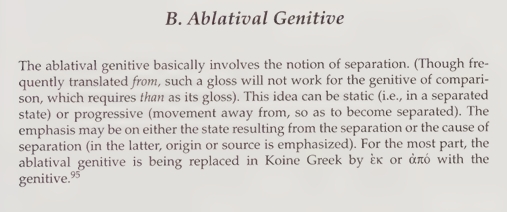
“The genitive substantive is the source from which the head noun derives or depends. As such, this use is generally a rare category in Koine Greek. For the word of supply the paraphrase out of, derived from, dependent on, or ‘sourced in.’ Again, as with the genitive of separation, the simple genitive is being replaced in Koine Greek by a prepositional phrase (in this instance, ἐκ + gen.) to indicate source.”
Daniel B. Wallace, Greek Grammar Beyond the Basics (Grand Rapids: Zondervan, 1996), 109–10.
That matters because it means ἐκ + genitive is exactly the sort of construction you would expect if an author wanted to express source/origin more clearly. In other words, ἐκ κοιλίας is not some strange reading if taken as “from the womb” in an origin-point sense. It is standard Koine explicitness.
And Wallace further cautions that the distinction between source and separation is not a rigid rule:
“The distinction between source and separation, however, is more difficult to call. Frequently, it is a matter merely of emphasis: separation stresses result while source stresses cause.”
Wallace, Greek Grammar Beyond the Basics, 110.
He then adds the point that especially helps here:
“This is also true in the prepositional constructions, for separation can be represented either by ἐκ or ἀπό, while source is usually restricted to ἐκ.”
Wallace, Greek Grammar Beyond the Basics, 110.
If anything, his framework makes ἐκ with the genitive the natural place to look for an explicit source/origin sense.
And when Wallace defines the genitive of separation, he ties it to a lexical idea of departure or motion away:
“Only if that word, usually a verb, connotes motion away from, distance, or separation can the genitive be one of separation.”
Wallace, Greek Grammar Beyond the Basics, 108.
That is exactly the problem for the “after birth” reading in Luke 1:15: there is no exit-verb there. Luke does not say John came out of the womb and was then filled. He says he will be filled ἔτι ἐκ κοιλίας μητρὸς αὐτοῦ.
A preposition is just a small linking word that marks a relationship—words like “from,” “to,” “in,” “with,” “by,” “through.” Greek uses prepositions the same way. For example, ἐκ means “from / out of.” The genitive is a case—a noun ending that signals a relationship between words. Think of it like how English suffixes can signal relationships or functions (e.g., hike → hiking marks an activity; enjoy → enjoyment marks a state/thing). Some examples
- “of” (possession/association): “the word of God”
- “from” (source/origin): “chosen from the nations”
- “with” (content after “fill” verbs): “filled with the Spirit”
- and others
It’s not a single dictionary meaning. It’s a relationship-marker whose sense is determined by the construction and context. When Greek uses ἐκ with the genitive, the phrase commonly indicates source/origin—the point of derivation or beginning.
For instance, ἐκ τοῦ οἴκου means “from the house,” and idioms like ἐκ κοιλίας μητρός mean “from [the] mother’s womb.” That’s why it’s misleading to translate ἐκ κοιλίας as “separated from the womb” (as though it were an obstetric claim about post-birth existence). In ordinary Greek usage, ἐκ with a genitive is perfectly at home as origin-point language: “from the womb,” i.e., as early as that stage of life.
Your brief translation treats ἐκ as if it automatically means “separated from” sense. But Wallace’s categories don’t support that. In Koine Greek, ἐκ with the genitive commonly functions as source/origin language (“from/out of” as derivation), and Wallace explicitly tells you what paraphrases belong with this category:
“For the word of supply the paraphrase out of, derived from, dependent on, or ‘sourced in.’”
Daniel B. Wallace, Greek Grammar Beyond the Basics (Grand Rapids: Zondervan, 1996), pp. 109–110.
And he immediately adds the Koine tendency that matters here—source is often made explicit not by a bare genitive, but by the prepositional phrase ἐκ + genitive:
“Again, as with the genitive of separation, the simple genitive is being replaced in Koine Greek by a prepositional phrase (in this instance, ἐκ + gen.) to indicate source.”
Wallace, GGBB, pp. 109–110.
So the default grammatical direction of ἐκ with the genitive is not “post-exit separation,” but origin/source (“from”). Even if someone wants to argue that “separation” language is possible with ἐκ, Wallace explicitly cautions that the difference between “source” and “separation” is frequently a matter of emphasis and not a rigid semantic rule:
“The distinction between source and separation, however, is more difficult to call. Frequently, it is a matter merely of emphasis: separation stresses result while source stresses cause.”
Wallace, GGBB, pp. 109–110.
And then he gives a guideline that matters for this exact dispute:
“(This is also true in the prepositional constructions, for separation can be represented either by ἐκ or ἀπό, while source is usually restricted to ἐκ.)”
Wallace, GGBB, pp. 109–110.
When Greek wants to make these relationships explicit, source/origin is typically marked with ἐκ with the genitive, while separation is often marked with ἀπό with the genitive (and sometimes ἐκ) and even then, the line between “source” and “separation” is frequently just emphasis. That’s source/origin language: it identifies the starting point (“from the womb”). If Luke wanted the result idea (“away from / separated from”), the natural way to press that would be ἀπό-style separation phrasing or a verb that actually encodes separation.
In Wallace’s framework, “separation” is typically tied to lexical/semantic cues: a governing verb or context that implies movement away, distance, removal, etc.
Here, Luke isn’t describing John being removed from the womb. He’s describing the onset point of a condition (“filled with the Spirit”) and then adds an onset marker.
The appeal to “separation from the womb” also ignores how this phrase actually functions in biblical literature. It is stock scriptural language for a person’s origin, divine claim, consecration, and vocation from the earliest stage of life. That is why commentators regularly connect Luke 1:15 with prophetic and consecration texts such as Judges 13, Isaiah 44, Isaiah 49, Jeremiah 1, and Galatians 1. Marshall explicitly says the phrase expresses divine choice and care from the very beginning of a person’s life, and Garland says John’s prophetic role begins even before birth.
That matters because my opponent is acting as though “from the womb” must mean the opposite of prenatal reference, as though it can only mean “once separated from the womb.” But that is simply not how the idiom works. Fitzmyer says the phrase can mean either “from birth on” or “while still in the womb,” and he adds that in Luke 1:15 the latter sense is evident from Luke 1:41. Bock says the same thing: there is discussion over whether the phrase means “from birth” or “while still in the womb,” but Luke 1:41, with the testimony of the child in Elizabeth’s womb, argues for the latter rendering. So even if the phrase can be broad in the abstract, Luke’s own narrative context resolves the ambiguity in a prenatal direction.
In other words, “from the womb” here is likely prophetic vocation language. Scripture often uses womb-language to say that God’s purpose for a person reaches back before public life, before visible ministry, before birth itself. John is not being described as a nonperson who later receives divine regard once he exits the birth canal. He is being described as one whose consecration and Spirit-endowment reach back to the womb itself. That is exactly why the phrase fits so naturally in Luke 1:15: Luke is stressing not merely that John will someday be Spirit-filled, but that this divine marking begins shockingly early.
There is also a textual variant here, and it actually supports my reading of the passage. The variant “in the womb” does not support a post-birth reading; it points in a prenatal direction. What it shows is how the original was naturally understood by at least some early readers. The harder reading, “still from his mother’s womb,” preserves the broader biblical idiom of prophetic consecration and divine claim from the womb. The easier reading, “still in the womb,” is an interpretive smoothing that makes the prenatal force unmistakable. Thus the main text’s ἐκ κοιλίας retains the richer scriptural idiom, while the variant ἐν κοιλίᾳ—attested in W (Codex Washingtonianus, 032) and supported by some Old Latin and Syriac witnesses—simply makes explicit what the original already implies.
This matters because, if the original really meant only after separation from the womb, then ἐν κοιλίᾳ would be a strange scribal move. Why would a copyist take a supposedly clear post-birth statement and rewrite it into a more explicitly prenatal one? But if the original already carried the sense of divine marking from the womb itself, then the variant makes perfect sense: the scribe heard the prenatal force of the verse and rendered it more plainly. It shows ancient attestation for a prenatal understanding of the text, gives my reading real historical precedent, and explains the textual data more naturally than the post-birth alternative.
ἔτι
ἔτι is an adverb that commonly carries the force of “still / yet / even / already.” In this construction it functions as an earliness intensifier: it highlights how early the stated reality applies. The natural reading is:
“He will be filled with the Holy Spirit—even from his mother’s womb.”
That is ἔτι is adverbially modifying the prepositional phrase (“from the womb”) to sharpen it: as early as that point. To say that ἔτι is “adverbially modifying” the phrase simply means that it is functioning like an adverb. Which is adding force to ἐκ κοιλίας by stressing the timing: even/already/still from the womb. If you force ἐκ κοιλίας into “separated from the womb” (in the sense “after birth”), you end up making Luke say something like:
“He will be filled with the Holy Spirit—even after he’s separated from the womb.”
But that is a bizarre and rhetorically empty “even.” “Even after birth” isn’t a surprising intensification. Everyone else the believes will one day after their birth (if God grants) have the holy Spirit the default assumption. The whole point of ἔτι here is that Luke is stressing earliness
Louw–Nida classifies ἔτι (along with ἀκμήν and τὸ λοιπόν) under the semantic domain of time extension—an action or state continuing up to and beyond an expected point. They define it like this:
“extension of time up to and beyond an expected point—‘still, yet.’”
Johannes P. Louw and Eugene A. Nida, Greek-English Lexicon of the New Testament: Based on Semantic Domains (New York: United Bible Societies, 1996), 645.
And they illustrate ἔτι with exactly the kind of construction you’re pointing to—ἔτι with a genitive absolute / temporal clause:
ἔτι αὐτοῦ λαλοῦντος … “he was still speaking when…” (Mt 26:47)
Louw–Nida, 645.
This is the logic:
- ἔτι marks continuance (“still/yet”), i.e., something holds at a time when you might not expect it to hold, or “already at this point.”
- In Luke 1:15, ἔτι is paired with ἐκ κοιλίας (“from the womb”) to locate the Spirit-filling as early as that stage—still in the womb / already from the womb.
So before we even get into larger debates about tense or the semantics of ἐκ, ἔτι already pushes you away from the “post-birth separation” reading. The phrase reads most naturally as origin/onset language: shockingly early—already from the womb.
BDAG groups ἔτι under the semantic category “continuance” (“yet / still”), and then it explicitly distinguishes uses of ἔτι with present, past, and future reference. Under future reference BDAG gives Luke 1:15 as a direct example:
γ. of the future
πλησθήσεται ἔ. ἐκ κοιλίας he will be filled while he is still in his mother’s womb Lk 1:15
(ἔ. ἐκ κοι. Is 48:8; cp. 43:13 …)William Arndt et al., A Greek-English Lexicon of the New Testament and Other Early Christian Literature (Chicago: University of Chicago Press, 2000), 400.
BDAG literally cites Luke 1:15 under ἔτι with future reference and glosses it: “he will be filled while he is still in his mother’s womb.” So yes, the verb is future because prophecy. But the onset is specified by ἔτι ἐκ κοιλίας, and BDAG explicitly reads that as prenatal, not postnatal.
In the Lexham Syntactic Greek New Testament, Luke 1:15 is structured so that πνεύματος ἁγίου πλησθήσεται ἔτι is the segment clause, and ἐκ κοιλίας μητρὸς αὐτοῦ is the attached prepositional phrase.
Segment Clause
πνεύματος ἁγίου πλησθήσεται ἔτιPrepositional Phrase
ἐκ κοιλίας μητρὸς αὐτοῦAlbert L. Lukaszewski and Mark Dubis, The Lexham Syntactic Greek New Testament (Logos Bible Software, 2010), Luke 1:15.
So on Lexham’s syntactic analysis, ἔτι belongs with the Spirit-filling clause, while ἐκ κοιλίας μητρὸς αὐτοῦ functions as the attached prepositional phrase specifying the relevant point or stage. In other words, the syntax supports the sense, “he will be filled with the Holy Spirit, even/still from his mother’s womb,” not “he will be filled once separated from the womb.” The sentence is arranged so that ‘even/still’ goes with ‘he will be filled with the Holy Spirit,’ and ‘from his mother’s womb’ tells you the point at which that applies. So the natural sense is that John will be filled with the Holy Spirit already from the womb, not only after he leaves it.
This also fits Dr. Michael Heiser’s analysis of such:
First, the claim was that the Greek preposition ek not only means out of, from in Luke 1:15, thereby denoting that the child only had the Holy Spirit (and so, personhood in this logic) once he had exited the womb. Therefore, the child didn’t have the Spirit (and is not a person) while in the womb.
To overturn the claim we would need clear examples where ek indeed does denote location.” Put another way, we would need to find instances where the preposition does not speak of distance from the noun it governs (in Luke 1:15, that would be the womb), but rather at or in the noun it governs. If we find instances of this usage, the claim is undermined (and then the rules of logic can beat the snot out of it).
So, according to the scholars who produced the LSGNT, ek/ex has the syntactical force of location 53 times. The next step is naturally to look up the occurrences. A number of them are instances where Jesus is “at (ek) the right hand of God,” for example, which clearly intends to suggest nearness, not distance.It is telling that Luke 1:15 is in the list of results (not shown in the screen capture). The scholars who created this database saw the preposition ek in that verse as denoting location. We would not choose at or on for the translation, since either defies common sense that is, you cannot describe location with respect to a womans womb with at or on precisely because a womans womb is inside her body. Hence the best way to translate ek here would be with in to denote location. The certainty of this translation is secured by something the our pro-abortion theorist forgot (or never saw): the adverb eti (“still, yet”) immediately preceding the prepositional phrase. The whole phrase, then, is “yet/still in his mother’s womb.” Let me suggest that it makes zero sense to have John the Baptist having the Holy Spirit while still outside his mother’s womb. I’m just saying.
Even more interesting is Acts 14:8, also in the LSGNT result list. It is a word-for-word parallel (minus eti) to Luke 1:15 – “from (ek) his mother’s womb.” The verse in context reads as follows:
8 Now at Lystra there was a man sitting who could not use his feet. He was crippled from birth and had never walked.
Now here is the question: Can we really conclude that this man was only crippled after he had been born? Did the doctor or the midwife drop him? Did he pop out prematurely and hit the ground, incurring a paralyzing injury? I would suggest that his crippling condition could just as well have been congenital, incurred while in (ek) the womb of his mother. It would seem that a congenital condition is actually what is in mind in view of the negative adverb in the description, oudepote, which BDAG defines, “an indefinite negated point of time, never.”3 But I have no reason to believe that the author of the material promoting Luke 1:15 and the preposition ek as support for abortion ever even thought about analyzing all the occurrences of the preposition this way. It’s simply another case of cherry-picking a grammar (usually it’s a lexicon) to “prove” whatever point it is that one favors. Not only is it an exegetical fallacy; it’s an exegetical travesty (sounds like a good book title).
Abortion, Luke 1:15, and Syntactical Databases – Dr. Michael Heiser
For the portion from Wallace in question:


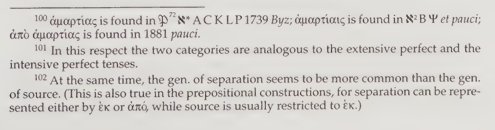

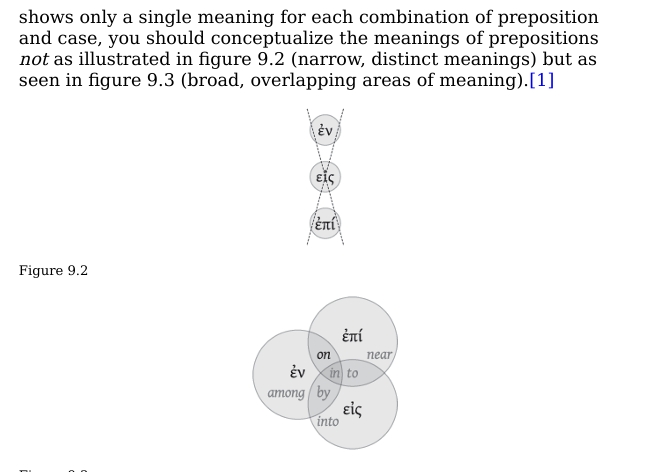
Porter does not read ἐκ as a magic word meaning “after separation from.” Its basic force is “out of,” and its ordinary extensions include source and origin. So ἐκ κοιλίας is perfectly natural as origin-point language: from the womb. Then Luke strengthens that with ἔτι, which marks an unexpectedly early point of application—even/still from the womb. By contrast, “he will have the Spirit sometime after he is physically separated from the womb” is not only textually forced, but rhetorically pointless. There is nothing surprising about a vague post-birth filling. The surprise lies in the earliness. And that exposes the deeper problem in my opponent’s reading: it quietly assumes that a merely physical act of separation is what suddenly makes Spirit-filling possible. But that is not something the Greek says. It is a doctrine smuggled into the clause.

If “separation from the womb” is the decisive condition, then what is doing the work: air in the lungs, cutting the cord, exiting the mother’s body, or simply no longer sharing maternal space? None of those are intelligible grounds for saying a subject can now receive the Holy Spirit whereas moments earlier he could not. The whole thing collapses into arbitrariness. Luke’s wording makes far better sense on the ordinary reading: John’s Spirit-filling is being marked as astonishingly early, not postponed until some supposedly magical moment of physical separation.
Argument from Galatians 1:15: “ἐκ κοιλίας” can’t mean “after birth”
Paul says:
ὁ ἀφορίσας με ἐκ κοιλίας μητρός μου
(“the one who set me apart from my mother’s womb”)
Now notice what your rule would force us to say:
If ἐκ κοιλίας means “separated from the womb” (i.e., after birth), then Paul’s claim reduces to:
“God set me apart after I was born.”
That’s just pointless. Paul isn’t making the banal point that God’s plan for him began once he was outside the womb. He’s stressing divine initiative and earliness: God’s purpose reaches back to the earliest point you can name—his origin, his beginning, his womb-life. The whole force is “God’s claim on me precedes my awareness, my choice, my merit.”
Now bring that back to Luke 1:15:
πλησθήσεται ἔτι ἐκ κοιλίας μητρὸς αὐτοῦ
(“he will be filled… even from his mother’s womb”)
If ἐκ κοιλίας in Paul is plainly origin/earliness language—and it is—then the burden shifts. You don’t get to treat the same womb-idiom as a technical obstetric phrase in Luke (“after separation from the womb”) unless you can justify why the idiom suddenly changes meaning. And Luke makes the earliness even harder to dodge by adding ἔτι (“even/already/still”), which is exactly the wrong adverb if your point is “only later.” ἔτι intensifies earliness/continuance.
Leaping for Joy?
Because joy is a manifestation of a soul. John in the womb didn’t have a soul, and because of this could not experience joy while in the womb.
The exegesis of Luke 1:41-44 makes it clear that the “joy” in vs 44 was Elizabeth’s, as explained in vs 41 & 42, not the baby’s in her womb.
What you’re doing here is wanting the joy to be the baby John’s while he was in the womb, even though Scripture says that it was Elizabeth who had the joy. We don’t make Scripture say what we want it to say however. We learn what Scripture actually says and then form our conclusions from that.
39 Now at this time Mary arose and went in a hurry to the hill country, to a city of Judah, 40 and entered the house of Zacharias and greeted Elizabeth. 41 When Elizabeth heard Mary’s greeting, the baby leaped in her womb; and Elizabeth was filled with the Holy Spirit. 42 And she cried out with a loud voice and said, “Blessed are you among women, and blessed is the fruit of your womb! 43 And how has it happened to me, that the mother of my Lord would come to me? 44 For behold, when the sound of your greeting reached my ears, the baby leaped in my womb for joy. 45 And blessed is she who believed that there would be a fulfillment of what had been spoken to her by the Lord.”
With Luke 1:41–44, where the baby leaps in Elizabeth’s womb, he argues that the leap should not be understood as a meaningful prenatal act of joy but as a merely non-volitional movement, like a twitch. On this view, Elizabeth is the one who experiences the real joy and spiritual illumination, while John’s movement itself is just an ordinary fetal action that Elizabeth interprets under the Spirit. So his overall position is that the narrative contains no real evidence of prenatal personhood, prenatal joy, or prenatal Spirit-empowerment, because all of those realities begin only after bodily birth.
First, even if the baby’s movement was, at one level, an ordinary kind of prenatal motion, that does not settle what the movement means in Luke’s narrative. Robertson is explicit that the leap was “a common enough incident with unborn children,” but he immediately adds that Elizabeth “was filled with the Holy Spirit to understand what had happened to Mary.” The point, then, is not the crude inference, “a fetus moved, therefore miracle.” The point is that this particular movement is prophetically interpreted within a Spirit-saturated narrative. That is hardly strange. Scripture repeatedly presents God as the one who discloses the meaning of events that, considered merely at the level of bare sensation, could be missed or misread. Daniel does not autonomously decode mystery; God makes it known. Paul likewise says that the things of God are spiritually discerned, not grasped by unaided natural judgment. So here too: the movement is real, and the Spirit reveals its significance.
Second, your reading crashes into verse 44 itself, because Luke does not say merely that Elizabeth felt joy and happened to notice a random twitch. Elizabeth says, “the baby leaped in my womb for joy.” In the text, the joy-language is attached to the baby’s leap, not reassigned to Elizabeth alone. Robertson even notes that ἀγαλλίασις in Luke 1:44 is the same joy-word already used in Luke 1:14 in connection with John’s coming. So Luke is not narrating a bare involuntary spasm and then having Elizabeth project meaning onto it from the outside. He is presenting the leap as a joy-laden prenatal response, one whose meaning Elizabeth recognizes because she is filled with the Holy Spirit. That is a very different thing from saying, “the baby twitched, and Elizabeth was the only one experiencing joy.”
Your reading of Luke 1:41–44 keeps trying to flatten the event into a meaningless prenatal twitch plus Elizabeth’s private emotional reaction. But that is not how Luke narrates it, and it is not how major commentators read it.
“As Mary greets her, the child in Elizabeth’s womb leaps prophetically, and from that Elizabeth, filled with the holy Spirit, concludes that Mary is to give birth to ‘the Lord.’ Thus each mother learns from heaven about the child of the other. And John goes before the Lord (1:17) to become—even in the womb—his precursor.”
Joseph A. Fitzmyer, The Gospel According to Luke I–IX (Anchor Yale Bible), 358.
That is already fatal to the “mere twitch” reading. Fitzmyer does not say Elizabeth took a random fetal spasm and invested it with symbolic meaning. He says the child leaps prophetically and becomes Christ’s precursor even in the womb. In other words, the movement itself is caught up in Luke’s theology of revelation and fulfillment. God is the one who discloses the meaning of the event, just as elsewhere in Scripture God reveals the significance of things that mere natural observation would not grasp on its own. So the point is not the crude inference, “a fetus moved, therefore miracle.” The point is that this particular movement is prophetically interpreted within Luke’s Spirit-filled narrative.
And Darrell Bock says much the same thing, but even more directly against the physiological reduction:
“Many speculate that Elizabeth’s excitement caused fetal movement. But such attempts at physiological explanation miss the point of the narrative. John is seen as beginning his forerunner ministry by his response (1:15).”
Darrell L. Bock, Luke 1:1–9:50 (BECNT), on Luke 1:41a.
That is exactly right. Luke is not pausing his infancy narrative to record ordinary prenatal mechanics, as though he were cataloging twitches, flutters, and other weird biological trivia that is irrelevant to the narrative. He is narrating a sign event. If your reading were right, Luke’s inclusion of the leap would become almost absurd. Why mention this movement in particular if it is no more meaningful than any other involuntary fetal motion? Are we supposed to expect a theological aside about random kicks and bodily secretions next? Of course not. Luke includes it because, in his narrative, it matters. That was one hell of a timely twitch!
Bock goes on:
“Elizabeth interprets the significance of the movement. She functions as a prophetess, declaring the divine significance of an action.”
Darrell L. Bock, Luke 1:1–9:50 (BECNT), on Luke 1:41b–44.
The claim is not that the movement ceases to be bodily or creaturely. The claim is that Elizabeth, under the Holy Spirit, is enabled to understand what this movement means. That is not bizarre at all. Scripture often presents bodily or historical events whose full significance must be revealed by God rather than inferred by bare natural reasoning. Daniel does not autonomously decode mysteries; God makes them known. Paul likewise says the things of God are spiritually discerned. So here too: the movement is real, bodily, and creaturely, but the Spirit discloses its meaning.
And then Bock says something damaging to your claims that the joy belongs only to Elizabeth:
“Luke clearly intends the reader to see the movement as special and significant by his remark in 1:15, but beyond this connection, Hendriksen says, it is wise not to go. However, Luke’s thrust is on the divine sign present in the baby’s action and the motive attributed to his action; that is, that the baby responds with joy (ἐν ἀγαλλιάσει). … Though John’s consciousness is certainly not an explicit point, the action belongs to the child.”
Darrell L. Bock, Luke 1:1–9:50 (BECNT), on Luke 1:44.
That is the point you keep refusing to face. Luke does not say merely that Elizabeth felt joy and happened to notice a random movement. Elizabeth says:
“For behold, when the sound of your greeting reached my ears, the baby leaped in my womb for joy.”
Luke 1:44
In the text, the joy-language is attached to the baby’s leap, not reassigned to Elizabeth alone. Bock explicitly says the motive attributed to the baby’s action is joy. It’s not “Elizabeth alone was joyful, and the fetus twitched incidentally.” The child responds with joy, and Elizabeth, filled with the Spirit, recognizes the significance of that prenatal response.
A.T. Robertson, too, helps here by holding both truths together:
“The babe leaped in her womb (eskirtēsen to brephos en tēi koiliāi autēs). A common enough incident with unborn children (Gen. 25:22) to be sure. But Elizabeth was filled with the Holy Spirit to understand what had happened to Mary.”
A. T. Robertson, Word Pictures in the New Testament, vol. 2, on Luke 1:41.
That is exactly the balanced point. No one has to pretend that every prenatal movement is miraculous in itself. The question is what this movement means in this narrative. Robertson says the movement as such is common enough, but its significance is not naturally self-interpreting. Elizabeth is filled with the Spirit to understand what has happened. So again, the narrative is not about a random twitch onto which meaning is projected; it is about a real bodily event whose theological significance is divinely revealed.
Robertson also makes a lexical observation that reinforces the point:
“With leap for joy (en agalliāsei). By means of (en) joy. The verb from which this substantive comes occurs in verse 14 and the substantive here is a kind of repetition of that prophecy.”
A. T. Robertson, Word Pictures in the New Testament, vol. 2, on Luke 1:44.
So the joy-language in verse 44 is not accidental. Luke is echoing the earlier promise about John’s joy and bringing it to expression here in the womb. This is why your opponent’s reading is so flat. It takes a narrative carefully loaded with prophecy, fulfillment, Spirit-revelation, and prenatal recognition, and reduces it to a biological reflex plus maternal overinterpretation.
Third, this is another false dichotomy. It can be true both that the movement had a physical dimension and that Luke presents it as a meaningful prenatal response. That is how signs work in Scripture all the time: something happens in the created order, and then God, by his Spirit, reveals its significance. My opponent is trying to collapse the event into a mere twitch because he has already assumed that an unborn child cannot be the subject of joy or spiritual response. But that is the very point under dispute. So if he argues, “babies in the womb cannot do this, therefore this cannot mean what it appears to mean,” he is simply arguing in a circle. He is not deriving that conclusion from Luke; he is importing a first-breath anthropology and then using it to flatten the text. Luke does not say, “Elizabeth rejoiced, and the baby moved incidentally.” It says the baby leaped for joy, while Elizabeth, filled with the Holy Spirit, rightly understood the significance of that leap. That is why this objection is actually worse than McClellan’s move. McClellan at least tries to treat John and Jesus as exceptions, even though they were not exceptions in possessing some different kind of human nature. But this objection does not even get that far. It simply assumes the first-breath view from the outset, refuses to prove it, and then uses that assumption as the controlling lens through which the passage must be read.
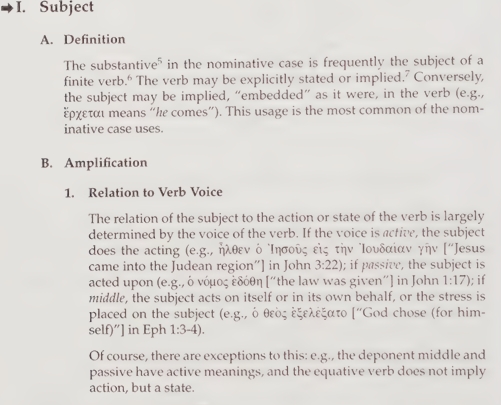
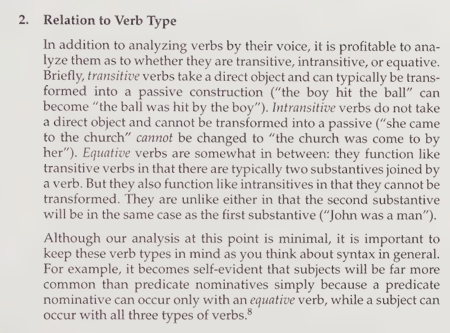
Fourth, verse 44 plainly makes the baby the actor. The verb ἐσκίρτησεν (“leaped”) is third person singular, and its subject is τὸ βρέφος (“the baby”). Since the nominative marks the subject of the clause, τὸ βρέφος is the one performing the action. Then ἐν ἀγαλλιάσει qualifies the action as a manner phrase, so the natural sense is that the baby leaped with joy. The verse therefore does not say that Elizabeth felt joy while the baby happened to twitch. It says that the baby leaped with joy. Any attempt to make Elizabeth the real subject of the joy imports her into the clause without grammatical warrant. If Luke wanted Elizabeth to be the one rejoicing, he needed to write a different sentence. He did not. He wrote one that attributes the joyful leap to the baby.
A Greek case is the form a noun, pronoun, adjective, or article takes to show what role it plays in a clause. In English, we usually rely on word order and helper words to show meaning: “the man hit the dog” is different from “the dog hit the man” because the order changes. Greek often works differently. It commonly marks a word’s function by changing its ending. That change in form is called its case. So when we say τὸ βρέφος is nominative, we mean that its form marks it as the subject of the clause. Since τὸ βρέφος (“the baby”) is nominative, it is the one doing the action of ἐσκίρτησεν (“leaped”).
That matters for Luke 1:44 because ἐν ἀγαλλιάσει most naturally modifies the verb, not some nearby noun. When grammarians say prepositional phrases often function adverbially, they mean such phrases usually tell you something about the action: how, where, when, or why it happened. In English, an adverb works the same way. If I say, “He spoke boldly,” the word “boldly” tells you how he spoke. The same basic point applies here. ἐν ἀγαλλιάσει tells us how the baby leaped. Since ἐν governs the dative, ἀγαλλιάσει is in the dative, and as a manner phrase it describes the way the action is carried out. The natural sense of the clause, then, is not that Elizabeth felt joy while the baby happened to move, but that the baby leaped with joy.
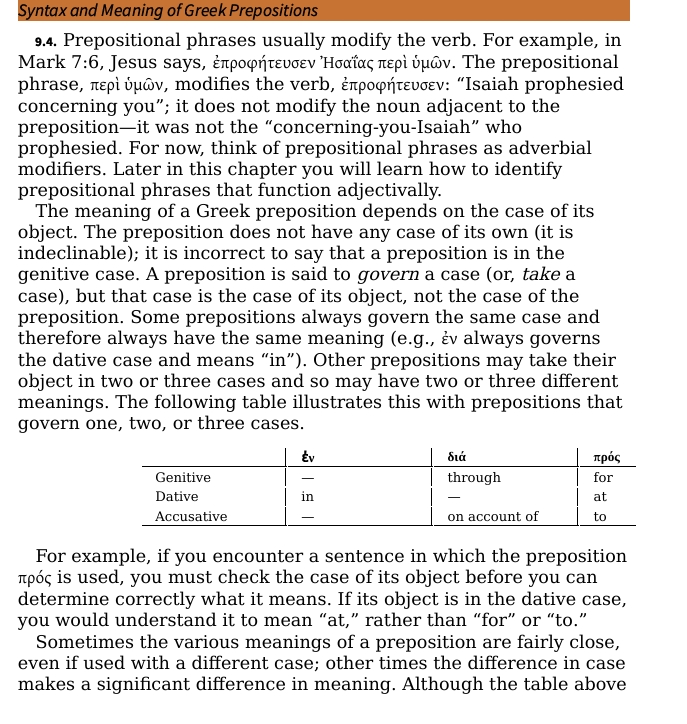
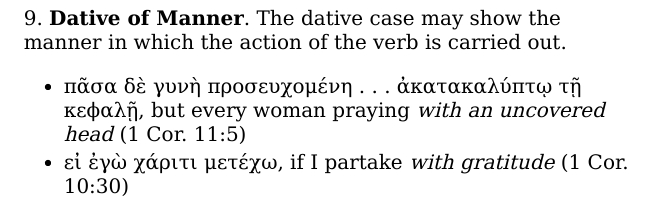
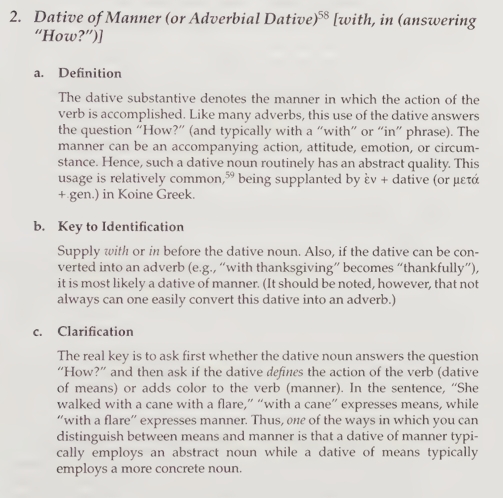
Fifthly, the lexical data cuts hard against the “mere spasm” view you presented in our conversation. BDAG defines σκιρτάω not as a word for random convulsion, but as “exuberant springing motion”—to “leap, spring about as a sign of joy.” It even lists Luke 6:23 as a clear example of joyful human leaping, and then says that in Luke 1:41, 44 the movements of the child in the womb are “taken as an expression of joy.” Likewise, ἀγαλλίασις is defined as “exultation” or a “piercing exclamation,” and BDAG glosses ἐν ἀγαλλιάσει as being “full of exultation, joy.” So Luke is not using vocabulary of involuntary spasm or meaningless reflex. He is using vocabulary of joyful leaping and exultation. It shows that Luke himself presents the movement as joy-laden and significant.
Finally, the first-breath view is out of step not only with Luke’s narrative, but with the empirical picture as well. Modern fetal research does not support the idea that the unborn child is a kind of inert pre-person waiting for birth to become the sort of being that can sense, respond, or participate in primitive mental life. Even standard medical summaries note fetal movement, sucking, swallowing, hearing, startle responses to sound, and later rhythmic breathing before birth, while the lungs are still maturing for extrauterine life. And the research literature goes further: there is evidence for fetal sensory responsiveness, habituation, recognition, and even stimulus-specific memory traces formed in utero. That does not mean an unborn child has adult cognition, but it does mean the “nothing mental is there until first breath” claim is far too crude. Indeed, if the argument is that breathing marks the beginning of personhood, it is worth noting that fetuses already exhibit breathing movements in the womb; the difference at birth is not that breathing suddenly appears out of nowhere, but that respiration becomes independent of the placenta. So the scientific picture, like the text of Luke, fits much better with continuity of human life and developing capacities than with a sharp metaphysical threshold at first breath.
By the third trimester, fetuses show organized sensory responsiveness, memory formation, and discriminative reactions to stimuli in utero. A 2022 study found that fetuses at 32–36 weeks displayed more “laughter-face” responses after carrot exposure and more “cry-face” responses after kale exposure, and a 2025 follow-up reported that repeated prenatal odor exposure was associated after birth with less cry-face and more laughter-face responses to those same odors. None of that proves adult-like reflective emotion in the womb, but it does show that the unborn child is not a blank, affectless organism waiting for birth to become the sort of being that can register and respond to experience. More importantly, it exposes a deeper problem in the first-breath view. If actions, reactions, sensory discrimination, memory traces, and organized responses tell us nothing at all about whether a being is a person, then why should those same kinds of phenomena count as evidence of personhood in newborns or severely limited human beings after birth? Once those indicators are declared irrelevant in utero, the view starts cutting the evidential ground out from under personhood judgments more generally.
In fact, his view seems unable to live with its own standard. If breathing, brain activity, sensory responsiveness, organized reactions, and other observable marks tell us nothing about whether a being is a person before birth, then why do those same sorts of indicators suddenly matter after birth when we judge whether someone is alive or dead? Why does cessation of breathing or brain function count, in his framework, as evidence that a person is no longer living, if those features are supposedly irrelevant to personhood as such? Once he severs personhood from every ordinary sign of living human activity before birth, he starts undermining the very evidential framework by which we identify living persons at all. The result is an unstable and unlivable criterion: one that makes personhood hang on an arbitrary birth-threshold while stripping away the natural signs by which we ordinarily distinguish the living from the dead.
The late-term case is especially damaging to the first-breath view. One can at least understand why someone might try to distinguish a fetus at 20 weeks from one near delivery, but the claim that a child at 38 weeks feels nothing until crossing the birth canal is much harder to sustain. The visible and functional continuity between a baby minutes before birth and minutes after birth is overwhelming; birth changes location and mode of respiration, not the kind of being involved. The medical literature also describes term fetuses mounting graded stress responses to hypoxia, acidosis, labor, and delivery, including catecholamine surges and related physiological adaptations before birth. So while one should be careful not to claim more than the science clearly establishes about subjective experience, it is simply false to picture the near-term unborn child as inert until first breath
For Science Stuff:
Beyza Ustun, Nadja Reissland, Benoist Schaal, and Jackie Blissett, “Flavor Sensing in Utero and Emerging Discriminative Behaviors in the Human Fetus,” Psychological Science 33, no. 10 (2022): 1658–1671.
Beyza Ustun-Elayan, Jacqueline Blissett, Judith Covey, Benoist Schaal, and Nadja Reissland, “Flavor Learning and Memory in Utero as Assessed through the Changing Pattern of Olfactory Responses from Fetal to Neonatal Life,” Appetite 206 (2025): 107948.
Kholoud Movalled et al., “The Impact of Sound Stimulations during Pregnancy on Fetal Learning: A Systematic Review,” Archives of Gynecology and Obstetrics 308 (2023): 1287–1304.
John F. Padbury et al., “Fetal Catecholamine Release in Response to Labor and Delivery,” Journal of Clinical Endocrinology & Metabolism 55, no. 3 (1982): 495–497.
Noah H. Hillman, Suhas G. Kallapur, and Alan H. Jobe, “Physiology of Transition from Intrauterine to Extrauterine Life,” Clinics in Perinatology 39, no. 4 (2012): 769–783.
American College of Obstetricians and Gynecologists, “Gestational Development and Capacity for Pain,” accessed March 10, 2026.
The Baby
Luke’s own diction strengthens the point even further. In Luke 1:41 and 1:44, John in Elizabeth’s womb is called τὸ βρέφος—that is, the baby. Then in Luke 2:12 and 2:16, the newborn Jesus lying in the manger is likewise called βρέφος. That continuity matters. Luke does not reserve baby-language for after birth, nor does he signal that birth marks the moment when a fundamentally different kind of subject comes into existence. Rather, the same term spans the transition from womb to manger. The unborn John is a βρέφος; the born Jesus is a βρέφος. So when people try to read Luke 1 as though prenatal life is somehow not yet the kind of reality Luke later calls a baby, Luke’s own vocabulary cuts against them.
This also exposes the deeper metaphysical problem with the rival view. If the unborn child is not yet the same personal subject who later exists after birth, then the identification language of the passage becomes unintelligible. The issue is not merely that Scripture sometimes speaks proleptically or uses anticipatory language. Of course it does. John Frame’s Plymouth Rock example works only because the referent already existed prior to receiving that later designation. The rock was there before the Pilgrims arrived; the name came later. But that is not analogous to the claim being made here. On the first-breath view, the problem is not simply that the name comes later. The problem is that the person himself allegedly does not yet exist. On that view, the text would not merely be using later language for an earlier stage of the same individual. It would be identifying one subject with something that is, strictly speaking, not yet that subject at all.
Nor can the point be rescued by appealing to predestination, proleptic speech, or representative language. Those categories are real, but they are not doing the kind of work the rival view needs them to do here. Predestination refers to a real person whose existence and future history are willed by God. The language is teleological and decretal: God ordains what that person will be and do. But that is not the same thing as identifying a non-existent person with an entity that is supposedly not yet that person. Likewise, proleptic speech works only when there is continuity of referent. We may call something by a later designation ahead of time, but that only makes sense if the thing in question is already the same underlying reality. John Frame’s Plymouth Rock example works because the rock already existed before it received that later name. The term is retrospective, but the referent is continuous. The first-breath view, however, cannot avail itself of that analogy, because on that view the issue is not merely that the name comes later; it is that the personal subject himself does not yet exist. In that case, Luke would not merely be using later language for an earlier stage of the same individual. He would be identifying a later person with something that, on this theory, is not yet that person at all.
The same problem applies to appeals to representation. When Scripture speaks of descendants being “in” their forefather, or of someone acting in the loins of another, the point is covenantal, legal, or seminal representation, not personal identity in the strict sense. Levi paying tithes in Abraham is not presented as though Levi already existed then as a distinct personal subject consciously acting. The language expresses solidarity and representation, not literal pre-existence. But Luke 1 is not framed in those categories. It does not say John was represented in Elizabeth’s womb, or that he was only foreordained there to become a person later. It identifies the one in the womb as τὸ βρέφος, the baby, and attributes to him a meaningful act within the narrative itself. The grammar does not present a placeholder for a future person, nor merely a body awaiting personal status, nor simply a legal representative of someone who will exist later. It presents John himself.
That is the decisive issue. If the unborn John were not numerically identical with the later John, then Luke’s language would collapse into the very category mistake the rival view is trying to avoid. The problem would not be that Scripture occasionally speaks anticipatorily; the problem would be that here Scripture would be speaking as though one subject exists and acts when, on that theory, no such subject yet exists. But Luke gives no hint that he is speaking by anticipation, legal fiction, or representational shorthand. He speaks straightforwardly. The one in the womb is the baby. The one in the womb leaps. The one in the womb responds to the presence of the Messiah. So the text only makes sense if the prenatal John and the postnatal John are one and the same personal subject.
And here is an even sharper closing paragraph if you want to press the metaphysical point harder:
The rival view therefore faces a dilemma. If Luke is speaking literally, then the unborn John is already the same personal subject later born, which destroys the first-breath position. But if Luke is speaking only by anticipation, then the anticipation is unintelligible, because it identifies a later person with an earlier entity that is, on that theory, not yet him at all. In other words, the first-breath reading cannot explain why this identification is legitimate. It can point to analogies involving later naming, predestination, or representation, but none of those analogies involve what is being claimed here: the direct identification of the subject in the womb with the later personal agent. Luke’s language makes perfect sense on a continuity view of personal identity. It becomes strained and unstable on a first-breath view.
 The Council
2 thoughts on “From the Womb: Luke 1 and Prenatal Personhood”