
Dan’s framing:
“Christianity has always maintained some kind of opposition to abortion, it has never been directly based on the Bible. It has always been socially contingent and it has only become the highly salient central identity marker of conservative Christianity that it is today since the 1970s…”
“…when folks like Jerry [Falwell] and Paul [Weyrich] set out on a national campaign to gin up outrage about abortion among evangelicals so that that opposition to abortion could be turned into a central identity marker that they could then operationalize to serve their own political… agenda.”
Dan’s “1970s Falwell/Weyrich” opener is what happens when confidence outruns logic. It’s a bundle of basic fallacies dressed up as scholarship: the genetic fallacy (attack the origin story instead of the claim), guilt by association (“bad people used this issue, therefore the issue is bad”), and then the final move—pure non sequitur—as if the timeline of political mobilization tells us anything about what we ought to believe. Even if every detail of his sociology were correct, it would still be irrelevant to the moral question. “This became salient in the 1970s” is not an argument against the proposition that abortion is morally wrong. Unlike Dan, we may hold things irrespective to the popularity.
And the irony is thick: Dan mocks “politics disguised as religion,” while his own moral instincts line up with whatever the current DNC consensus is—then he retrofits the Bible into supporting it.
Dan also says:
“From the earliest post–New Testament period for which we have Christian sources, abortion is explicitly condemned as a grave moral wrong. Texts such as the Didache and 2nd-century Christian writers treat abortion as incompatible with Christian moral life. This opposition appears early, clearly, and repeatedly…”
That admission puts Dan in a bind. His opening frame is that abortion opposition is basically a modern political identity marker—something engineered in the 1970s. But then he acknowledges that the earliest Christian sources we can actually read treat abortion as a grave moral wrong. Those two narratives can’t both function the way he wants them to. Jerry Falwell didn’t write the Didache. 1970s evangelical politics didn’t time-travel to the second century.
So Dan can’t decide whether abortion opposition is a modern invention or an early Christian consensus—so he tries to say both: “it’s politically manufactured,” and “it’s early, clear, and repeated.” Pick one.
Now, to be fair: early Christian opposition doesn’t automatically prove the position is biblical. But it does prove something Dan’s rhetoric is designed to obscure: this moral instinct wasn’t cooked up by modern party machines. It existed within the orbit of the apostolic age, in communities steeped in Scripture and early Christian moral formation.
Breath of Life
Here’s Dan’s claim:
“The Bible… treats personhood as something achieved at birth and treats breath as fundamentally constitutive of life.”
And the prooftext he’s leaning on is Genesis 2:7:
“God breathed into his nostrils the breath of life, and the man became a living being.”
Dan’s move is simple: breath is the marker of life → therefore the Bible defines personhood as beginning at first breath.
Genesis 2:7 isn’t describing ordinary human generation at all. It’s describing special creation—Adam formed from dust, with no mother, no womb, no gestation, no embryology. Adam “becomes living” when God breathes life into a fully formed body. The point is theological: life is from God and man is dependent on God for animation. It is not a biological rule that “humans aren’t alive until lungs inhale outside air.” That’s not what the text is doing, and everyone knows it.
Dan is acting like a unique origin miracle can be universalized into a fetal personhood policy. But that’s illegitimate. Adam is not a fetus. He isn’t even an ordinary human case. He’s an exception by definition—special creation that has nothing to do with ordinary procreation.
So using Adam-as-dust to define fetal personhood is like using Eve-from-rib to define obstetrics. Dan is searching for a text that sounds like it supports birth-personhood, then extracting one detail (“breath”) and pretending it settles the question. But that detail doesn’t establish his case. It establishes that God gives life—something pro-lifers already affirm—while Dan tries to smuggle in an entirely different conclusion: that prenatal humans don’t count as persons until first breath.
Dan’s whole move depends on treating “breath” like a medical/legal switch: no breath → no “life” → no personhood. But the Bible itself uses breath-language as a stand-in for life in general, as the life-principle God sustains, and even as pure metaphor. In other words, Scripture treats “breath” as a way of talking about life, not as a policy-ready criterion for when moral status begins.
In the flood narrative, “breath of life” is shorthand for “the living things that die”:
- Genesis 6:17 speaks of the destruction of “everything… in which is the breath of life.”
- Genesis 7:22 says that “everything on dry land in whose nostrils was the breath of life died.”
In the flood narrative, for example, “breath of life” is simply shorthand for the living things that die. Genesis 6:17 and 7:22 are not offering a theory of personhood; they are describing the destruction of animate life. The same pattern appears elsewhere. Job 12:10, Isaiah 42:5, and Acts 17:25 speak of God as the one who gives and sustains breath continuously, not merely as the one who initiates life at birth. Notice when you die, you remain a person, but the body dies.
God “gives breath” = God sustains life continuously, not just at birth
Multiple texts describe God as the one who gives breath—not merely at birth, but as the ongoing ground of creaturely life:
- Job 12:10: in God’s hand is “the breath of all mankind.”
- Isaiah 42:5: God “gives breath to the people on [the earth].”
- Acts 17:25: God “gives to all mankind life and breath and everything.”
If Dan turns “breath” into “personhood begins at first inhalation,” these passages become incoherent. Does our personhood switch off between breaths? The texts treat breath as something God continually sustains in living humans, not as a one-time threshold that suddenly confers personhood at birth. Dan’s rule confuses a sign of life with the ground of personhood. A sign can come and go without changing what kind of thing someone is. Breathing can stop temporarily, become assisted, weaken, or resume. None of that turns a human into a nonhuman
God “takes away breath” = death (breath functioning as synecdoche again)
The Bible also works in reverse: when breath is removed, the creature dies:
- Psalm 104:29: “When you take away their breath, they die…”
Psalm 104:29 works in reverse: when God takes away breath, creatures die. That is breath functioning as synecdoche for life, not as a technical declaration that “personhood has been switched off.”
Breath/life “returns” = revival, not “becoming a person again”
Likewise, when Elijah prays in 1 Kings 17 and the life of the child returns to him, no one thinks the child “became a person again.” The language tracks life and death, not personhood thresholds. When someone is revived, Scripture can describe it as life returning:
- 1 Kings 17:21–22: Elijah prays, and “the life of the child came into him again, and he revived.”
Breath as the life-principle, not oxygen mechanics
Some texts use “breath” in the register of spirit or animation—God’s life-giving power:
- Ecclesiastes 12:7: “the spirit returns to God who gave it.”
- Ezekiel 37:5–10: the valley of dry bones—”breath” comes and they live.
Ezekiel 37 is especially devastating to Dan’s argument because it uses “breath” as divine animation, a theological symbol of God restoring life—not as a biological definition of when humans “count.”
Breath used metaphorically (not even about biology)
Scripture can even use breath-language as metaphor for a nation’s life or hope embodied in a ruler:
- Lamentations 4:20: “The breath of our nostrils, the LORD’s anointed…” (referring to the king)
So “breath” can be literal, synecdochic, and metaphorical—all in the same canon.
If Dan wants to absolutize “breath of life” language, then he has another problem: Scripture uses that language for animals too. So “has breath” cannot by itself define human personhood. At most it marks creaturely animation. That means the breath category is too broad to do the specific work Dan wants.
The Double Standard
Here’s the pattern: When a text threatens Dan’s conclusion (Jeremiah 1:5, Psalm 139, Luke 1), he waves it off as “poetry,” “rhetoric,” “not policy-ready,” “not a legal systematic principle.”
But when a text sounds like it can be leveraged for his conclusion (Genesis 2:7 and “breath”), the genre sensitivity suddenly vanishes. Now a common biblical idiom becomes a technical definition. Now poetry becomes policy in favor of the true God of LDS, the DNC.
Even outside technical theology, people regularly speak of “breath” as equivalent to life without implying anything about personhood beginning. We say someone “took his last breath” or “there was no breath left in him,” and nobody thinks that means personhood flickers on and off with respiration. Biblical language works similarly.
Dan doesn’t have a hermeneutical method. He has a filter: texts that support his position get treated as definitive; texts that don’t get dismissed.
Even on Dan’s own terms, the argument collapses
Suppose we played Dan’s game and treated “breath” as a literal biological threshold rather than biblical idiom. His conclusion still doesn’t follow—because modern biology shows the fetus isn’t “non-breathing” in any relevant sense.
From implantation onward, the embryo receives oxygen continuously. Initially this happens through diffusion from maternal tissues and early uterine structures. By 10–12 weeks gestation, there’s a major physiological shift: free maternal blood flow into the intervillous space ramps up, and placental oxygen tension rises. The placenta functions as the organ exchanging oxygen and carbon dioxide for the fetus throughout pregnancy. In other words, prenatal humans are oxygenated and metabolically alive long before birth.
And if we’re talking about actual breathing movements—diaphragm and chest movements, even though they’re moving amniotic fluid rather than air—those begin surprisingly early:
- Detectable in research as early as 8–10 weeks gestation
- Observable in clinical radiology around 15 weeks
- Established as regular patterns by about 20 weeks
So if Dan wants “oxygenation” or “respiration” to be the criterion of life, he’s already conceded the game. Prenatal humans meet both standards well before birth.
Here’s what’s actually funny: even if we accepted Dan’s oxygen/”first breath” metric, it’s too strong for his own position. Babies are oxygenated in the womb the entire time—life doesn’t flick on at birth like a light switch. The transition from placental to pulmonary respiration is a change in method of oxygenation, not the sudden onset of oxygenation itself. Given the facts, the implication of Dan’s own position is the Bible is pro-life.
Dan’s claim is basically this:
“The most explicit engagement with that issue is Exodus 21:22–25… The first [outcome] is that the injury causes the woman to miscarry and the penalty is… a fine… The second outcome is permanent injury or death for the pregnant woman in which case talionic justice is activated… Eye for an eye… life for a life. The fetus is treated as property…”
He doubles down by appealing to “early Jewish attestation” (Josephus) as if that locks the meaning:
“He that kickth a woman with child, if the woman miscarry, shall be fined… If she die… he also shall die…”
Dan’s whole reading depends on smuggling “miscarriage” into the text and then pretending the rest follows naturally. It doesn’t. A careful reading pushes the other way.
The text doesn’t say “miscarry.” It describes the children “coming out.”
The hinge phrase in Exodus 21:22 is not “she miscarries.” It’s that her children come out. That matters, because the law then distinguishes:
- the children “come out,” but no harm follows → fine
- harm follows → life for life / eye for eye / tooth for tooth, etc.
That is a textbook case-law pattern: an event occurs; if there is no injury, penalty X; if injury occurs, penalty Y.
The miscarriage reading has to force the first outcome into “the fetus dies,” even though the passage’s own structure treats the first outcome as something that can happen without harm.
The law’s own categories fit premature birth far better than miscarriage
Notice what the law does next: it triggers a full talionic schedule—life for life, eye for eye, tooth for tooth, hand for hand, and so on.
That structure makes immediate sense if the case law is tracking injury outcomes (to the mother and/or the child) following a traumatic premature delivery. It makes far less sense if the first outcome is already “the fetus is dead,” because then you’re stuck with an absurd implication: a dead fetus counts as “no harm.” And that’s the sleight of hand Dan needs because his reading requires fetal death to be treated as a kind of property loss that triggers only a fine.
But that’s not how the law is written. It’s written as: birth-event and assessment of harm. I’ve explained more here:
https://watchmencouncil.com/2020/05/20/is-abortion-biblical/
One of the strongest internal signals is the word the text uses for what comes out: children (not “tissue,” not “product,” not “property”). That doesn’t magically settle every modern philosophical question, but it absolutely undermines Dan’s confident rhetoric that the fetus is “more property than person.”
And this is where Dan’s “poetry” move becomes pure hypocrisy. When Jeremiah/Psalm talk about “me” in the womb, Dan says “poetry.” But when Exodus uses ordinary legal language for “children,” Dan suddenly feels licensed to translate it into “property” (as if that entails non-human).
HALOT: primary meaning is “boy/child,” with “miscarriage” noted as a special/derivative gloss in Ex 21:22
HALOT’s article on יֶלֶד lists the normal meaning (“boy, male child”) across many texts, and then—importantly—notes Ex 21:22 under a line that includes:
SamP.M106 yāled, pl. yālīdem (→ יָלִיד): ילד: MHeb.; Ug. yld, Pun. Nab. Palm. (Jean-H. Dictionnaire 107); Arb. walad son, young animal; Akk. (w)ildu; → וָלָד, יָֽלֶד, יְלָדִים יַלְדֵי: (4 times) and יִלְדֵי Is 57:4 † (Bauer-L. Heb. 566d), יְלָדָיו (יְלָדָו Job 38:41, Bauer-L. Heb. 252r), יַלְדֵיהֶם: —1. boy, male child: a) Gn 4:23 21:8, 14-16 37:30 42:22 44:20 Ex 2:3, 6-10 2S 6:23 12:15, 18f, 21f 1K 3:25 14:12 17:21-23 2K 4:18, 26, 34 Is 9:5 Jl 4:3 Ru 4:16 Qoh 4:13, 15; b) pl. boys, children Gn 30:26 32:23 33:1f, 5-7, 13f Ex 1:17f 21:4 1S 1:2 2K 2:24 4:1 Is 2:6 8:18 29:23 57:4f Zech 8:5 Job 21:11 Ru 1:5 Lam 4:10 Da 1:4, 10, 13, 15, 17 Ezr 10:1 Neh 12:43; miscarriage (SamP. ולדה) Ex 21:22; c) יֶלֶד זְקֻנִים son begotten by an old man, child of his old age Gn 44:20 (= בֶּן־זְ׳ 37:3), יֶלֶד שַׁעֲשׁוּעִים darling child Jr 31:20, יַלְדֵי זְנוּנִים Hos 1:2, יִלְדֵי פֶשַׁע Is 57:4; —2. הַיְלָדִים “the young men”, body of advisors :: הַזְּקֵנִים 1K 12:8, 10, 14 / 2C 10:8, 10, 14 (Malamat JNES 22:247; BA 28:41ff); —3. young animal: cow and bear Is 11:7, raven Job 38:41, hind and mountain goat 39:3. †
Ludwig Koehler et al., The Hebrew and Aramaic Lexicon of the Old Testament (Leiden: E.J. Brill, 1994–2000), 412.
That line tells you two crucial things:
- The baseline semantic range is “child/boy/offspring.”
- “Miscarriage” is not the default meaning—it’s an eisegetical rendering attached to this disputed passage, even flagged with a textual tradition note (SamP).
So lexically, the word isn’t doing what Dan wants by itself. Dan is importing an interpretation and then acting like the lexeme forces it.
TDOT frames the entire root family as birth/procreation language:
Basic meaning: “bring forth (children)” … “The qal… meaning ‘bear’ is reserved for women…” … Nouns include yeleḏ, ‘child, boy’ …
(Josef Schreiner and G. Johannes Botterweck, “יָלַד,” in Theological Dictionary of the Old Testament, ed. Helmer Ringgren, trans. David E. Green (Grand Rapids, MI; Cambridge, U.K.: William B. Eerdmans Publishing Company, 1990), 76–81.)
That’s against Dan’s rhetoric that Exodus 21 is “obviously” talking about property damage. The semantic field is birth/offspring, not “loss of property.” Unless Dan can show children just are property and have no value in Hebrew Bible.
This is where the lexicon data matters. Exodus 21:22 doesn’t say, “she miscarries.” It describes a birth-event using birth vocabulary. Once you see that, Dan’s chain—“miscarriage → fine → fetus = property”—stops looking like the “plain reading” and starts looking like a conclusion-driven reconstruction.
Because if the text’s own wording is “the children come out,” then the legal question becomes: what harm follows? That’s exactly how the case law is structured—event, then assessment, then penalty.
“Fine” does not equal “non-person”
Even if we grant (for argument’s sake) that the first outcome is some kind of fetal loss, Dan’s inference still doesn’t follow. Different penalties do not automatically map to personhood metaphysics. Ancient case law often scales penalties by circumstances (intent, negligence, social order, compensable damages, evidentiary limits, etc.). Penalty structure alone is not a personhood meter.
Dan says: “When somebody accidentally kills an enslaved person, there’s a socially standardized 30 shekels… With a fetus, there is no such socially standardized value… the husband determines the value of that piece of property.”
But the inference is shaky.
- A standardized amount in one case can reflect that case’s legal category (a fixed statutory schedule for a particular scenario), not a ranking of moral worth.
- Exodus 21:22 explicitly involves judicial arbitration (“as the judges determine”), which is exactly what you expect in a damages framework: the claimant proposes, the court prevents abuse. That isn’t “property valuation.” That’s controlled restitution.
So Dan’s logic is basically: “one case has a fixed schedule, this case has assessed damages, therefore the fetus is property.” That simply doesn’t follow. It’s a category error about how case law can vary penalty
Dan pretends the logic is simple: “fine → property.” But that’s not how legal reasoning works, ancient or modern. A fine can address wrongful harm to persons in cases where the law’s mechanism is restitutionary rather than capital.
Josephus doesn’t rescue Dan
While Dan is keen on pointing out the bias of Philo and anyone who doesn’t agree with his interpretation, he doesn’t apply the same suspicion to the witnesses who do agree with him. That asymmetry matters here, because Dan wants Josephus to function like a neutral witness to the original meaning of Exodus, while at the same time arguing that Greco-Roman philosophical categories reshaped how people read fetal personhood. But Josephus is precisely the kind of witness who can reflect later categories, because he is a Greco-Roman Jewish author presenting biblical law in a Greco-Roman register. That makes his testimony useful for tracing reception history—but it makes it incapable of proving what the Hebrew text itself “really means.”
Josephus cannot be treated as a neutral window into what Exodus “really means,” because he is not writing a halachic commentary on a disputed Hebrew casuistic text—he is producing a Greco-Roman presentation of Jewish law for outsiders. As David Nakman notes, “Josephus mainly writes for a gentile audience … and … the level of detail reflects the general nature of a review for a gentile readership and not a detailed halachic essay for the Jewish reader” (Nakman, “Josephus and Halacha,” 285). In that setting Josephus can (and does) fold in customary practice, inference, or later interpretive assumptions without labeling them as such. Nakman adds that Josephus’s halachic material only matches rabbinic halacha “in a little more than half the cases,” with the rest diverging for multiple possible reasons (Nakman, 285). And he gives a concrete illustration of how “Torah paraphrase” can smuggle in extra detail: Josephus says that a lamb for a burnt offering (olah) “must be one year old”—a rule that “does not appear in Leviticus 1,” the passage he is summarizing (Nakman, 285). That’s the methodological point: citing Josephus on Exodus 21 doesn’t settle the Hebrew law’s meaning; at best it shows how a first-century author presented it in a Gentile-facing register.
That’s why it’s a category mistake to treat Josephus as your adjudicator for a contested Hebrew phrase: he is often doing something closer to cultural translation and public presentation than line-by-line legal exegesis.
You can see the same dynamic in several places where Josephus effectively adds or reshapes legal material while presenting it as “Mosaic.” For example, he states that women’s testimony should not be accepted because of the “levity and boldness” of their sex (Antiquities 4.219). He also forbids robbing the treasures and temples of foreign gods (Antiquities 4.207)—a move that sits in tension with biblical commands to destroy idolatrous cult objects (cf. Exod 23:24). And when he retells the “stubborn and rebellious son” law (Antiquities 4.260–265), his presentation shifts the emphasis toward general disrespect and frames the matter in a way that has been plausibly read as aligning Jewish custom with Roman assumptions about paternal authority (patria potestas). The cumulative point is straightforward: Josephus is invaluable for mapping how Torah was received and presented in the first century, but precisely because he paraphrases, smooths, and sometimes reframes, he cannot be used as an exegetical trump card to settle what Exodus 21 “really means” in Hebrew—especially when the Hebrew passage is already contested and Josephus is perfectly capable of importing later sensibilities into his paraphrase.
And this isn’t speculative. Josephus’ legal paraphrases can incorporate non-biblical customary assumptions without labeling them as such. Modern scholars note that he includes much that is “customary rather than prescribed”—even when it’s not actually in the biblical law. in Antiquities 4, while summarizing Mosaic legislation, Josephus declares: “Let the testimony of women not be accepted because of the levity and boldness of their gender” (Ant. 4.219)—a sweeping legal rule that is Josephus’s own judgment, not a line you can simply lift out of Torah. So even when he’s “paraphrasing Torah,” he may be blending Torah with later legal sensibilities. For more I recommend:
Nakman, David. “Josephus and Halacha.” Pages 283–288 in A Companion to Josephus. Edited by Honora Howell Chapman and Zuleika Rodgers. Chichester, UK: Wiley-Blackwell, 2016.
Finally, even the scholarly debate on Exodus 21:22–23 recognizes competing interpretive trajectories: Josephus lines up with one stream; LXX/Philo with another. That alone is enough to show Josephus doesn’t settle the meaning—he represents a side.
John Smith’s more cautious line (“Exodus 21 doesn’t map neatly onto modern categories”) is actually closer to being responsible than Dan’s overconfident “property” rhetoric. But here’s the key: Dan can’t simultaneously say (1) the Bible lacks the machinery for modern personhood debates and (2) Exodus 21 clearly teaches fetal non-personhood as property. Those are incompatible postures. Either the text is underdetermined—or Dan’s reading is.
What Dan wants is the worst of both worlds: maximum skepticism toward pro-life inferences, maximum certainty for his own.
Does Dan’s Book help?
Currently, we’ve been looking at his show, but now let’s see what his published works say. McClellan argues that to understand ancient biblical views on the unborn’s legal status, you have to look at Israel’s case laws, especially how “life for life” (talionic justice) is applied unevenly depending on a person’s social status. Exodus 21 shows that even when a human dies, the law doesn’t always treat it as “murder” in a simple binary way: an ox-goring case can lead to the owner’s death or a monetary “redemption” price, reflecting indirect culpability. More starkly, if the gored victim is enslaved, the penalty is a fixed payment (30 shekels), not “life for life,” and other passages describe enslaved people as property in ways that reduce legal protection for their deaths. The upshot is that “personhood” functions on a spectrum between “person” and “property,” and the law treats “murder” as requiring a certain degree of personhood. Then the author applies that framework to Exodus 21:22–25: if men injure a pregnant woman and it results in miscarriage, the penalty is a husband-assessed (and arbitrated) fine; if the woman herself is harmed, the penalty becomes fully talionic (“life for life… tooth for tooth…”). This contrast is presented as the Bible’s clearest legal signal about how fetal loss was classified versus harm to the mother.
“This passage was probably translated into Greek in the third century BCE, multiple centuries after its original composition, and in that Hellenistic context the translators understood the passage in a much different way. The Hebrew word that refers to the death of the woman is ason. The Greek translators, however, seem somehow to have associated the Hebrew word ason with the Greek word sōma, which means ‘body.’ As a result, they understood the fine to be imposed if there was ‘no body’—the fetus was not fully formed—and the death penalty to be imposed if there was a ‘body’—the fetus was fully formed. According to this reading, once a fetus was fully formed, they achieved a degree of moral and legal personhood that meant their killing was punishable by death. Philo of Alexandria certainly understood it this way when he referred to Moses pronouncing ‘the sentence of death against those who cause the miscarriage of mothers in cases where the foetus is fully formed.’
“So what changed? The translation of the book of Exodus into Greek would have been done by highly educated Greco-Roman Jewish people likely living in Alexandria, Egypt. These folks would have been familiar with existing Greco-Roman ideas about personhood, and around that time, a fetus was thought to become a person when the human soul entered the body (‘ensoulment’). There were three general views on this that corresponded to popular philosophical schools of that day. According to Stoicism, it was contact with the air at birth that marked the joining of soul to body and the initial achievement of personhood. Within Epicureanism and Pythagoreanism, ensoulment was understood to correspond with conception. The Aristotelian view held that human ensoulment occurred around day forty of the gestational period for male fetuses and day ninety for female fetuses (women were thought to develop more slowly and to basically be underdeveloped men).
“The wildly inaccurate science aside, this was frequently linked with the ‘quickening,’ or the point at which a mother can begin to feel the fetus moving. The English word ‘quick’ originally meant ‘alive,’ and so ‘quickening’ would mean ‘coming to life’ or ‘receiving life.’ This would happen with the fetus’s full formation and likely influenced how the Septuagint translators interpreted Exodus 21:22–23. This may also make sense of Ecclesiastes 11:5. The text was written either during the Persian or Greco-Roman periods, and although it’s difficult to interpret, one way to read it is as a reference to the ‘breath’ coming to ‘the bones in the womb of the pregnant one.’ If this interpretation is accurate, the quickening is being represented as the fetus becoming enlivened by a kind of figurative breath.”
Dan McClellan, The Bible Says So: What We Get Wrong About Scripture’s Most Controversial Issues, pp. 108–109.
McClellan suggests that “quickening” (tied to the fetus’s full formation) “likely influenced how the Septuagint translators interpreted Exodus 21:22–23” (Dan McClellan, The Bible Says So, p. 109).
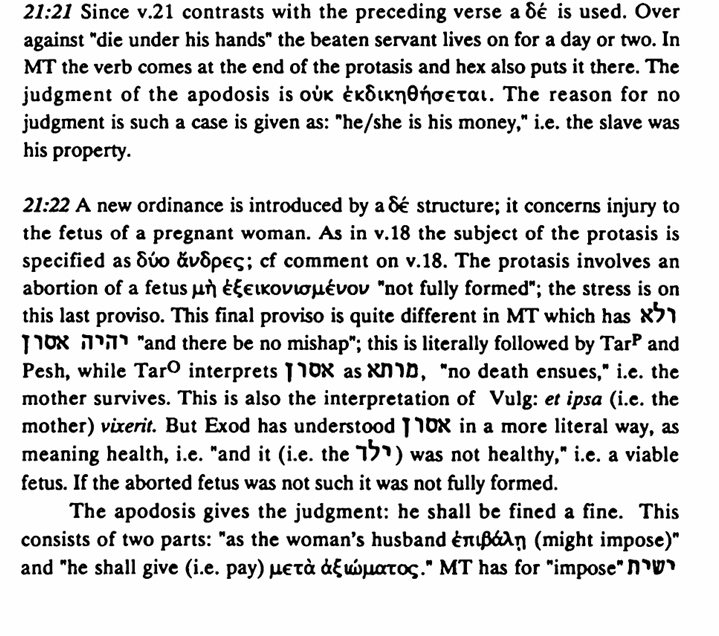
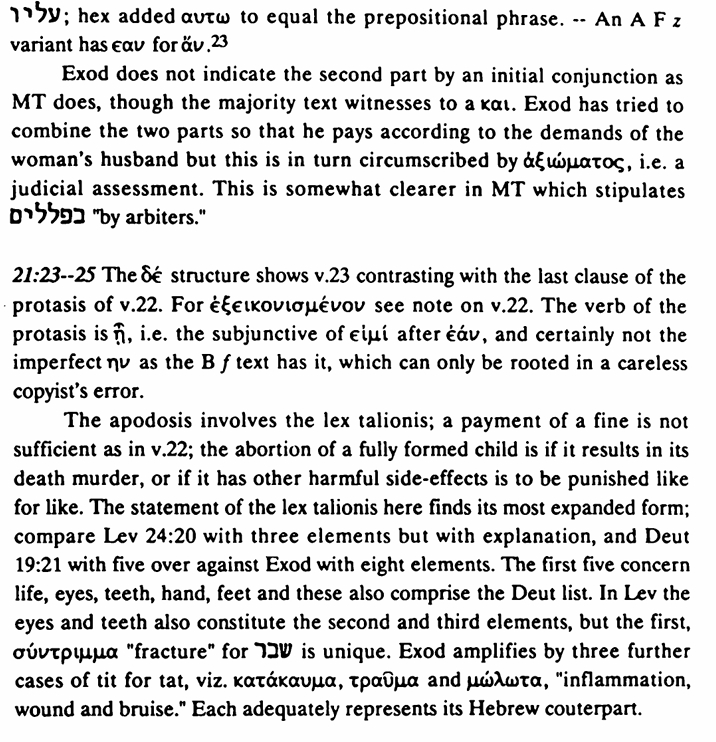
But it isn’t very clear that Greek ensoulment theory is what’s driving the LXX. Wevers explains the shift in terms of the translator’s construal of the Hebrew condition (ʾāsôn) as health/viability, which then gets expressed as “not fully formed”: “Exod has understood ʾāsôn in a more literal way, as meaning health… ‘and it… was not healthy,’ i.e. a viable fetus. If the aborted fetus was not such it was not fully formed.” (John William Wevers, Notes on the Greek Text of Exodus [SCS 30], p. 333). He also stresses that the husband’s demand is “circumscribed by… a judicial assessment” (Wevers, Notes, p. 333).
Gurtner likewise frames the passage in terms of translation/interpretive issues and even warns against overconfident metaphysical readings because the scenario itself is debated: “Whether this is a miscarriage or premature birth… seems unclear.” He notes the LXX’s key wording (“her child comes out not fully formed (μὴ ἐξεικονισμένον)”) and adds that the verb choice taps Greek biblical “formation/image” diction: “Exod’s ἐξεικονίζομαι occurs at Gen 1:26; 9:6 on the formation of humans in the image of God” (Daniel M. Gurtner, Exodus: A Commentary on the Greek Text of Codex Vaticanus [Brill], p. 391).
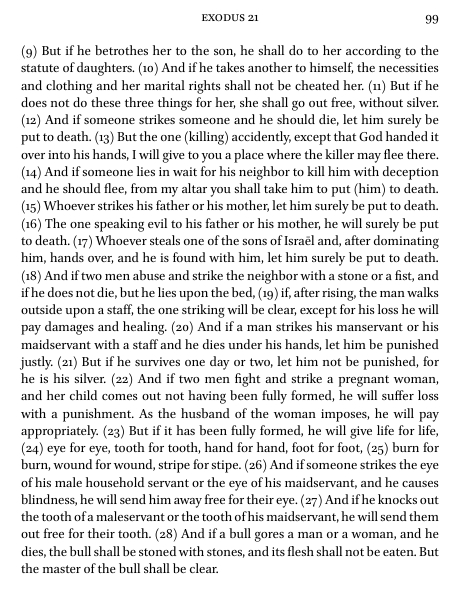
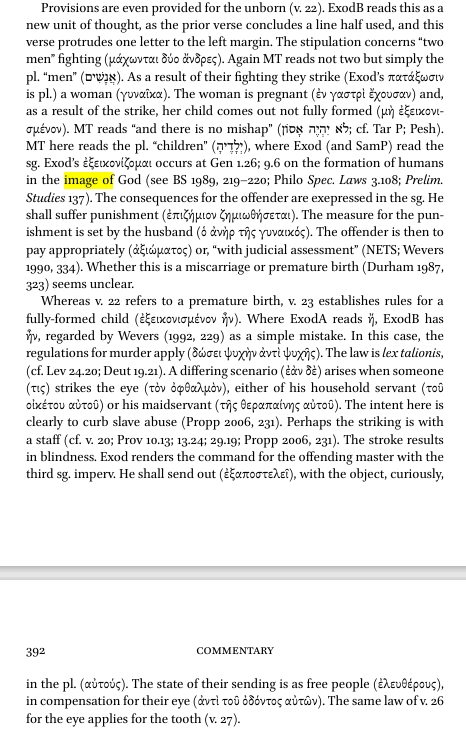
So even if Greek embryological ideas could have been “in the air,” these Greek-text commentaries point to more immediate drivers: how the translator read the Hebrew, how he rendered it with Greek formation-language, and a judicial damages framework—and the underlying case (miscarriage vs. premature birth) isn’t even settled.
The early rabbinic literature and medieval and modern Jewish authorities affirm the same understanding. Rashi, Ramban, Abraham ibn Ezra, Malbim, Baruch Epstein, and many others interpret Exodus 21:22–23 to mean a fetus does not possess legal personhood. In early rabbinic writings, fetuses are described as “mere fluid” prior to forty days of gestation, at which point they become a part of their mother’s “thigh.” According to the Mishnah and medieval Jewish commentators, a fetus did not become a nefesh—a “soul”—until their head or the majority of their body had departed from the womb. Mishnah Oholot explains, “When a woman is in difficult labor, one may cut up the fetus in her stomach and take it out limb by limb, for her life takes precedence of its life. Once most of it has come out one may not touch it, for one may not push aside one soul for another.”
7
Dan’s appeal to rabbinic and medieval Jewish authorities does not prove what Exodus 21 itself means. It proves that a later halakhic tradition developed a particular way of classifying fetal status. That is an important historical fact, but it is not the same thing as saying, “the Bible clearly teaches birth-only personhood.” Dan constantly warns others not to impose later concepts onto ancient texts, yet here he does exactly that by treating later rabbinic categories as though they settle the meaning of Exodus.
And even the Mishnah quote does not do the work he wants. Mishnah Oholot is a triage case, not a general declaration that the fetus is “just property” or morally worthless. The whole point of the ruling is that when the mother’s life is in immediate danger, her life takes precedence. That is an emergency-conflict judgment. It is not a blank check for abortion, and it is not even framed as “there is no life there.” In fact, the Mishnah speaks of its life and then later of one soul for another. That is already more morally serious than Dan’s rhetoric suggests.
More than that, Dan keeps blurring legal status, ritual-juristic category, and metaphysical humanity. Saying that a fetus is not yet a nefesh in a certain rabbinic legal sense is not the same thing as saying it is not human, not morally significant, or merely disposable matter. Ancient legal systems routinely classify beings differently for particular rulings without those classifications exhausting their moral status. Dan’s whole argument repeatedly confuses how a legal tradition handles hard cases with what a human being is.
Dan appeals to rabbinic authorities when they help him, but he dismisses other ancient readings when they move in a more fetal-protective direction by blaming them on Greek philosophy or later influence. He cannot have it both ways. Either later interpretive traditions are relevant, in which case he must admit there was real diversity and not one clean line to his conclusion, or later traditions are not decisive, in which case his rabbinic appeal cannot settle Exodus 21.
There is no obvious reason to privilege later rabbinic judgments over early Christian ones, as though the former are neutral historical windows and the latter are merely theological distortions. Both are post-biblical traditions. Both interpret inherited Scripture through later conceptual frameworks. So once Dan starts appealing to Mishnah, medieval rabbis, and modern Jewish authorities, he has already left the realm of “the Bible clearly teaches X” and entered the realm of competing interpretive communities. At that point, he cannot simply assume the rabbinic line is superior—especially when early Christians, much closer to the apostolic world, also spoke clearly and early against abortion.
For folks who insist that abortion is murder, this question is easily answered in the affirmative by isolating and then imposing some assumptions on a couple of passages from the Hebrew Bible and the New Testament. The first to come up is usually Jeremiah 1:5, which says, “Before I formed you in the womb, I chose you. Before you came out of the womb, I consecrated you. A prophet to the nations, I appointed you.” If God knew Jeremiah in the womb, he must have had an identity and therefore must already have been a human being. Or so the argument goes. But this interpretation has critical problems. First, the passage actually indicates God knew Jeremiah before his formation in the womb. Jeremiah’s identity would precede his conception, which suggests this passage is about God’s foreknowledge and is not an identification of when human identities become legally viable. Also, shouldn’t an omniscient deity have had eternal foreknowledge of all humans who would ever be born? This reading would mean people born thousands of years from now are already legal human beings with legal protections. The problems with such a ludicrous reading are obvious. The reality is that the passage is only intended to rhetorically amplify Jeremiah’s prophetic authority by insisting that—in contrast to other prophets called in adulthood—his consecration as a prophet preceded even his conception and birth. This is a remarkable exception, though, and not the rule, so it’s also not generalizable to all humanity (though the later authors of Isaiah 49:1 and Galatians 1:15 would cosign the same claim). Jeremiah 1:5 just doesn’t indicate the biblical authors would have thought of any fetus—much less all—as a legally viable human being.
Dan’s treatment of Jeremiah 1:5 rests on a basic misdirection. He acts as though the pro-life appeal to the passage is: “God foreknew Jeremiah, therefore Jeremiah was already a legally viable human being.” But that is not the force of the text, and it is not the strongest use of the text. The point is not that divine foreknowledge magically creates legal personhood. The point is that the text naturally speaks of Jeremiah as a continuous personal subject across preconception, gestation, and birth. “Before I formed you in the womb, I knew you; before you came out of the womb, I consecrated you.” The repeated second-person reference matters. The text does not speak as though there is a non-personal biological process in the womb that later turns into Jeremiah. It speaks as though the one formed in the womb and the one later born is the same “you.”
That is why Dan’s omniscience objection misses the point. Of course God eternally knows all future persons. Nobody serious is arguing that divine omniscience by itself establishes legal protections for merely possible future humans. The relevant point is not bare foreknowledge in abstraction, but the way Jeremiah 1:5 links God’s knowledge, formation, consecration, and calling to one continuous referent. Dan tries to dissolve that by saying the text is “only” amplifying Jeremiah’s prophetic authority. But that does not help him. A rhetorical amplification still works by presupposing intelligible categories. If the text says God knew and consecrated Jeremiah before birth, it still treats the prenatal Jeremiah as the same someone who later speaks and prophesies. The exceptional nature of Jeremiah’s vocation does not erase the personal continuity the text assumes.
Dan also slips in a foreign category when he says Jeremiah 1:5 does not indicate when “human identities become legally viable.” But that is not a category Jeremiah 1:5 is trying to answer, and it is not the category pro-lifers need from the text. “Legal viability” is Dan’s modern import. The issue is whether the biblical author speaks as though the one in the womb is already the same personal subject later born. Jeremiah plainly does. So Dan is demanding that the passage answer a question it was never written to answer, then faulting it for not doing so. That is not exegesis. That is category imposition.
And the “remarkable exception” point is overstated too. Even if Jeremiah’s prophetic consecration is unique, the language of divine relation before birth is not unintelligible in Scripture. Dan himself notes Isaiah 49:1 and Galatians 1:15 as parallels. That is already enough to show that the biblical authors are perfectly willing to speak of persons in continuity with their prenatal state. The fact that these texts concern special callings does not turn the prenatal referent into a nonentity. It simply means the calling is unusual. Unusual calling does not mean unreal subject.
A more frequently cited passage for this line of argumentation is Luke 1:41–44, which describes the fetal John the Baptist hearing the voice of the pregnant Mary and leaping “for joy” in Elizabeth’s womb. This reading insists that if John could experience joy, he must have been a conscious and viable human being. The interpretive problems here are even clearer. To begin, this is another example of a rhetorical exception to the rule, and it is also not generalizable to all humans. The author makes this pretty explicit in verse 15 by explaining that John would be filled with the holy spirit even within the womb. The author isn’t saying this because it’s normal, but precisely because it’s not. The author wants to emphasize that John is a shocking exception to the norm. The fetal leap is described as a unique, supernaturally orchestrated event, and it is Elizabeth who interprets it as a leap “for joy.” But fetuses do not experience emotions like joy. Those only begin to develop after birth. A fetus also can’t identify a woman they’ve never met by her voice alone, much less know the identity and mission of the fetus she herself is carrying based only on hearing her voice. This passage also just doesn’t work.
Dan’s reply to Luke 1:41–44 misses the point. The pro-life use of the passage is not, or at least need not be, the crude claim that “all fetuses normally feel joy, therefore all fetuses are legally viable persons.” That is the weaker argument Dan wants to attack because it is easier to caricature. The real point is simpler and stronger: Luke narrates the unborn John as a personal subject in continuity with the child later born. The text does not speak as though Elizabeth is carrying an impersonal blob that later becomes John. It speaks as though John is already John in the womb.
And Dan’s “exception” point does not solve that. Even if John’s leap is a unique, Spirit-wrought event, that still does not help Dan’s larger thesis. A miracle does not erase the subject on whom the miracle is performed. If John is “filled with the Holy Spirit, even from his mother’s womb,” that does not reduce prenatal life to non-personhood. It shows that Luke is perfectly willing to speak of prenatal life as the life of a real personal subject under divine action. The exceptionality of John’s prophetic role does not destroy the continuity the narrative assumes.
In fact, Dan’s own objection gives the game away. He says fetuses cannot naturally identify a woman they have never met, much less know the significance of the child she carries. Exactly. That is why the text presents the event as Spirit-orchestrated. But once he grants that, his naturalistic objection becomes irrelevant. Luke is not claiming John performed an ordinary developmental feat. Luke is narrating a miraculous response. And a miraculous response still belongs to someone. Dan keeps acting as though “miraculous” means “not evidence of personhood,” when in reality it only means “not normal.” Those are not the same thing.
There is also a linguistic point that makes Dan’s reading even harder to sustain. Luke uses βρέφος for John in the womb (Luke 1:41, 44), and the same term is used later for the newborn Jesus (Luke 2:12, 16). So Luke’s own diction cuts against the kind of sharp prenatal/postnatal discontinuity Dan wants. Luke does not reserve personal baby-language for after birth. He spans the womb-to-manger transition with the same category.
That means Dan’s reply fails at two levels. First, the miracle objection does not touch the actual point, because no one needs Luke 1 to prove that all fetal behavior is ordinary or that every fetus experiences joy in the same way. Second, even as a miracle text, Luke 1 still treats the unborn John as the same personal subject later born and named. The exception proves too much for Dan: if he says the Bible teaches personhood only at birth, then even one narrative that naturally identifies the unborn as a personal subject is already a problem for his universal claim.
For more:
From the Womb: Luke 1 and Prenatal Personhood – The Council
Many commentators bring up Psalm 139:13–16 as an indication that God takes special care with the gestation of the human embryo. The psalm as a whole is about God’s love and closeness, and in verse 13, the psalmist poetically praises God for his care and oversight of their development in the womb: “It was you who created my insides; you wove me together in my mother’s womb.” Verse 16 then says “your eyes saw my golem,” which is a word that could be translated “embryo” but seems to refer fundamentally to material in an unfinished or undeveloped state. According to bioethicist David Albert Jones, “The focus is on God’s intimate personal understanding of the human individual from the very beginning of his or her existence, to the present and into the future.” 5 Evidently there’s some kind of threshold of divine knowledge and concern that is crossed with this figurative rhetoric that indicates the author and their audience thought of the fetus as indistinguishable morally and legally from a born human. An omniscient deity should have intimate personal understanding of each individual creature of all species, though. This seems to be the rhetorical gist of Jesus’s statement in Matthew 10:21 that not a single sparrow falls to the ground without God’s knowledge and attention, or his other statement in Luke 12:6 that you can buy sparrows super cheap, but God doesn’t forget a single one of them. Does this not also extend to their own gestation? Do we imagine that God says, “They’re not my problem until the eggs hatch”? If God feeds the birds and even clothes the flowers (Matthew 6:25–30), it sounds like that intimate personal care and understanding extends beyond the fauna to include the flora as well. “That’s just rhetoric!” you might object, and you’d be right. The same is also true of Psalm 139, Jeremiah 1:5, and Luke 1:41–44. The praise and the rhetorical turns of phrase we find in these and other passages are powerful and moving, but they’re not part of a self-conscious and systematic anthropological theory that harmonizes seamlessly with their moral and legal frameworks. They don’t tell us what the biblical authors and audiences thought about the legal status of the fetus or the morality of abortion.
Dan treats the pro-life use of Psalm 139 as though it rests on a crude syllogism: God knows and cares about the unborn, therefore the unborn must already possess full legal personhood. But that is not the strongest point of the passage. The force of Psalm 139 is not merely that God has generic providential concern over an embryo. The force is that the psalmist speaks of his prenatal existence in the first person. “You formed my inward parts… you knit me together in my mother’s womb… your eyes saw my unformed substance.” The text does not describe a morally indifferent biological process that later turns into the psalmist. It speaks as though the one in the womb and the one now praising God are the same “I.”
That is why Dan’s sparrow and flower analogy misses the point. Of course, God knows sparrows and sustains flowers. No one denies that divine providence extends beyond humanity. But Psalm 139 is not simply saying, “God also pays attention to embryos the way he pays attention to birds.” It is doing something more personal and more specific. It is an autobiographical confession of continuity: the psalmist identifies himself with his prenatal state. Sparrows and flowers are not speaking in the first person about God’s crafting of them in the womb. The issue is not bare divine attention. The issue is the text’s way of identifying the subject.
So Dan’s objection again imports the wrong category. He says these texts do not tell us about “the legal status of the fetus.” Fine—but that is because Psalm 139 is not a statute. It is poetry. Yet poetry still reveals a conceptual world. It still tells you how the speaker naturally construes himself. And Psalm 139 construes the unborn as the same personal subject later born. Dan wants to leap from “not a systematic legal treatise” to “therefore irrelevant to moral anthropology.” That does not follow. Texts do not have to be self-conscious philosophical essays to carry real implications.
In fact, Dan’s method is inconsistent. When texts like Psalm 139, Jeremiah 1, and Luke 1 point toward prenatal personal continuity, he dismisses them as rhetoric. But when “breath” language in Genesis sounds useful to his position, suddenly rhetoric becomes doctrine and a flexible idiom becomes a technical threshold for personhood. So the issue is not really genre. The issue is which entailments Dan is willing to allow.
For more on Psalm 139:
 The Council
One thought on “Breath, Birth, and Abortion”