

On Twitter, Bethany McGrew wishes to debate me over original sin and maybe some other issues. I sent her my video on the topic:
Here was her response to my argument:
Yes, I understand what an entailment is. But you failed to demonstrate how what he said entailed that there are people who wouldn’t need God’s Grace. Maybe you could do so now?
The first point you seem to make is that “by nature” means “from birth” rather than by force of habit. And you point to Ephesians 2:3 to say we were “by nature” children of wrath therefore you conclude we were born with Adam’s sin.
You criticize Warren’s usage of a specific lexicon in favor of another one. And you say you examine other areas where Paul speaks of human nature. Yet you ignore Romans 2:14 that says the Gentiles do “by nature” things contained in the law. Would you be consistent then and say that Paul means to say that Gentiles obey the law “from birth”? And if so, what does that do to the doctrine of Original Sin?
You then critique Warren’s usage of a specific definition of “natural” in 1 Corinthians 2:14. You think Paul means to say that people can’t receive from the Spirit “from birth” regardless of the fact that some children were apparently filled with the Spirit in the womb, like John the Baptist.
But the problem is again how this word “natural” (Greek Psychikos) is used elsewhere in the Bible. Both in a James 3:15 and Jude 1:19 the KJV renders the word “sensual”. Therefore Warren’s point remains and you’re showing you haven’t done a basic word study on these things.
Pelagian Controversy
First, the entailment point was never that Warren explicitly says [ I know that you know, but I’m adding it for the many of people that will make this mistake], “some people do not need grace.” The point is that his anthropology entails it. If people are born innocent, holy, and not yet under wrath, and only later become sinners by their own act, then they do not begin life needing grace as the remedy for native corruption. They may need God as Creator and Sustainer, but that is not the issue. The issue is whether man needs saving grace because he is already fallen in Adam, or only later after he self-corrupts. On Warren’s view, grace is not universally necessary as the remedy for an original ruined condition.
More than that, if Warren denies original sin, then he must allow that a person could in principle remain sinless for life. But if that is possible, then such a person would not need pardon, propitiation, or rescue from wrath. Saving grace would no longer be universally necessary as the remedy for man’s condition. And if he replies that everyone nevertheless will sin, then he has made universal sin certain without any inherited corruption to explain that certainty. So either he allows the real possibility of a person who never needs redemptive grace, or he smuggles in a necessity of sin that his own denial of original sin cannot account for.
Furthermore, his system does not merely deny the need for grace as remedy after sin. It denies the need for grace even in coming to faith. He rejects prevenient grace and denies regeneration prior to faith, which means he posits a man who is already sufficient to respond to God without an antecedent work of saving grace. So the issue is not merely that his view weakens grace at one point. It is that his anthropology makes grace non-necessary both at the level of original ruin and at the level of conversion itself.
Children of Wrath
A dative is just a noun form that shows how a word relates to the rest of the sentence. In a passage like Ephesians 2:1, the dative can mark different relations depending on context. So when Paul says they were dead “in trespasses and sins,” the question is whether the dative is best taken as sphere/location meaning the realm or condition in which they existed, or as cause/means meaning what brought about their death. deSilva argues that it is more likely a dative of location or sphere, because Paul immediately treats “trespasses and sins” as the conceptual region in which they once “walked.”
Paul interprets the addressees’ lives as they were conducted prior to their coming to faith as no life at all, but rather as the equivalent of being “dead”–specifically, “dead in your trespasses and sins.” These nouns are simply in the dative case, which the NRSV interprets as a dative of means (“dead through the trespasses and sins”). It is more likely, however, that the addressees would have heard this as a dative of location or sphere (“dead in your trespasses and sins”),335 especially as Paul immediately goes on treat “trespasses and sins” as the conceptual “region” in which they once “walked” (NRSV: “lived,” 2:2). Paul frequently uses the figure of “walking” as a metaphor for a person’s general conduct, whether good (2:10) or bad (2:2).336 This is, indeed, a typical Jewish idiom. The Hebrew noun halakah, which denotes a legal prescription derived from the Torah, is formed from the Hebrew verb for walking (hlk). The pious Jew sought to “walk” in line with the Torah, hence the Torah and regulations derived from the Torah for new occasions unforeseen in the Torah provided instructions for “how to walk,” how to order one’s “steps,” figuratively speaking. The figure has deep roots in the Jewish Scriptures (see, e.g., Ex 18:20; Lev 18:4; 26:3–4; Deut 10:12–13; 11:22; 19:9; 26:17; 28:9; 30:16;Ps119:1; 128:1).
Paul’s claim that the addresses were formerly “dead” clearly assumes a metaphorical application of this term since the addressees were in fact “alive” in the obvious, biological sense. Given how the language is used later in the discourse (see especially 5:8–14), it seems likely to indicate their former, utter alienation from the God who is the source of light and life. Such a life is no life at all. This would be in keeping with Pauline thought elsewhere. He expresses the opposite idea, for example, when he describes those who are now believers as people who, being “alive to God,” must also consider themselves “dead to sin” (Rom 6:11). Similarly, the transformation of lifestyle that happens as those who formerly gave their physical beings over to sin as “tools for working unrighteousness” now present their physical beings to God as “tools for working what is righteous” Paul likens to “coming alive from the dead” (Rom 6:13).337
David A. deSilva, Ephesians, New Cambridge Bible Commentary (Cambridge: Cambridge University Press, 2022), 112.
The second is the larger spatial contrast across the paragraph. Ephesians 2 keeps speaking in realm language: dead in trespasses and sins, walking according to this world, under the ruler of the air, then later made alive with Christ, raised, seated in the heavenly places, and finally “in Christ Jesus.”
“But now in Christ Jesus,” denotes the contrast between their present condition and that prior to conversion. There are three notes of contrast. First is the adversative δέ, “but.” Second is νυνί, “now,” which expresses their present condition and this is in contrast to the time indicated by ποτέ, “formerly,” (v. 11) [46] and τῷ καιρῷ ἐκείνῳ, “in that time,” (v. 12) which denote the time before conversion. Third is the change in locale to indicate relationships; before conversion they were χωρὶς Χριστοῦ “separated from Christ” (v. 12), but now are ἐν Χριστῷ Ἰησοῦ, “in Christ Jesus.” Again the preposition ἐν with the dative denotes location and also relationship. Thus, their position is really “in Christ Jesus” rather than “in the world” (v. 12) or “dead in trespasses and sins” (vv. 1, 5). Those who were separated from Christ are now in Christ Jesus. …
“you who formerly were far away have been brought near.” The pronoun ὑμεῖς, “you,” which refers back to “you, the Gentiles in the flesh” in verse 11, is emphatic by its mere mention as well as its repetition in the context. Paul gives two more contrasts. First is the contrast of the Gentiles who were μακράν, “far away,” and are now ἐγγύς, “near.” [47] Lincoln rightly points out that the terms “far” and “near” were used in the OT to describe the Gentile nations as “far off” (Deut 28:49; 29:22; 1 Kgs 8:41; Isa 5:26; Jer 5:15) while describing Israel as “near” (Ps 148:14). [48] The idea of “come or brought near” was also used in Qumran when one became a member of the community and in the rabbinic literature for the “far,” the non-Israelite, who was accepted as a proselyte in Israel. [49] However, in the present context the reference is to their being brought near to God, “not by being turned into a Jew, but by being included along with the Jew in Christ Jesus.” [50] The Jews were near to God because they had the revelation of God, which explained their approach to God. The Gentiles, lacking this revelation, were far away but by the work of Christ had been brought near to God. … However, the whole context argues for the temporal contrast between the Gentiles’ past and present relationship to God. The verb ἐγενήθητε, “have been brought,” is a passive which indicates that the Gentiles were recipients of God’s action rather than a result of self effort as already discussed at 2:8–10. The aorist may indicate an emphasis on past action of Christ’s death as the means by which the “drawing near” of the Gentiles was accomplished.
Harold W. Hoehner, Ephesians: An Exegetical Commentary (Grand Rapids: Baker Academic, 2002), 354.
Hoehner shows that Ephesians 2 is full of realm language. He says the preposition ἐν with the dative in 2:13 denotes location and relationship, so that believers are now ‘in Christ Jesus’ rather than ‘in the world’ or ‘dead in trespasses and sins.’
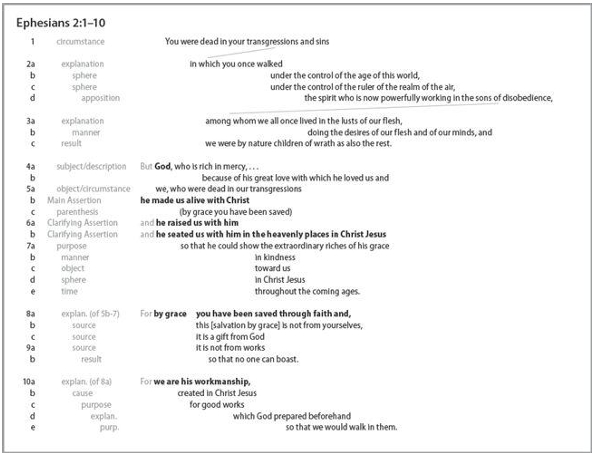
In the ancient world, people often understood human conduct as taking place within a larger spiritual conflict, with unseen powers working behind visible actions. Paul is doing something similar in Ephesians 2. He portrays fallen humanity as born into a realm already dominated by hostile powers, so that men do not enter moral life from a neutral position. They come into the world on the side of rebellion and then walk accordingly. Even if one grants that the dative in 2:1 can be discussed in terms of sphere or cause, the flow of the passage moves behind mere acts to the underlying condition that gives rise to them
The chart above is Clinton Arnold’s way of showing the structure and flow of Ephesians 2:1–10. On his reading, the readers’ former life was not freedom but bondage, a bondage governed by three compelling influences: the world, the devil, and the flesh. He makes the point in unmistakable realm language, speaking of “the kingdom of the air,” “the realm or sphere of the devil’s influence,” “the present evil age,” and the “spatial and temporal aspects of fallen human existence.” In other words, the passage moves from old realm to new realm, from old condition to divine reversal, not from neutral agency to later corruption.
The readers former lifestyle, which characterizes all who are outside of Christ, was not true freedom but evidence of a fearful bondage to forces over which they had no control. Three compelling influences directed their lives: the world (v.2), the devil (v.2), and the flesh (v.3). The first two of these evil influences are depicted by coordinated phrases, each of which is introduced by the preposition according to: (1)according to the age of this world, and (2)in accordance with the ruler of the realm of the air. In (1)the keyword17 aiōn usually means age or time span. However, the term was well known in Hellenism as a personal deity, and it appears numerous times in the magical papyri with this sense. It was a popular expression for personal powers in the Nag Hammadi texts and other Gnostic documents. If it refers here to a deity Aion, as many commentators suppose, then it would have been readily intelligible to Gentile readers.18 But the context requires that this term be understood in the Jewish sense of a period of time. Paul has already used the word at 1:21 when referring to the typical Jewish two age schema, and several verses later (v.7) he employs it in a temporal sense.19
The whole phrase according to the age of this world signifies the world existing in that particular span of time. In these three references a contrast is being developed between the marks of the old age and the new age which is dawning in Christ Jesus. According to the manner of this world-age is a way of speaking about both the spatial and temporal aspects of fallen human existence. The previous lifestyle of the readers has been dominated by this present evil age (cf. Gal. 1:4) and this world, rather than being focussed on heaven and the life of the age to come.20 Their behaviour has been determined by the powerful influence of societys attitudes, habits, and preferences, which were alien to God and his standards.21 Hence the NIVs rendering: when you followed the ways of this world. (2) Those outside of Christ are not only subject to the pervasive bondage of the present evil age; they are also inspired and empowered by personal evil forces. Paul depicts the second hostile influence as a powerful supernatural being who rules over this host of evil spirits: the ruler of the kingdom of the air.
Ephesians, as we have seen, contains more about the principalities and powers than any other New Testament letter and provides the most detailed response to these spiritual authorities (see on 1:21). Further, it draws special attention to the ultimate authority of evil lying behind them, namely, the devil (4:27; 6:11) or evil one (6:16), who is here called the ruler, or prince, a term used in the Old Testament for a national, local, or tribal leader,22 and refers to him as the chief or leader among these powers of darkness. In the Gospels he is called the ruler of the demons (Matt. 9:34; 12:24; Mark 3:22; Luke 11:15) and the prince of this world (John 12:31; 14:30; 16:11). He is the god of this age (cf. 2Cor. 4:4), a personal centre of the power of evil. This evil ruler is in control of the kingdom of the air. Here, as in Colossians 1:13, 23 the word rendered kingdom denotes the realm or sphere of the devils influence rather than his personal authority. That realm is further defined as the air.24
According to the ancient world-view, the air formed the intermediate sphere between earth and heaven. It was the dwelling place of evil spirits (as the magical papyri25 and the literature of Judaism26 attest), not an atmosphere of opinion with ideas, attitudes, and the like, which is a more recent Western understanding. The kingdom of the air, then, is another way of indicating the heavenly realm, which, according to Ephesians 6:12, is the abode of those principalities and powers, the world-rulers of this darkness and spiritual forces of wickedness, against which the people of Christ wage war. The hostile powers inhabit the heavenly realms (cf. Eph. 3:10; 6:12), a notion that has its antecedents in the Old Testament and Jewish thought.27 If there is any distinction between the expressions the kingdom of the air and the heavenly realm, it is that the former indicates the lower reaches of that realm and therefore emphasizes the proximity of this evil power and his influence over the world.
The devil is further characterized as the spirit29 who exercises effective and compelling power over the lives of men and women: the spirit who is now at work in those who are disobedient. His manner of operation is described by means of a dynamic power term which, together with its cognate noun,30 always denotes supernatural power in the New Testament. It has already been used in Ephesians of God, who mightily works out everything according to his will (1:11) and who has exerted his mighty strength in Jesus resurrection and exaltation (1:20). Here the word designates the spirits evil supernatural activity whereby he exercises a powerful, compelling influence over the lives of men and women. Indeed, so effective is his present evil working that Paul can refer to his victims as sons of disobedience, that is, men and women whose lives are characterized by disobedience. They are rebels against the authority of God who prefer to answer the promptings of the archenemy.31 Such men and women have not responded in gratitude or praise to the evidences of Gods eternal power and divinity which he has provided in creation (Rom. 1:19–21; cf. 2:8). They reject the gospel (cf. 2Thess. 2:8) and disregard his will.
Peter T. O’Brien, The Letter to the Ephesians, The Pillar New Testament Commentary (Grand Rapids, MI: Wm. B. Eerdmans Publishing Co., 1999), 151–53.
When Paul says that ‘by nature’ we were destined for wrath, he probably intends to convey that we inherited this status and condition at birth.… Because the wrath of God comes as a result of our status as ‘dead in … transgressions and sins’ (2:1), in one sense it can be said that we are all born dead. This is further heightened by the inescapable bondage exerted by the world, the devil, and the flesh. …
There is no sign that they would even want to [turn from it], because the entire course of their lives is under the control of three powerful forces that determine their everyday conduct and thoughts. The world, the devil, and the flesh have proven to be compelling powers. …
The central point of this message is that God has made them alive. This can be appreciated and fully understood only if the readers first know the full extent of their predicament prior to God’s gracious action toward them.… All of humanity is inescapably trapped in a threefold form of bondage. Paul uses the word ‘dead’ to characterize this bondage.
Clinton E. Arnold, Ephesians, Zondervan Exegetical Commentary on the New Testament, pp. 198, 211.
The central point of the passage is that God has made them alive, and Arnold says that this can only be appreciated if the readers first grasp “the full extent of their predicament” beforehand. He then describes that predicament as a threefold bondage under the world, the devil, and the flesh. So structurally, verses 1–3 are not there merely to list a few bad acts. They are there to expose the depth, hopelessness, and enslaving character of the old condition so that verses 4–10 land with their full force of the splendor and joy found in Christ. Life apart from Christ is not true life at all. Outside of him there is only death, bondage, and progressive ruin under the power of evil.
Even commentators who do not go all the way to a pure dative of sphere still do not help your case. Lincoln says the dative expresses both cause and manifestation: trespasses and sins both bring about death and characterize the existence of the spiritually dead. It does not describe morally neutral people randomly choosing their way into Satan’s realm. It still places sin within an ongoing condition and pattern of death, which Paul then immediately treats as the sphere in which they once lived.
Paul does not confine the problem to some especially wicked subset. He begins with “you,” but then immediately expands the scope: “among whom we all once lived … as also the rest.” That move brings both Gentiles and Jews under the same indictment. And “as also the rest” closes the door on any attempt to narrow the passage to some extreme group. Paul is describing the whole human order outside Christ. Christians escape it only because God has made them alive together with Christ. So the point is not that some people are born in this realm while others are not. The point is that this is the common condition of Jew and Gentile alike apart from grace.
I think the phrase itself leans in that direction, especially once Paul says “by nature children of wrath.” This is kinship language, language of identity, lineage, and belonging. In the broader biblical pattern, and especially in Johannine categories, not being born of God does not place someone in a neutral middle state. It places him in the opposing order. First John draws that contrast sharply between the children of God and the children of the devil. So when Paul calls men “children of wrath,” he is not merely saying that they sometimes commit wrath-deserving acts. He is describing a standing, an order of belonging, a condition that marks what they are apart from grace. And when he adds “by nature,” the point becomes even stronger. This does not sound like a condition later manufactured out of neutrality. It sounds like a status bound up with what men are from the start outside Christ.
Ignorance of Romans 2:14
12 All who sin apart from the law will also perish apart from the law, and all who sin under the law will be judged by the law. 13 For it is not those who hear the law who are righteous in God’s sight, but it is those who obey the law who will be declared righteous. 14 (Indeed, when Gentiles, who do not have the law, do by nature things required by the law, they are a law for themselves, even though they do not have the law. 15 They show that the requirements of the law are written on their hearts, their consciences also bearing witness, and their thoughts sometimes accusing them and at other times even defending them.) 16 This will take place on the day when God judges people’s secrets through Jesus Christ, as my gospel declares.
At most, that text shows that φύσει must be read in context because it has a range of usage. But when you look at Paul’s nearby usage, the pattern cuts against reducing the term to mere habit. In Romans 1:26, the nature language refers to a created sexual order, not simply a custom people pick up later. In Romans 2:27, Paul speaks of uncircumcision ‘by nature,’ that is, a bodily condition one has natively rather than by acquired practice. In Galatians 2:15, Paul says ‘Jews by nature,’ again referring to a condition had by birth, not by force of habit. And in Romans 11:24, ‘by nature’ and ‘contrary to nature’ clearly refer to what belongs to something according to its native order. So even within Paul, the φύσις word-group regularly points to what something is by constitution, origin, or created order. That makes your appeal to Romans 2:14 much less persuasive. And once you return to Ephesians 2:3, the case gets stronger still, because Paul has already described sinful conduct in the preceding clause. ‘By nature children of wrath’ is therefore best read not as a mere restatement of acquired behavior, but as the deeper condition that explains it.”
There is also the question whether Romans 2 is an exception at all. I do not think it is, and that is why I did not treat it as a serious counterexample. I take the Christian Gentiles reading, where Paul is speaking of Gentiles who did not have the law by birth, not of morally neutral pagans instinctively producing obedience to God’s demands from their own native resources or from some independent principle of natural law. For reference:
The Law and the New Testament – The Council
John the Baptist?
Your attempt to use John the Baptist against me also does not succeed. John does not negate the natural order. He proves the opposite. His case only shows that God performed an extraordinary work by filling him with the Holy Spirit from the womb. And the text itself stresses how unusual that is. John is singled out precisely because this is not the ordinary state of man. So his case cannot be used to erase the broader biblical pattern of humanity’s native condition apart from grace. If anything, it confirms that such prenatal empowerment is exceptional and therefore dependent on special divine action. The very surprise of the text proves too much for your position. If your view and Warren’s were true, then John’s prenatal response should not appear so remarkable. If infants are born morally intact and uncorrupted by original sin, then there is no obvious reason why receptivity to God from the womb would be treated as such an extraordinary thing. But the text does treat it as extraordinary. That fits far better with my position: John’s case is not the natural baseline of innocent humanity, but a striking instance of special divine empowerment from the womb. The exception only stands out because the ordinary condition of man is otherwise.
My point is not that receiving the Spirit from birth is impossible. My point is that it is not the natural condition of fallen man because of original sin. God designed man to live as a Spirit-empowered creature in fellowship with him, but that original order has been ruined in Adam. So we are not born already enjoying that life. That is why John the Baptist is remarkable. His prenatal filling is not the norm. It is a special act of grace. Your view has no real theological explanation for why man is not ordinarily born in that state. Mine does. Original sin explains why Spirit-given life is now extraordinary rather than native.
From the Womb: Luke 1 and Prenatal Personhood – The Council
Breath, Birth, and Abortion – The Council
Sensual?
You are acting as though I ignored Jude and James, but I explicitly appealed to them. My argument was never that psychikos in isolation always lexically means “devoid of the Spirit.” My point was that Jude 19 pairs the term with “not having the Spirit,” while James 3:15 places it in the sequence “earthly, natural/unspiritual, demonic.” That is exactly why Warren’s attempt to turn the word into a morally neutral category fails. The contextual force in both places is plainly unspiritual, not innocent or religiously undetermined.
The appeal to KJV “sensual” does not help either, because older English did not always use that word in the narrow modern sense. The Geneva Bible renders Jude 19 as “natural, having not the Spirit,” while the KJV renders 1 Corinthians 2:14 “the natural man receiveth not the things of the Spirit of God.”
The Douay-Rheims even renders 1 Corinthians 2:14 “the sensual man,” showing that “sensual” could be used for the same unspiritual anthropological category that other translations call “natural.” Webster’s 1828 dictionary confirms the older theological sense, defining sensual as “carnal,” “in opposition to the spirit,” and “not spiritual or holy.” So reading KJV “sensual” as though it must mean merely acquired vice or sexual indulgence is just reading modern connotations back into older English.
This is the same kind of mistake people make when they read older English translations through modern definitions. Take Genesis 1:28 in the KJV, where God tells man to “replenish the earth.” Some people read that with a modern ear and imagine it must mean “fill again,” as though the earth had previously been populated and then emptied out, perhaps after some angelic catastrophe. But in older English, replenish could simply mean fill. It is anachronism. So building a whole doctrine of Genesis 1 on the modern connotation of an older English word is not exegesis. That is exactly the same mistake being made with “sensual.” If someone sees the KJV’s wording in Jude or James and immediately hears the modern sense, as though it must mean sexually indulgent or merely habit-formed vice, they are doing the same thing.
James places it between “earthly” and “demonic” in a context of envy and selfish ambition. Jude uses it of divisive false teachers and immediately glosses them as those “not having the Spirit.” So the contextual force in both passages is against your position.
This is why your argument looks under-researched. You are trying to overturn modern lexical data and contextual exegesis with an old English gloss. But Louw-Nida says ‘unspiritual, worldly, natural,’ and BDAG says ‘natural, unspiritual, worldly’ in contrast to the realm characterized by the Spirit. James says it is ‘earthly, ψυχική, demonic.’ Jude says these people are ψυχικοί, ‘not having the Spirit.’ That is not a morally neutral anthropology. That is the merely natural order set against the Spirit.
ψυχικός, ή, όν (ψυχή; in var. mngs. Diocles, Aristot. et al.; Ptolem., Apotel. 3, 14, 1 [opp. σωματικος]; SIG 656, 20 [166 B.C.]; 4 Macc 1:32; Philo; Jos., Bell. 1, 430; Just., D. 30, 1; Tat.; Ath. 23, 2 [Thales]) ‘of the soul/life’, in our lit. pert. to the life of the natural world and whatever belongs to it, in contrast to the realm of experience whose central characteristic is πνεῦμα, natural, unspiritual, worldly (cp. PGM 4, 524f and 510=Rtzst., Mysterienrel.3 175f lines 28 and 20, where the ἀνθρωπίνη ψυχικὴ δύναμις is contrasted w. the ἱερὸν πνεῦμα. On this s. πνευματικός 2aγ; also β and PGM 4, 725; Herm. Wr. 9, 9; Iambl., Myst. 6, 6 P.: the ἀνθρωπίνη ψυχή in contrast to the gods and to γνῶσις; Orig., C. Cels. 4, 57, 14). ⓐ adj. ψυχικὸς ἄνθρωπος (Hippol., Ref. 5, 27, 3) an unspiritual pers., one who merely functions bodily, without being touched by the Spirit of God 1 Cor 2:14. σῶμα ψυχ. a physical body 15:44ab. The wisdom that does not come fr. above is called ἐπίγειος, ψυχική (unspiritual), δαιμονιώδης Js 3:15.
ⓑ subst. α. τὸ ψυχικόν the physical in contrast to τὸ πνευματικόν (cp. Iren. 1, 5, 1 [Harv. I 42, 1]) 1 Cor 15:46. β. Jd 19 calls the teachers of error ψυχικοί, πνεῦμα μὴ ἔχοντες worldly (lit. ‘psychic’) people, who do not have the Spirit, thereby taking over the terminology of gnostic (on ‘psychic’ and ‘pneumatic’ people in gnostic thinking s. AHilgenfeld, Die Ketzergeschichte des Urchristentums 1884, index) opponents, but applying to gnostics the epithets that they used of orthodox Christians.—DELG s.v. ψυχή. M-M. TW. Sv.
William Arndt et al., A Greek-English Lexicon of the New Testament and Other Early Christian Literature (Chicago: University of Chicago Press, 2000), 1100.
79.5 ψυχικόςb, ή, όν: pertaining to human nature (possibly contrasting with σάρκινοςc and σαρκικόςc ‘natural, human,’ 79.4, in focusing somewhat more on so-called higher endowments of personality)—‘natural, human.’ ψυχικὸς δὲ ἄνθρωπος οὐ δέχεται τὰ τοῦ πνεύματος τοῦ θεοῦ ‘but the natural person does not receive the things of the Spirit of God’ 1 Cor 2:14. For another interpretation of ψυχικός in 1 Cor 2:14, see 41.41.
41.41 ψυχικόςc, ή, όν: (derivative of ψυχήa ‘inner self,’ 26.4) pertaining to behavior which is typical of human nature, in contrast with that which is under the control of God’s Spirit—‘unspiritual, worldly, natural.’ ψυχικὸς δὲ ἄνθρωπος οὐ δέχεται τὰ τοῦ πνεύματος τοῦ θεοῦ ‘a person who is unspiritual cannot receive the gifts that come from God’s Spirit’ or ‘a person who is worldly …’ 1 Cor 2:14. In a number of languages the equivalent of ‘unspiritual’ is simply ‘one who is not guided by God’s Spirit’ or ‘one who does not live in accordance with God’s Spirit.’ For another interpretation of ψυχικός in 1 Cor 2:14, see 79.5.
Johannes P. Louw and Eugene Albert Nida, Greek-English Lexicon of the New Testament: Based on Semantic Domains (New York: United Bible Societies, 1996), 694. 508.
Overall, one reason your response fails is that it never actually deals with my case as a whole. In a discussion about original sin, you did not even attempt to dispute my reading of Romans 5. But the issue is larger than Romans 5 by itself. Paul’s anthropology is framed in exhaustive categories. In Romans 8, 1 Corinthians 2, Colossians 1, Ephesians 2, and Romans 5, Paul does not reason as though there is a morally neutral class standing somewhere between Adam and Christ, flesh and Spirit, death and life, light and darkness, kingdom of God and the present evil age . That tertium quid is something your theology requires, but it is not something derived from the New Testament.
And that is the deeper problem. Until you can explain the universality of sin, the universality of death, and the relevance of Adam’s trespass to the condemnation of all in Romans 5, while also showing that Paul’s repeated exhaustive contrasts actually leave room for your neutral anthropology, you have not touched the substance of my argument.
 The Council