Expanding Presuppositional Principles: Transcendental Argument, Epistemology, and the Impossibility of the Contrary

In a previous article, I discussed some of the basic principles of presuppositionalism. Here, I’d like to expand on those foundations and develop a few core arguments more thoroughly. 1. Transcendental Argument In that earlier piece, I briefly introduced the … Continue reading Expanding Presuppositional Principles: Transcendental Argument, Epistemology, and the Impossibility of the Contrary
Revelation, Not Assumption: A Critique of the Axiomatic Defense

We’re going to take a look at an article from Creation Ministries International by Dr. Jonathan Sarfati titled, “Is using the Bible to prove the Bible circular reasoning?” Here’s a key excerpt: All philosophical systems start with axioms (presuppositions), or … Continue reading Revelation, Not Assumption: A Critique of the Axiomatic Defense

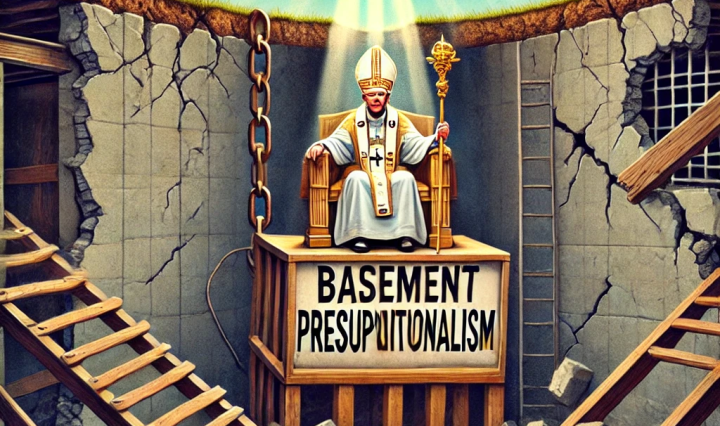
Basement Presuppositionalism: A Failed Thought Experiment of Redeemed Zoomer

A common strategy among skeptics is to construct exaggerated or absurd counterexamples to Christian epistemology rather than engaging with its actual claims. One such attempt is Basement Presuppositionalism, a thought experiment gaining traction as a supposed refutation of presuppositionalism. Presuppositionalism, … Continue reading Basement Presuppositionalism: A Failed Thought Experiment of Redeemed Zoomer

Classical Apologetics: Stated and Rejected

Classical Apologetics is an approach to Christian apologetics that emphasizes the use of rational arguments and evidence to demonstrate the truth of Christianity. It typically follows a two-step method: Classical Apologetics: Key Arguments Cosmological Argument: Teleological Argument: Moral Argument: Ontological … Continue reading Classical Apologetics: Stated and Rejected

Exploring the Unitary-Knowledge Argument: A Dialogue on Omniscience and Epistemology

drake007: If no one has comprehensive knowledge of the universe, then no one can have any knowledge of the universe. Only God could have comprehensive knowledge of the universe. We have some knowledge of the universe. Therefore, God exists. Do … Continue reading Exploring the Unitary-Knowledge Argument: A Dialogue on Omniscience and Epistemology