

36 One of the Pharisees asked him to eat with him, and he went into the Pharisee’s house and reclined at table. 37 And behold, a woman of the city, who was a sinner, when she learned that he was reclining at table in the Pharisee’s house, brought an alabaster flask of ointment, 38 and standing behind him at his feet, weeping, she began to wet his feet with her tears and wiped them with the hair of her head and kissed his feet and anointed them with the ointment. 39 Now when the Pharisee who had invited him saw this, he said to himself, “If this man were a prophet, he would have known who and what sort of woman this is who is touching him, for she is a sinner.” 40 And Jesus answering said to him, “Simon, I have something to say to you.” And he answered, “Say it, Teacher.”
41 “A certain moneylender had two debtors. One owed five hundred denarii, and the other fifty. 42 When they could not pay, he cancelled the debt of both. Now which of them will love him more?” 43 Simon answered, “The one, I suppose, for whom he cancelled the larger debt.” And he said to him, “You have judged rightly.” 44 Then turning toward the woman he said to Simon, “Do you see this woman? I entered your house; you gave me no water for my feet, but she has wet my feet with her tears and wiped them with her hair. 45 You gave me no kiss, but from the time I came in she has not ceased to kiss my feet. 46 You did not anoint my head with oil, but she has anointed my feet with ointment. 47 Therefore I tell you, her sins, which are many, are forgiven—for she loved much. But he who is forgiven little, loves little.” 48 And he said to her, “Your sins are forgiven.” 49 Then those who were at table with him began to say among themselves, “Who is this, who even forgives sins?” 50 And he said to the woman, “Your faith has saved you; go in peace.”
Pooda uses Luke 7:47–50 to argue against a strict Protestant reading of justification by faith alone. His basic claim is that the woman’s love is not merely a sign that she was already forgiven, but a real cause or condition of the remission of her sins. He points to Jesus saying, “many sins are forgiven her because she loved much,” and then joins that with “thy faith hath saved thee” to argue that both love and faith are involved in justification. He rejects the idea that her love is only evidential and appeals to Gregory the Great to support the view that charity burns away sin. In the wider video, this becomes part of his broader Roman Catholic case that Trent did not condemn the gospel but only condemned a version of “faith alone” that excludes hope, love, repentance, and other Spirit-wrought dispositions from the sinner’s justification.
In Thomistic thought, a disposition is often not what an Edwardsian would mean by that term. The Thomist is often talking about a kind of preparedness or fitness for receiving something further. So prior to justification, God inwardly moves the sinner and produces certain acts or mental events in the intellect (mind) and will (faith, hope, fear, repentance, and the like) which are then said to dispose the person to receive grace.
But in a more Edwardsean framework, a disposition is usually thought of differently. It is not mainly a preparatory fitness to receive something else, but an inward tendency or settled inclination, once it exists, issues in action. So an Edwardsian will often hear “disposition” and think of something that causes acts, whereas the Thomist is often using it for something more like readiness or suitability to receive grace.
He reads Luke 7 as teaching that love plays a causal role in the remission of sins: “Her many sins are forgiven, because she loved much,” followed by, “Your faith has saved you.” But that claim can only be taken in one of two ways. Either the passage presents love and faith as joint causes of forgiveness, or else it presents love as so inseparable from saving faith that “faith” here effectively means faith considered in its loving character.
Yet either way, his appeal fails to establish what he wants. If he means the former, he drifts toward the idea that the woman’s love is what obtained her pardon, which is far too close to making forgiveness hinge on her own moral condition. If he means the latter, then love is no longer functioning as a distinct co-cause at all, but simply as a feature of the faith that saves. In that case, Luke 7 does not get him to a separate Tridentine principle of justification. It only restates faith in a different register.
Yet even that retreat fails to establish his point. It only rephrases the Protestant view in different terms. The question is not whether forgiven sinners love; all sides agree that they do. The real question is which way the explanatory order runs in the text. Is love the antecedent condition that obtains forgiveness? Or is it the fruit and public manifestation of forgiveness already received through faith? Merely asserting that love “belongs to faith” does not prove the former rather than the latter. On the contrary, it fits just as well—and in context better—with the latter: faith as the sole instrument that receives mercy, and love as the necessary expression of a heart that has already received it.
Luke 7 itself supplies contextual clues that points the other way. Jesus does not state the relation between love and forgiveness in general or an abstract way. He anchors it in the parable of the two debtors. The one forgiven more loves more, and the one forgiven less loves less. The direction of explanation is therefore set by Jesus himself. Forgiveness produces love. Love does not produce forgiveness.
That is why, when Jesus says, “Her many sins are forgiven, because she loved much,” the most natural reading is not that love functions as a second instrument securing remission, but that her love is the visible evidence and fitting expression of forgiveness already bestowed. The “because” clause is therefore best read evidentially or explanatorily, not causally, as though her love moved God to pardon her.
Commentators often press exactly this point. David Garland asks whether the woman’s love is the cause of forgiveness or the consequence of it. If her loving actions are what bring about forgiveness, the text collapses into a works-principle. Garland instead argues that she likely came into Simon’s house already aware that her sins had been forgiven, so that the statement should be read as evidential: her great love demonstrates that her many sins have been forgiven. That reading fits the parable perfectly. Love is the response to canceled debt. Her actions, then, are acts of gratitude for mercy received through Christ, not the purchase price of absolution. She did not love in order to be forgiven; she loved because she had been forgiven. And that is exactly the point Jesus presses on Simon: her behavior reveals the heart of one who has been forgiven much, and therefore loves much.
As Garland notes:
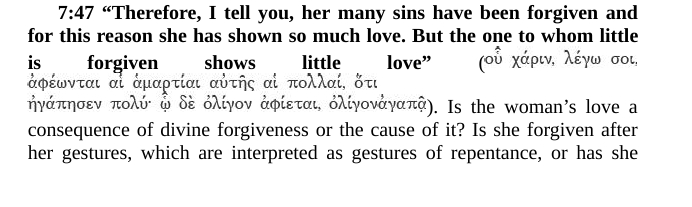
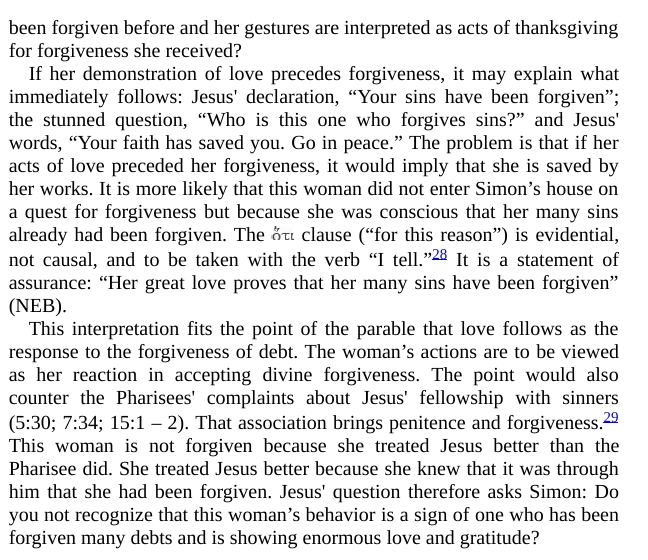
David E. Garland, Luke, Zondervan Exegetical Commentary on the New Testament 3 (Grand Rapids, MI: Zondervan, 2011)
Ὅτι has been understood as introducing a clause (“she loved much,” ἠγάπησε 3rd sg. aor. act. indic. of ἀγαπάω) that provides the ground or cause of the woman’s forgiveness (cf. Bovon 1.297; Fitzmyer 686). However, since the final clause of this verse refers to “loving little” (ἀγαπᾷ, see 7:5) as evidence of being “forgiven little” (ἀφίεται 3rd sg. pres. pass. indic. of ἀφίημι, lit. “to whom little is forgiven” NRSV), ὅτι is better understood as introducing a clause which gives evidence of forgiveness (“that’s why she loved much” HCSB; cf. NIV; Moule 147; Robertson, Pictures 109; Z §§420–22; ZG 203; Bock 703–5; Fitzmyer 687, 692; Marshall 306; Nolland 358). The final clause is unlikely to ref. to the Pharisee’s experience of “little forgiveness” (Fitzmyer 692). As with 5:31–32, the need is to grasp the significance of sin and therefore the greatness of forgiveness (Marshall 313; Nolland 359).
Thompson, Alan J. Luke. Exegetical Guide to the Greek New Testament. Nashville: B&H Academic, 2017.
In Luke 7:47, the question is what kind of relation the ὅτι-clause expresses. It certainly connects love and forgiveness, but it does not follow that it makes love the ground of forgiveness. A well-attested usage of ὅτι is evidentiary. Which means it isn’t the cause but the evidence of something else.
On this reading, the woman’s great love is the manifestation of great forgiveness already granted, not the condition that purchases it. We’ve already pointed out the parable itself sets the direction of explanation (those forgiven much love much) and the narrative closes by naming faith as the saving instrument (“your faith has saved you”). The grammar therefore fits the story: love is the product, not the basis. Wet windows do not cause rain but are evidence of such an event. Likewise, love does not cause remission. Other examples of such can be found in passages such as Luke 1:22; 6:21; 13:2; Gal. 4:6; John 9:16; and 1 John 3:14 (more on this later). And the closing line “Your faith has saved you” lands exactly there. Love functions in the narrative as fruit and evidence, not as an additional lever that makes faith effective.
Underdetermination
Pooda cannot get from Luke 7 to Trent nearly as easily as he assumes. Even if one grants, for the sake of argument, that the woman’s love stands in some explanatory relation to her forgiveness, the text still underdetermines the specifically Tridentine conclusion he wants to draw from it.
That is because the phrase “she loved much” does not, by itself, tell us whether love is functioning as a distinct preparatory disposition alongside faith, or whether it is simply describing faith itself in its affectionate, Christward form.
Jimmy does not treat faith and love as two separable justificatory items that jointly qualify a sinner for pardon. Rather, in the case of sinners coming to God for mercy, he argues that faith and love are two aspects of the same Godward movement. Pooda therefore faces a dilemma. If by “love” he means obedience, then he has smuggled works into the act of justification. But if by “love” he means the inward heart-orientation of the regenerate sinner toward God, then that love is not clearly distinguishable from regeneration or faith itself. At that point, the appeal to Luke 7 no longer supports a Roman Catholic doctrine of distinct co-operating dispositions. It is equally compatible with the claim that love is simply living faith viewed from another angle.
Pooda might object that a conflict exists between my reading and Jimmy’s. Namely, my reading distinguishes love from faith as an evidential fruit, whereas Jimmy at times speaks of love as simply another way of viewing faith. But I do not think this creates any real contradiction. I agree that there are instances in which Jimmy is right to speak that way. What I deny is that love must function that way in every instance. There can also be cases in which love refers more broadly to obedience or to the manifest life of one who loves God. So I am not contradicting Jimmy so much as denying that his way of construing the relation between faith and love must be imposed on every text in exactly the same way.
This is what makes Luke 7 evidentially insufficient for Pooda’s larger theological conclusion. Jimmy’s point is not that faith and love are indistinguishable in every conceivable context. His narrower claim is that, for sinners seeking reconciliation with God, love for God cannot be abstracted from faith in Christ. In that setting, “faith is love,” or at least love is the affectionate and relational form that such faith takes. So even if Jesus’ statement places love in an explanatory relation to forgiveness, that alone does not establish a Tridentine model in which charity is a distinct infused virtue added to faith as a separate precondition of justification.
 The Council
Great article! I am curious if you have been keeping up with the recent discourse on the alleged Marian apparition in Fatima and if you planned on adding to the conversation at all.
LikeLike
I do not have much to say about that theory. I tend to be agnostic about the demonic explanation. Whatever occurred at Fatima is still up in the air. The possible explanations could include human fabrication, delusion, demonic activity, or some mixture of all three. I am able to rule out a genuine Marian apparition because I already know Roman Catholicism is not true. That said, I am not especially well versed in the topic itself. I would recommend this review if you find such interesting:
https://triablogue.blogspot.com/2010/09/fatima-prophecies.html
https://triablogue.blogspot.com/2007/01/miracle-of-sun.html
https://triablogue.blogspot.com/2018/01/the-blue-nun.html
https://triablogue.blogspot.com/2019/07/our-lady-of-guadalupe.html
The biggest takeaway is for me that anyone who tries to lead people away from Yahweh is a false teacher. And when Rome’s claims are weighed against Scripture, along with its many internal contradictions, it becomes clear that Rome is not the true Church of Christ, but a counterfeit communion claiming an authority it does not possess.
Ethan actually debated my friend years ago, though apparently, he has since become a Papist.
LikeLike