

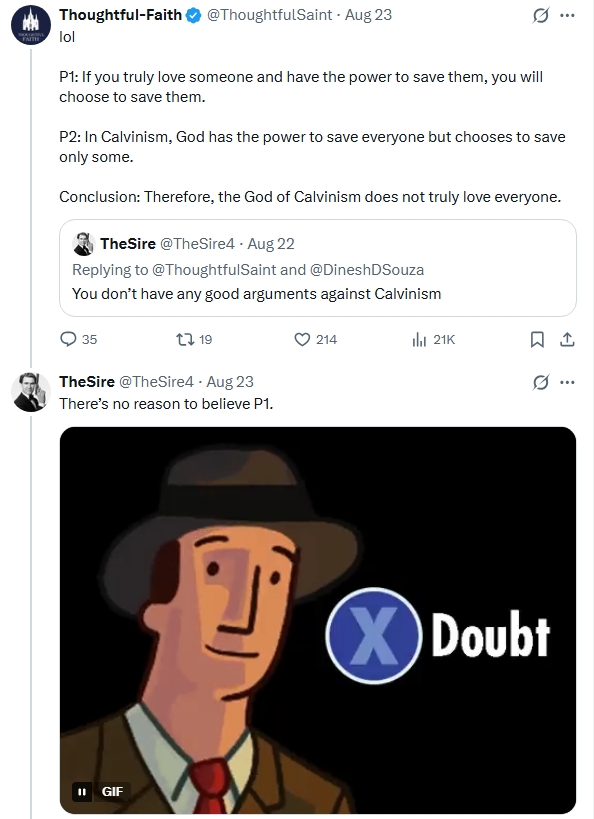
Jacob Hansen responded to me with the following argument:
P1: If you truly love someone and have the power to save them, you will choose to save them.
P2: In Calvinism, God has the power to save everyone but chooses to save only some.
Conclusion: Therefore, the God of Calvinism does not truly love everyone.
The problem is that we have no reason to accept premise 1, and Jacob refused to provide an argument for it. I have better reason to believe that God genuinely loves people whom he does not ultimately save than I have to believe this principle that genuine love necessarily entails choosing salvation whenever one has the power to accomplish it. Divine testimony gives me reason to affirm both God’s love and his judgment.
Premise 1 is not even obviously true in ordinary cases. Suppose your child committed some horrible atrocity and you were in a position of authority—a judge, governor, politician, or something similar—with the power to spare him from the punishment he deserved. Does loving your child entail that you must use your power to save him from that punishment?
Obviously not. You might genuinely love your child while nevertheless believing that justice requires that he suffer the consequences of what he has done. In fact, using your authority to exempt him simply because you love him could itself be morally wrong.
There is also a useful parallel here for an LDS critic. Mormon theology treats gods as exalted human beings. So consider the following:
P1: If a human truly loves someone and has the power to prevent their arbitrary suffering, he will choose to prevent it.
P2: In LDS theology, gods are exalted human beings.
P3: LDS gods have the power to prevent arbitrary suffering but often choose not to.
Conclusion: Therefore, LDS gods do not truly love everyone.
I do not think this argument works against my own view, but I do think it creates a much more serious problem for most LDS theology. On the LDS view, gods are exalted human beings. That means the moral continuity between humans and gods is much tighter than it is in classical theism. If an ordinary human had the power to prevent horrific and apparently arbitrary suffering but repeatedly refused to do so, we would normally call that neglectful or morally vicious unless some sufficient justification could be given.
But in the LDS case, I am not aware of any principled justification for why exaltation suddenly makes permissible conduct that would otherwise count as severe neglect in a human being. The natural LDS response is going to be that a loving being may have morally sufficient reasons for permitting suffering he has the power to prevent. But once that possibility is admitted, Jacob can no longer simply assume that love plus power necessarily entails intervention. He now needs an argument for why salvation is different.
The same problem exists in the original argument. “Save” is doing too much work. Saving an innocent person from drowning is one thing. Saving a guilty person from a just sentence is another. You cannot simply take the intuition that “if you love someone, you save them from danger when you can” and transfer it without argument to the question of whether God must save guilty sinners from divine judgment.
Calvinism does not teach that God arbitrarily throws innocent people into hell. God condemns people in virtue of their sins. So Jacob really needs a much stronger premise:
If you genuinely love someone, then whenever you have the power to remit the punishment they justly deserve, you must do so.
That claim is much less plausible than the original wording makes it sound.
There is also a stronger version of Jacob’s objection that could be made using possible worlds. Someone might say: suppose there is a logically possible world in which every person is saved. If God is perfectly loving and has the power to actualize that world, why would he choose a world in which some are lost instead?
That is at least a more interesting question, but it still does not establish Jacob’s conclusion.
First, it assumes a possible-worlds framework that I do not accept. It assumes that God stood before a range of genuinely possible worlds, including one in which everyone is saved, and could have actualized that world instead of this one. I deny that modal picture. I do not think God had a bunch of possible worlds in front of him and picked this one. I think this is the only possible world. So asking why God did not choose the universalist world already assumes the modal metaphysics I reject.
Second, even if I granted that framework for the sake of argument, the conclusion still would not follow. I would simply say that God has some morally sufficient reason for actualizing this world rather than the alternative. Merely showing that God could have actualized a world in which everyone is saved does not show that choosing this world is unloving.
To get from:
God could have actualized a world in which everyone is saved
to:
therefore, a loving God would have actualized that world
you still need another premise. Something like:
A perfectly loving God must actualize whichever possible world contains the greatest amount of salvation.
But why should anyone accept that? Once again, the conclusion is being smuggled into a controversial theory of divine love.
There are other problems with treating this as a defeater for Calvinism as such. Calvinism is perfectly consistent with God judging people according to their deeds. The claim is not that everyone receives an identical punishment regardless of conduct, but that all sinners are liable to condemnation, with greater and lesser punishment corresponding to culpability. Unconditional election is not the same thing as indiscriminate condemnation.
And even if someone somehow established that eternal conscious torment is incompatible with universal divine love, that still would not refute Calvinism as such. A Calvinist could be an annihilationist while continuing to affirm unconditional election, particular redemption, and effectual grace. At most, that argument would target a particular Calvinist doctrine of hell.
So the objection keeps requiring additional premises. Jacob begins with the intuition that if you love someone and can save them, you will. But that intuition is exactly what needs to be defended. Once we distinguish rescue from deserved punishment, allow that love can coexist with morally sufficient reasons for nonintervention, and question the possible-worlds framework itself, the argument loses most of its force.

