
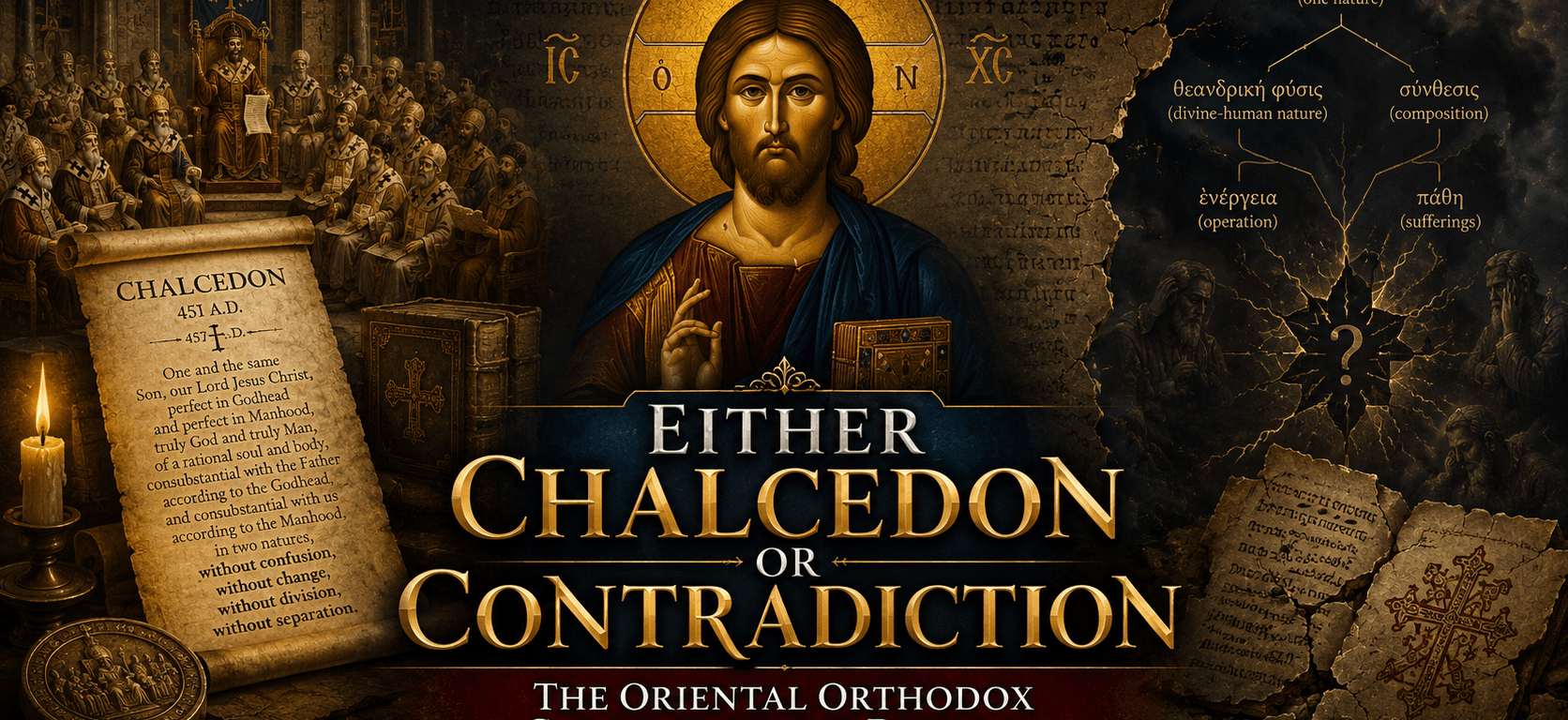
——–The Dilemma of Oriental Orthodox Christology
I was recently engaged in a dialogue concerning Oriental Orthodox Christology. I argued that Oriental Orthodoxy is, in many respects, functionally similar to Eastern Orthodoxy, but someone challenged that claim by appealing to their distinctive Christology.
LightSpeed:
OOs affirm that the incarnation entails 1 nature, not 2. They would only be similar to EOs relative to Protestantism and perhaps relative to Catholicism and the Assyrians (debatably)
I think if you have never read St Cyril or know very much about the first 3 ecumenical councils or the development of OO theology through Dioscorus of Alexandria, Severus of Antioch or Gregory of Tatev, you should probably just start off with like some YouTube video that explains how OOs conceive of the “1 composite nature” in their view rather than to throw this shot in the dark which already presupposes Dyophysitism
Because the people in question developed even your own understanding of theology. I doubt you come into contact with your understanding of Dyophysitism and Triadology and anything else related to Christianity entirely on your own.
Whatever doctrines you affirm have a history behind them so the most principle question is whether they ultimately come from Our lord Jesus Christ who is God. How did He want us to understand Him? What did He leave to show us how to know and love Him?
This assumes they affirm a simple nature in Christ. The nature is composite and the “nature” in question is affirmed as a Hypostasis (particular reality) which entails that the unity of nature they concieve of is one which has the uncreated and created realities of Christ united into a singular one yet never mixing due to difference in gradations of reality. This would only follow if they affirmed that the divine essence and human essence became 1 in Christ (thus making some kind of 3rd essence).
TheSire:
The reason I do not think you can start with historical theology is that you already need theological categories in order to interpret the history. You need some prior account of what the Church is, whether Christ established apostolic succession, whether certain charisms belong to the Church, and what kind of authority those charisms would have. None of that is simply handed to you by “Church history” as raw data. You cannot merely peer at historical events and infer God’s intentions from them without already bringing theological assumptions to the table. History has to be interpreted, and the standards by which you interpret it cannot themselves be derived from uninterpreted history.
This only avoids contradiction if “created” and “uncreated” are not being predicated of the same subject in the same respect. If you mean that the one hypostasis of Christ possesses both an uncreated divine nature and a created human nature, then I do not object to that as a formal contradiction. But in that case, you have not shown that createdness and uncreatedness can belong to the same nature. You have merely relocated the distinction to different respects or different realities in Christ.
If, however, you mean that the hypostasis itself, or this so-called “composite nature,” is both created and uncreated without qualification, then the contradiction remains. Calling it a “composite hypostasis” does not explain how the created and uncreated can be one reality without either a distinction of respect or some form of composition.
The issue, in my mind, is that this position fails to distinguish itself from Chalcedon except by changing the terminology. If the claim is simply that Christ is one hypostasis with both divine and human realities united without confusion, mixture, or the production of a third essence, then that sounds functionally Chalcedonian. And that was precisely my original point. the non-Chalcedonian position either collapses into contradiction, or it reduces to Chalcedon under different words.
I also do not know what “difference in gradations of reality” is supposed to mean unless it implies some kind of ontological overlap. Things that differ by degree share a common property or scale. Hotter and colder share temperature. Greater and lesser share quantity. Stronger and weaker share power. So if the created and uncreated differ only by gradation, then God and creation are being placed on one continuum of reality, with God as the highest instance and creatures as lower instances.
The Creator-creature distinction is not a difference of degree, but a difference of kind. God is not merely the highest being within a shared scale of reality. He is the uncreated source of all creaturely being. So either “gradation” is just vague language for saying that the divine and human remain distinct in Christ, in which case it adds nothing beyond Chalcedon, or it means there is a real ontological continuum between God and creation, in which case it is deeply problematic and even you should be able to see the weird Neo-platonic implications.
I am not committed to framing this whole issue in terms of “natures,” “essences,” and the rest of the Greek metaphysical apparatus. In fact, part of the problem is that many Apostolic traditions are overly shaped by Greek philosophical categories. The relevant predicates are either being applied to Christ in the same respect or in different respects.
If “created” and “uncreated” are predicated of the same thing in the same way, then the Oriental Orthodox position falls into contradiction. Something cannot be both created and uncreated in the same respect. But if they are not predicated in the same way, then the Oriental Orthodox position has not established anything uniquely non-Chalcedonian. It has simply admitted a distinction of respects within the one Christ.
Either the created and uncreated are united in such a way that the contradiction remains, or they are distinguished in such a way that the position becomes functionally Chalcedonian. If “composite” refers to a real metaphysical composition, then it needs to be explained how this does not introduce composition into the incarnate hypostasis. But if “composite” is not real, then the language does not actually distinguish the view from Chalcedon.
Likewise, if created and uncreated are distinguished only “in thought,” then is the difference between created and uncreated merely conceptual? That seems impossible and silly. But if the distinction is real, then why deny a real distinction in Christ after the union? My argument does not depend on granting all the metaphysical terminology. It only depends on the basic principle that contradictory predicates cannot be true of the same subject in the same respect.
This results in the divine and human being disguised by an illusion. Whence comes the illusion? Is it produced by our theological language, by our metaphysical categories, or by the way revelation itself speaks about Christ? And if the categories by which we confess Christ generate an illusion precisely where we are trying to avoid contradiction, then why should we trust those categories at all?

